
Custom activated PEG development and manufacturing
Custom PEG programs can require different levels of support depending on architecture, molecular weight, functionality, analytical requirements, clinical stage, and supply strategy. Whether you are developing a new activated PEG, switching an existing supplier, or qualifying a secondary source, our specialists help define service fit, documentation needs, analytical strategy, and the appropriate manufacturing pathway.
How we support custom PEG qualification and supply
Custom PEG programs may begin with new material development, supplier transition, secondary-source qualification, or preparation for a later clinical stage. Our approach connects technical assessment, analytical characterization, quality and documentation requirements, manufacturing fit, and supply planning into one structured pathway.
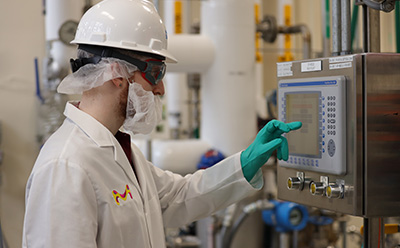
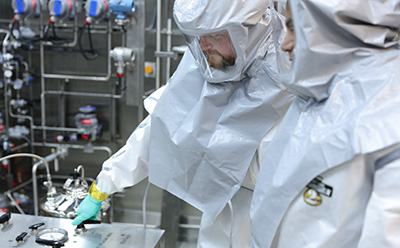
Define the regulatory requirements
Establish whether the functionalized PEG will be classified as an API Regulatory Starting Material or an API Intermediate — a designation that directly shapes GMP expectations, documentation, and filing strategy across regions. Get advice from our regulatory experts.
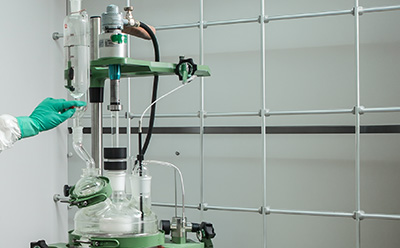
Design for PEGylation
Define the conjugation approach— cysteine-targeted, N-terminus-selective, or glycoPEGylation — to preserve biological function and ensure batch-to-batch consistency. Use a toolbox of functionalizations, including amines, maleimides, propionaldehydes, or activated esters, to match the conjugation target.
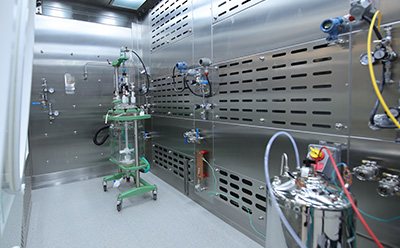
Develop the PEG functionalization process
Apply Design of Experiments and digital tools to optimize PEG functionalization, addressing challenges including emulsification, high solution viscosity, and filter cake compressibility. Use ion exchange chromatography and tangential flow filtration to achieve target purity under deoxygenated, low-endotoxin conditions.

Characterize the PEG properties
Develop a tailored analytical strategy using NMR, GPC, MALDI, and HPLC-CAD to confirm identity, molecular weight, polydispersity, functionalization, and purity. Screen for residual solvents, elemental impurities, hydroperoxides, and bioburden. Methods established during development are subsequently prepared for GMP production.
Transfer to GMP manufacturing
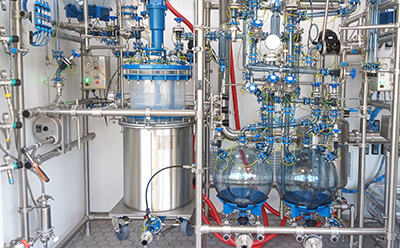
Transition to GMP production using a scale-down model, enabling a first-time-right approach with reduced scale-up risk. A dedicated MSAT team oversees the transfer and ensures critical process parameters are maintained at scale. Manufacturing capability spans grams to multi-kilogram quantities across clinical stages and commercial supply.
A proven track record of success
>99.5%
Typical PEG purity
20+
Years manufacturing custom PEGs
Related resource
- Whitepaper: Selecting a CDMO for custom activated PEGs
This article examines the critical success factors for PEGylated therapies and the decision-making process for when a custom PEG may be warranted rather than an off-the-shelf solution.
Related webinars

Learn how custom PEGs can provide value to your program and when they become necessary.
This webinar series showcases effective purification and crystallization strategies, including real-world case studies.
Explore green chemistry principles, the benefits of designing for sustainability and criteria for CDMO assessment.
Frequently asked questions
What information do you need to quote/scope a custom PEG request?
To develop an accurate scope, we typically review your target application, desired PEG architecture, molecular weight, functionalization, purity requirements, development phase, and anticipated scale. If you are transitioning from an off the shelf PEG or have analytical data or specifications available, we can also assess those to recommend the most appropriate development and manufacturing approach. Every project begins with a feasibility assessment to define the optimal path forward.
How do I know if my PEG will be classified as an API intermediate or a regulatory starting material?
Classification depends on the manufacturing process, the role of the PEG in the final drug substance, the proposed control strategy, and applicable regulatory expectations. Because the designation can affect GMP requirements, documentation, and filing strategy, it should be considered early. Our technical and quality teams can help customers evaluate the relevant manufacturing and documentation considerations for their program.
How do you handle switching from another supplier?
For supplier-transition programs, we review available specifications, analytical methods, manufacturing information, material attributes, quality documentation, and required scale. From there, we define the development, analytical, comparability, technical-transfer, and GMP activities needed to establish an appropriate qualification pathway. The exact approach depends on the program stage and the information available from the current supplier.
What should we evaluate when qualifying a second source for a custom PEG?
Consider material comparability, specifications, analytical methods, process understanding, impurity profile, documentation, GMP expectations, scale, lead time, change-control requirements, and future supply needs. These factors help determine the qualification work required before introducing an alternate supplier into a clinical program.
What is the difference between monodisperse PEG and mPEG?
Monodisperse PEG describes a PEG material with a defined chain length, while mPEG commonly refers to methoxy-terminated PEG. These terms should not be used interchangeably. The appropriate PEG architecture depends on the intended application, functionalization strategy, specifications, and manufacturing requirements.
External resource
European biotechnology: Selecting a CDMO for custom activated PEGs
This article examines the critical success factors for PEGylated therapies and the decision-making process for when a custom PEG may be warranted rather than an off-the-shelf solution.
Outsourced Pharma: How a specialized CDMO de-risks complex API development
Specialized CDMOs provide the expertise and flexibility needed to bring complex, high-potency APIs and targeted therapies to market.