Sterile Filter Area Calculations for Scale Up
Sterilizing Filter Sizing
Sterilizing-grade and bioburden reduction membrane filters are important components of aseptic drug manufacturing. Proper sizing of these filters is essential for ensuring predictable filtration operations.
- Undersized filters: may foul before the end of filtration runs
- Oversized filters: add costs with unnecessary filtration area and lower yields due to large hold up volumes in the filter
Bench-scale filtration tests can model large scale operations and estimate filtration area requirements that will meet process goals1. This article provides guidance on how to perform bench-scale tests to accurately size filters for production-scale sterile filtration operations. Beyond process development, filter sizing tests and their impact on scale up to process scale will also be discussed.
Section Overview
Predicting membrane filtration areas from models
Models have been developed that consider how the size and characteristics of particles in different process fluids affect fouling and adsorption on filter membrane pores. These models can be used to predict filtration area requirements for large-scale manufacturing operations based on bench-scale tests 1, 2, 3.
Bench-scale filter capacity tests are short-duration tests run at constant pressure. They typically use Optiscale® 25 disposable capsule filters, small volumes of fluid and simple equipment and run for less than 30 minutes (Figure 1). The data collected can be extrapolated using the models to determine filtration areas and the right filter format to accommodate a defined process time, batch size, and flow rate 4, 5, 6.
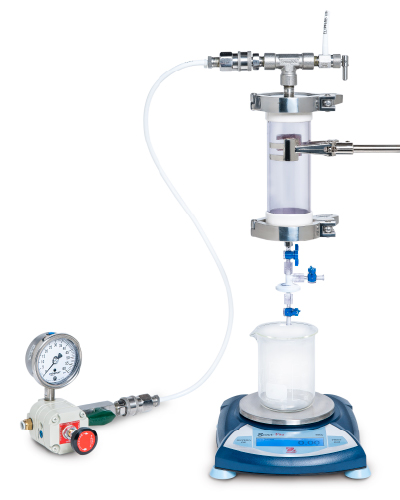
Figure 1.Constant pressure filter sizing test set-up. The pressure vessel is filled with product, pressurized, and applied to the test filter.
A simple Vmax™ filter sizing tool can quickly extrapolate the maximum capacity, or the Vmax™, of the filter from the test data. This is estimated by graphing time/volume by time and calculating the inverse of the slope. The Vmax™ term is then used along with the process variables to calculate the minimum required membrane area:
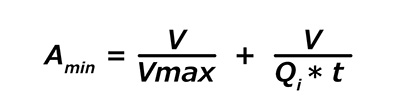
Amin: minimum filtration area (m2)
V : batch volume (L)
t: process time (hour)
Vmax: the theoretical maximum filter capacity (L/m2)
Qi: initial flow rate normalized to filtration area (LMH)
Filter sizing and safety factors for sterile filtration
Estimates of filtration areas for larger scale processes should include a safety factor to accommodate differences between bench and manufacturing scale operations, batch to batch variability and potential impact of process failure7. Examples of safety factors:
- Sterile buffer filtration typical safety factor: 1.1-1.3
- Sterile filtration of bulk drug substance typical fatty factor: 1.4-2.0
For help estimating filtration areas and calculating safety factors, contact us.
Minimize bioburden: Capacity testing with different fluids
Fouling fluids: Best practice for small-scale, constant-pressure filter capacity tests of fouling fluids is to capture at least 40% of the flux decay; this minimizes extrapolation error in filter sizing using the fouling models1.
Low fouling fluids: Those with less than 10% flux decay during a filter sizing trial. Minor differences in measured flux decay can lead to significant discrepancies in filtration area estimates resulting in insufficient or oversized filtration areas on scale-up. Additional bench-scale testing should include multiple pressures, extended loading, or be conducted at intermediate-scale, with the intended production-scale loading.
Non-fouling liquids: Filtration areas for large scale operations with non-fouling fluids, such as buffers, can be sized using filter permeability and process time rather than fouling characteristics.5 Assuming an unlimited filter capacity, the equation for minimum filter area reduces to:
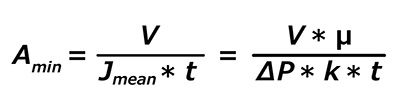
Amin: minimum filtration area (m2)
V: batch volume (L)
t: process time (hour)
Jmean: average flux from the trial data (LMH)
µ: specific viscosity
ΔP: Pressure drop (psi)
k = permeability [LMH/psi]
Minimum filter area is directly correlated to the fluid’s specific viscosity and is inversely related to the system pressure and the fluid’s permeability through the filter. Particularly for non-fouling fluids, filter sizing should consider the pressure drops due to the filter configuration (i.e., housing type); this information is readily available from the filter supplier.
Bioburden control: Capacity testing conditions
Filter sizing using constant pressure capacity tests should match the manufacturing conditions as closely as possible: operations that use a pump at manufacturing scale are most accurately sized using a constant-flow setup at bench scale.
While constant flow sizing is ideal, constant-pressure testing can save time and materials. If sizing for a constant flow manufacturing operation is extrapolated from constant pressure testing using the Vmax™ method, it is highly recommended to confirm the accuracy of the estimate at intermediate scale with a pump.
Process conditions and process holds
Representative simulation of process conditions increases the accuracy of filter sizing: process temperature, storage conditions, pH, and concentration should be maintained between small-scale and production operations.
Process holds performed during manufacturing should be simulated during a bench-scale study since the components of a process fluid may aggregate, interact or potentially adsorb to the membrane without pressure or flow. Higher adsorption could accelerate filter fouling.
Membrane prefilters
Prefilters can affect filter capacity. If a prefilter is implemented in production-scale operations, it should be tested in series at small scale, especially if the fluid has a high viscosity.1 As the prefilter fouls, the pressure drop on the prefilter increases, lowering pressure on the final sterilizing-grade filter.
One goal of filter sizing for serial filtration trains is to determine the optimal prefilter-to-final filter area ratio to help identify the most cost-effective filtration train for specific process conditions.
Watch our webinar on selection, sizing, and operation of bioprocess filtration trains for optimal performance.
Single or redundant filtration
Many final filtration operations implement redundant filtration, using two identical sterilizing-grade filters connected in series. This approach reduces filter permeability by half, doubling the system pressure.
To determine optimum filter size for a redundant filtration operation with a single filter and a non-fouling fluid, the target system pressure should correspond to half the maximum allowable pressure. Once the redundant filter is integrated at process scale, the system will achieve the desired pressure.
Factors that influence scale-up
Filter format can affect the pressure profiles across a filtration system and are more pronounced for non-fouling, low viscosity fluids, Figure 2. Since the membrane is not fouling, the housing and connections have an outsized impact on the filter’s overall resistance and pressure drop requiring adjustments to safety factors, inlet pressures or flow rates.
- Narrower inlet and outlet connections, such as hose barbs, will experience a larger pressure drop than larger connections, such as 1 ½ inch sanitary flanges.
- T-line housings will have different pressure drops compared to in-line housings due to the liquid flow path.
- Pressure losses are especially important for series filtration, as the inlet pressure on the downstream filter will be reduced due to the pressure drop across the first filter.
Flow-driven pressure drops of filter capsule types for Polyvinylidene fluoride-membrane filters
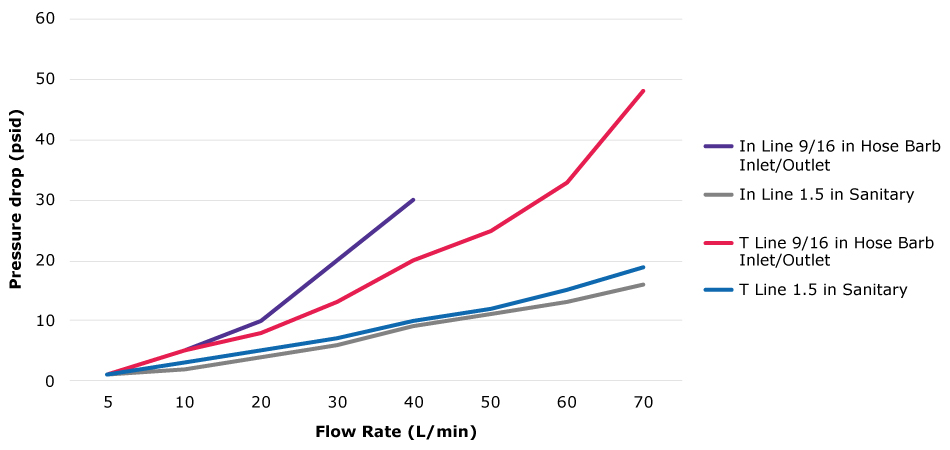
Figure 2.Pressure drop with flow rate for PVDF membrane filters and connectors
Impact to pressure drop of various filter housing configurations. Restrictions such as hose barbs and T-line housings can increase pressure drop across filters of the same membrane at the same flow rates.
Key takeaways for any filter sizing study
The constant pressure test is a quick, easy way to estimate filtration area requirements for sterilizing-grade filters used in aseptic drug processing. Data from bench-scale tests are analyzed to predict behavior for large scale processes:
- Bench-scale testing should closely model the manufacturing-scale process using appropriate raw materials, flow rates and pressures, process holds, and the use of prefilters or redundant filters. Accurate simulation of process conditions including temperature, pH, storage conditions and concentration, increases the accuracy of filter sizing.
- Low-fouling fluids may benefit from extended filtration test time to observe fouling behavior, running tests at different pressures to bracket fouling behavior, or increasing the safety factor to accommodate variability.
- Filters for non-fouling fluids can be sized based on filter permeability, desired filtration time, and the filter housing configuration.
- Redundant filtration of non-fouling fluids will reduce filter permeability by half, resulting in twice the pressure drop as compared to a single filter.