GC analysis of fatty acids in milk powder by transesterification and with flame ionization detection (FID)
Abstract
This work describes a gas chromatography (GC) method for the derivatization and analysis of 37 fatty acids in relation to a draft GB method intended to replace GB5413.36-2010 "National Food Safety Standard - Determination of Trans Fatty Acids in Infant Foods and Dairy Products". The addition of an internal standard solution to a milk powder sample was followed by transesterification using a methanol/sodium methoxide solution. Resulting fatty acid methyl esters (FAMEs) were separated on an SP®-2560 GC column. The analysis yielded a relative standard deviation of chromatographic peak areas of 1.10 to 3.73%, and observed resolution for all FAMEs was 1.76 or larger.
Section overview
Introduction
Fatty acids (FAs) in milk fat are considered to be important nutritional components of the diets of a substantial part of the human population.1 Hence, the FA profile is an important parameter in determining the raw milks suitability for processing into various dairy products and it influences the flavor, texture, and nutritional value.1-3 In order to ensure food quality and especially infant milk powder quality, Chinese standard method GB5009.168-2016 was released, describing the analysis of 37 fatty acids in food.4 This method includes sample preparation steps and analytical conditions for the determination of FA content in food using gas chromatography (GC). However, the regulatory body responsible for establishing the relevant testing standards as of November 2025 is evaluating an update (Draft of National Standard for Food Safety. Determination of fatty acid in food GBXXX-XXXX5) to achieve better resolution for some compounds. The draft pending review would then be upgraded to a national standard for the determination of 37 fatty acids in food. In response to the proposed draft, this /CN/enapplication has been developed.
The method described here includes transesterification of fatty acids, resulting in fatty acid methyl esters (FAMEs), which are then separated and quantified using GC-FID. Quantification of FAs in the sample was performed as follows:
- Step 1. Inject FAMEs standard solution (37 compounds) containing methyl undecanoate (C11:0, Figure 1) as an internal standard component onto the GC system to calculate the response factor between each component and the C11:0 FAME.
- Step 2. Spike milk powder sample with C11:0, perform the sample preparation (see section below) and inject onto the GC system.
- Step 3. Calculate content of FAMEs based on the ratio of peak areas and response factors of FAMEs to C11:0. For details please see “Calculation of FAMEs Content of Samples” section below.
- Step 4. Convert content of FAMEs into content of fatty acids in milk powder sample using the specific conversion coefficients (see official conversion factors in Appendix , Table A).
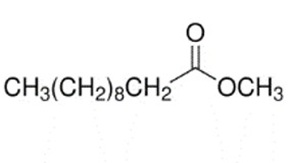
Figure 1.Structure of FAME methyl undecanoate (C11:0) used as internal standard.
Experimental
Standard and reagent preparation
Following processes were used for the preparation of standards and reagents:
- Fatty acid methyl esters standard solution (SS): A stock solution of 37 fatty acid methyl esters (CRM47885 for details about sample concentrations see the respective certificates of analysis) is used. Transfer 1,250 μL of the stock solution into a 5 mL volumetric flask. Fill up to mark with hexane to obtain the FAMEs standard solution. See Table 3 for final concentrations.
- Methyl undecanoate internal standard solution (ISS): Weigh 0.5 g (accurate to 0.1 mg) of methyl undecanoate into a beaker, dissolve in 100 mL of tert-butyl methyl ether, transfer into a 250 mL volumetric flask and make up to the mark with tert-butyl methyl ether. The C11:0 FAME concentration of the resulting solution is 2.0 mg/mL. This solution is valid for 1 week when stored refrigerated.
- Sodium methoxide methanolic solution (SMMS): Weigh 5 g sodium methoxide and dissolve in 60 mL methanol. After cooling to room temperature, quantitatively transfer the solution into a 100 mL volumetric flask, dropwise and slowly add methanol with continuous stirring. Make up to the mark with methanol to obtain a solution with a sodium methoxide concentration of 50 g/L. Store protected from light at 4 oC up to 1 week. Allow to equilibrate to room temperature before use.
- Neutralizing reagent solution (NRS): Weigh 50.0 g of disodium hydrogen citrate sesquihydrate and 75.0 g of sodium chloride into a 250 mL beaker. Dissolve in water, cool to room temperature, then transfer to a 500 mL volumetric flask and make up to mark with water to obtain a solution with a concentration of 100 g/L sodium hydrogen citrate sesquihydrate and 150 g/L sodium chloride. Store in the dark at 4 oC up to 1 month. Allow to equilibrate to room temperature before use.
Sample Preparation
A milk powder sample was purchased from a local supermarket and prepared according to the following procedure:
- Accurately weigh 0.1 ~ 0.3 g (precise to 0.1 mg) milk powder, equivalent to approximately 50 mg of fat, into a 50 mL centrifuge tube with a screw cap. For spiked samples, 400 µL of stock solution of 37 FAMEs is added and vortexed for 30 seconds (spike concentrations displayed in Table 1).
- Add 2.0 mL of water, mix thoroughly, tighten screw cap, and leave at room temperature for 15 minutes.
- Accurately add 5.0 mL of ISS, followed by 5.0 mL of 5% SMMS (this marks the start of the ester exchange reaction; start timing), tighten the screw cap, shake and mix for 10 seconds, and leave at room temperature.
- After 180 seconds, add 2.0 mL of n-hexane.
- After an additional 30 seconds, add 10 mL of NRS. This step stops the transesterification reaction. Exceeding reaction time beyond 240 seconds may result in ester hydrolysis.
- Shake and mix for 30 seconds, then centrifuge at 4,000 rpm for 5 minutes. Use the supernatant as the test solution for gas chromatographic analysis.
GC-FID method
For the analysis a 100 m x 0.25 mm, 0.20 µm poly(biscyanopropyl siloxane) column, SP®-2560, was used under the following optimized conditions (Table 2).
Calculation of FAMEs content in samples
Equation 1
XFAMEi = Fi × (Ai / AC11) × [(ρC11 × VC11) / (m × 10)]
XFAMEi: Content of fatty acid methyl ester i in the sample (g/100 g)
Fi: Response factor of fatty acid methyl ester i (see Equation 3)
Ai: Peak area of fatty acid methyl ester i in the sample
AC11: Peak area of the internal standard undecanoic acid methyl ester (C11:0) added to the sample.
ρC11: Concentration of undecanoic acid methyl ester (C11:0) in the internal standard solution (mg/mL)
VC11: Volume of internal standard solution added to the sample (mL)
m: Mass of the sample (g)
Equation 2
XFAi = XFAMEi × FFAME-i-FAi
XFAi: Content of individual fatty acids (g/100 g)
FFAMEi−FAi: Conversion factor from fatty acid methyl esters to fatty acids is listed in Table A (see Appendix)
Equation 3
Fi = (ρSi × A11) / (ASi × ρ11)
Fi: Response factor of fatty acid methyl ester i
ρSi: Concentration of each fatty acid methyl ester i in the fatty acid methyl ester standard mixture (mg/mL)
A11: Peak area of undecanoic acid methyl ester (C11:0)
ASi: Peak area of fatty acid methyl ester i
ρ11: Concentration of undecanoic acid methyl ester in the fatty acid methyl ester standard mixture (mg/mL)
Results
The chromatographic results for the GC-FID analysis of the FAMEs standard solution and of an unspiked and a spiked milk powder sample are displayed in Figures 2 to 4. The specificity data for all FAMEs are listed in Table 3, and repeatability as well as response factors for the FAMEs standard solution are displayed in Table 4. The resolution (RS) between all FAMEs was 1.76 or higher, and the relative standard deviation (%RSD) of the chromatographic peak area ranged from 1.10 to 3.73 %. The results of the quantification of fatty acid content in the milk powder sample is shown in Table 5.
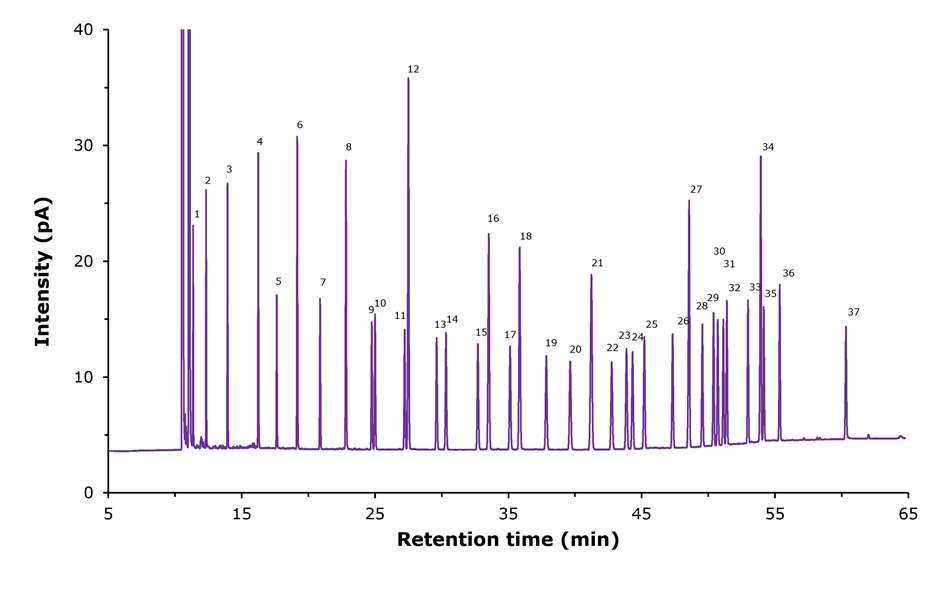
Figure 2.GC-FID chromatogram of the FAMEs standard solution (SS).
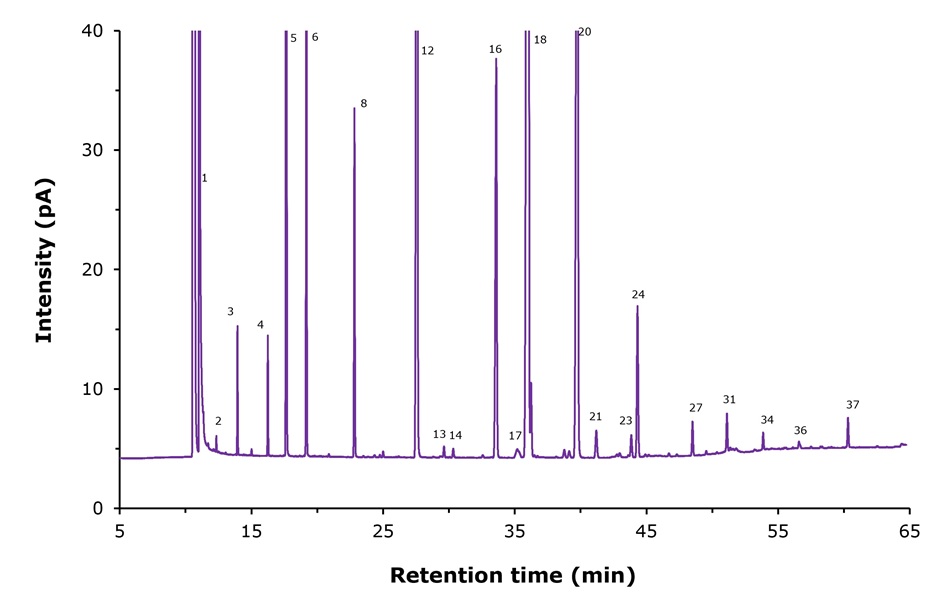
Figure 3.GC-FID chromatogram of an unspiked milk powder sample (with ISS).
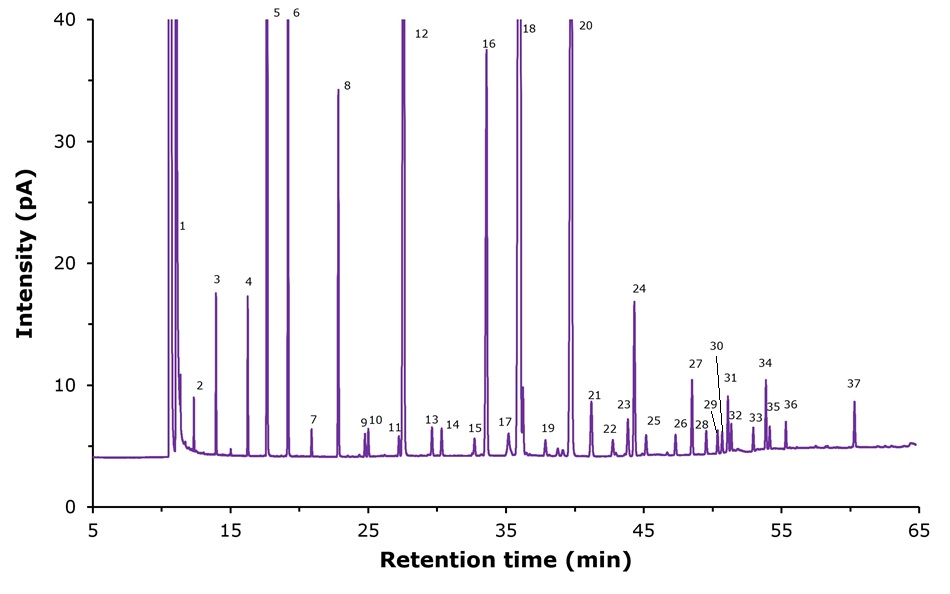
Figure 4.GC-FID chromatogram of milk powder sample spiked with 400 µL of FAMEs standard solution (see Table 1 for spike concentrations).
Conclusion
The SP®-2560 GC column demonstrated excellent separation capabilities, effectively resolving all 37 FAMEs with resolution values of 1.76 or greater, including several critical peak pairs that are traditionally challenging to separate (C14:1n5/C15:0, C15:1n5/C16:0, and C24:0/C20:5n3). Demonstrating low %RSDs (1.10-3.73%), highlights the high precision and reliability that is critical for or the accurate quantification of fatty acids in infant formula and other milk powder products, where nutritional content is strictly regulated due to its critical importance for infant development. This method aligns with the evolving regulatory requirements in China, where the current standard (GB5009.168-2016) is being revised. The developed protocol provides a valuable analytical tool for quality control and nutritional assessment of milk powder products, ensuring they meet the stringent requirements for fatty acid composition essential for cardiovascular health, central nervous system development, and immune function enhancement.
Explore gas chromatography accessories and gas purification/ management products.
Related products
GC column and accessories
Solvents, reagents, and reference material
Browse a range of FAME analytical standards and certified reference materials (CRMs) to support your laboratory workflows.