
Water for Atomic Absorption Spectroscopy (AAS)
Atomic absorption spectroscopy (AAS), also called atomic absorption spectrometry, is one of the oldest and most well-established techniques for elemental analysis, and it remains highly relevant today.1 Its origins trace back to early observations that specific salts in a chemical sample produce characteristic colors when introduced into a flame. Because AAS is often used to analyze trace amounts of elements, any contamination introduced by reagents can skew the analysis. In this article, we provide an overview of AAS and discuss the importance of water quality in AAS analysis.
Principle of AAS
Atomic spectroscopy is a family of analytical techniques used to identify and quantify the elements in a sample by measuring how atoms absorb or emit electromagnetic radiation. AAS uses the principle that atoms can absorb light at specific, unique wavelengths. It can measure the concentration of specific elements in a sample by detecting the light absorbed by its atoms in the gaseous state. Since each element has a unique, fingerprint-like spectrum, atomic spectroscopy is widely used for elemental composition analysis, often via emission, absorption, or fluorescence.
Applications of AAS
AAS is widely used for trace metal analysis in many industries because it is a sensitive, selective and reliable technique. Advances in instrumentation and techniques have made it possible to analyze very complex sample matrices, such as those frequently found in biological and geological samples. The small sample volume requirement offers additional benefits where the amount of sample available for analysis is limited, as in many clinical analyses.
Common uses of AAS include environmental monitoring (to analyze heavy metals such as Pb, Hg, Cd, As, or Cr in water, soil or sediments), testing of feed, food and beverages for safety (detecting toxic metals like Cd or Pb in foods to meet safety standards, or verifying the mineral content in beverages and drinking water) and quality control of industrial materials, lubricants or fuels.
In manufacturing, AAS is widely used to verify that the key elements in raw materials are present at the required levels and that toxic impurities remain within specified limits. For example, in concrete production, AAS can be used to measure calcium levels, as maintaining the correct balance is critical — while calcium contributes to structural strength, excessive amounts can compromise durability. AAS is also the method of choice to analyze trace levels of silica, making it valuable in power plants, semiconductor manufacturing, pharmaceutical production and water treatment facilities.
AAS is used to analyze metal content in rocks, ores and alloys (in mining, metallurgy, or geological exploration), in materials science, and even in archeology and in museums, where it is used to study artifacts or paintings.
In clinical testing and toxicology, AAS is used to measure trace elements such as Fe, Mg, Cu, Zn, or Pb in blood, serum or urine of patients for diagnosis.
In cosmetics and pharmaceutical manufacturing, AAS is used to analyze trace metals and other elements in raw materials and manufactured drugs, ensuring they meet safety, efficacy and regulatory standards.
Operation of flame and graphite furnace AAS
AAS measures elemental concentrations by first atomizing a sample using heat to produce free, ground-state atoms. These atoms then absorb light from an element-specific source at characteristic wavelengths, causing their electrons to transition to higher energy levels. The amount of energy absorbed is directly proportional to the concentration of the target element in the sample.
Figure 1 shows a simplified scheme of an atomic absorption system:
- Light source: The light source is usually a hollow-cathode lamp of the element being measured. When a ground state atom absorbs energy in the form of light of a specific wavelength, it is promoted to a higher energy level.
- Atomizer: AAS requires that the analyte atoms be in the gas phase, so the ions or atoms in a sample must undergo three sequential steps:
- Desolvation: evaporation of the solvent
- Vaporization/pyrolysis: elimination of organic matrix components
- Atomization: generation of free atoms in the gas phase. This occurs in a high-temperature source (up to 3000°C) such as a flame (FAAS) or a graphite furnace (GFAAS).
Detector: The detector measures the amount of light absorbed by atomized samples to quantify elemental concentrations, typically using a photomultiplier tube for high sensitivity.
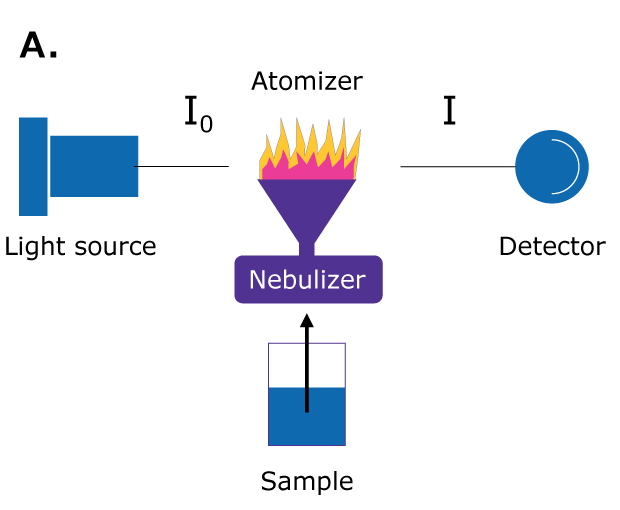
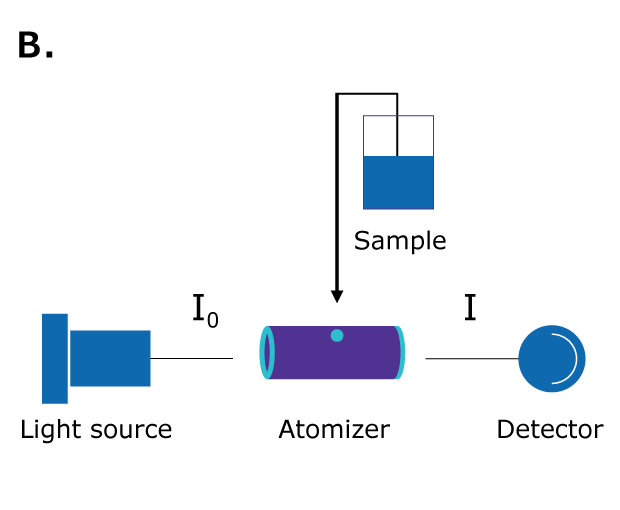
Figure 1. Schematic diagram of an atomic absorption spectrometer. A: Flame AAS (FAAS); B: Graphite Furnace AAS (GFAAS). The initial light intensity, Io, is decreased in proportion to the concentration of analyte atoms in the cell. A detector then measures the reduced intensity, I. By comparing I to Io, the analyte concentration in the sample can be determined.
Comparison between Flame AAS (FAAS) and Graphite Furnace AAS (GFAAS)
FAAS uses a burner to atomize the sample. It is a cost-effective, fast, and easy-to-use technique suitable for laboratories measuring a limited number of elements. Samples can be analyzed across a wide concentration range without dilution; however, it is less sensitive than GFAAS. This is due in large part to the sample introduction method. In FAAS, samples are introduced into a nebulizer, which generates an aerosol, which is then transported into the flame. Larger sample volume is needed to ensure sufficient aerosol generation and detection. It is well suited for higher concentration samples and routine single-element analysis.
GFAAS uses a heated graphite tube to atomize a very small amount of sample. It is a very sensitive technique, capable of ultra-trace analysis down to low ppb levels, making it ideal for labs requiring trace detection limits. Unlike FAAS, it does not require constant supervision since it operates without flammable gases, and only a small volume of sample is needed since it is directly deposited in the furnace. However, it requires a certain level of expertise to optimize the temperature program and achieve accurate results. GFAAS is a cost-effective option for labs where more expensive methods like ICP-MS may not be feasible.
Comparison between AAS and ICP
AAS and ICP mainly differ in how they generate and detect elements:
- AAS measures one element at a time by detecting how ground-state atoms absorb light in a flame or furnace, making it slower and generally less sensitive than ICP.
- ICP techniques (ICP-OES or ICP-MS) use very hot plasma to excite or ionize atoms and can measure many elements simultaneously, offering much higher sensitivity and faster multi-element analysis.
AAS is much cheaper to purchase and operate than ICP-OES or ICP-MS. It is straightforward to operate and robust in routine laboratory settings, while still offering excellent selectivity and sensitivity (from ppm to low ppb levels).
Impact of water quality on AAS
Trace elemental analysis requires high purity reagents and solvents to ensure accurate and precise measurements. Since water is used to prepare blanks, standards, and in the sample preparation procedures, it should be free of the elements being measured, as well as any other substances that could interfere with the analysis.
Ions/Metals
The water used as diluent for samples and standards, for blanks, and wash solutions should have extremely low ionic content. Contamination by metallic ions under investigation would lead to high background and inaccurate results. For example, when measuring trace levels of lead, even a small amount of lead present in the water used to dilute samples or prepare standards could artificially increase the measured concentration and compromise the results.
Particles
Particles scatter light and may cause signal interferences. In flame atomic absorption (FAAS), particles could pollute the nebulizer, increasing the need for instrument maintenance and preventing efficient nebulization and spraying of the sample solution into the flame. In GFAAS, particles may spoil the furnace.
Bacteria
Water contaminated by bacteria could contain bacterial degradation by-products such as ions which could interfere with the analysis (see “Ions/Metals” above).
Organics
Organics from lab water may affect how efficiently the analyte forms free atoms during atomization, and cause unstable signals, poor reproducibility or accuracy. In GFAAS, organics may change how the droplet of sample distributes inside the graphite tube and affect the atomization, therefore influencing signal intensity and precision.
Beyond water: Other contamination sources
- Sample preparation: Use only the highest quality acids and chemical modifiers
- Laboratory environment: The laboratory atmosphere may cause contamination at any stage in the AAS experiment, even when the sample is already in the atomization cell.
- Glassware washing procedures: If possible, avoid detergents since, if not extensively rinsed with ultrapure water, they may leave some contaminants on the container surface, which may leach into samples. Elements such as Na, Mg, Ca and Zn are frequently found after laboratory washing procedures. Acid wash, followed by thorough rinsing with ultrapure water, should be preferred.
Study: Water for AAS analysis of frequently measured environmental elements
A proof-of-concept experiment was carried out by measuring arsenic (As), cadmium (Cd), chromium (Cr), lead (Pb) and selenium (Se) in ultrapure water by GFAAS. These elements are toxic to humans and wildlife, and regulatory limits are set by environmental agencies (such as the EPA in the United States) for the concentration of these elements in drinking water, soil, and air.
The water purification system used in this experiment was similar to the Milli-Q® SQ 240C, and combined reverse osmosis, UV photooxidation, activated carbon and ion-exchange resins to produce ultrapure water from tap water. Table 1 shows that none of these elements were detected in freshly purified ultrapure water. Therefore, this water is suitable for GFAAS analyses.
Ultrapure water for atomic absorption spectroscopy
The water purity required for AAS depends on the sensitivity of the technique used. Ultrapure (Type 1) water with a very low level of ions (resistivity of 18.2 MΩ•cm), a low TOC and a 0.22 µm final filter, is recommended for use in GFAAS. For FAAS, ultrapure water is also recommended, although for less sensitive methods (ppm-high ppb), pure (Type 2) water may be sufficient.
A range of water purification solutions adapted to the needs of scientists working with AAS is available.