Skip to Content
Merck
CN

204390

Silver nitrate

99.9999% trace metals basis

Synonym(s):

Nitric acid silver(I) salt

Sign In to View Organizational & Contract Pricing.

Select a Size

Change View

About This Item

Linear Formula:
AgNO3
CAS Number:
Molecular Weight:
169.87
NACRES:
NA.23
PubChem Substance ID:
UNSPSC Code:
12352302
EC Number:
231-853-9
MDL number:
Assay:
99.9999% trace metals basis
Form:
crystalline, solid
Technical Service
Need help? Our team of experienced scientists is here for you.
Let Us Assist

vapor density

5.8 (vs air)

assay

99.9999% trace metals basis

form

crystalline, solid

reaction suitability

core: silver

impurities

≤1.5 ppm Trace Metal Analysis

mp

212 °C (dec.) (lit.)

application(s)

PEM fuel cells
homogeneous catalyst
material synthesis precursor

SMILES string

[O-][N+]([O-])=O.[Ag+]

InChI

1S/Ag.NO3/c;2-1(3)4/q+1;-1

InChI key

SQGYOTSLMSWVJD-UHFFFAOYSA-N

Looking for similar products? Visit Product Comparison Guide

General description

Silver nitrate is a water-soluble silver salt used as a precursor to prepare silver-containing nanomaterials or complexes.

Application

Silver nitrate can be used as:
  • An activator in Ni-P coating of fly-ash cenosphere particles by the electroless method.
  • A silver precursor to prepare Ag–TiO2 nanomaterials applicable in the photocatalytic degradation of rhodamine 6G dye molecule.
It can also be used as a catalyst in the:
  • Hydrolytic oxidation of organosilanes to generate hydrogen.
  • Oxidation of a variety of aldehydes to corresponding carboxylic acids in the presence of H2O2 as an oxidizer.

signalword

Danger

Hazard Classifications

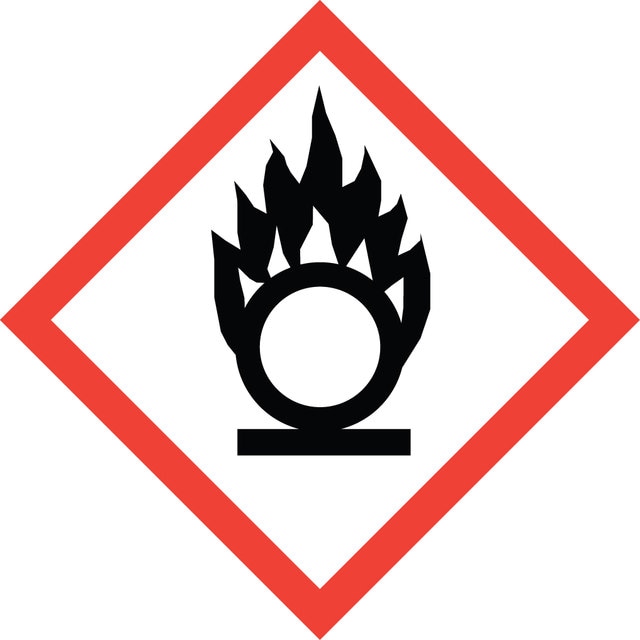
Aquatic Acute 1 - Aquatic Chronic 1 - Eye Dam. 1 - Met. Corr. 1 - Ox. Sol. 2 - Repr. 1B - Skin Corr. 1A

Storage Class

5.1B - Oxidizing hazardous materials

wgk

WGK 3

flash_point_f

Not applicable

flash_point_c

Not applicable

ppe

Eyeshields, Faceshields, Gloves, type P3 (EN 143) respirator cartridges

Regulatory Information

危险化学品
易制爆化学品

This item has


Choose from one of the most recent versions:

Certificates of Analysis (COA)

Lot/Batch Number

Don't see the Right Version?

If you require a particular version, you can look up a specific certificate by the Lot or Batch number.

Already Own This Product?

Find documentation for the products that you have recently purchased in the Document Library.

Visit the Document Library

B Vaseeharan et al.
Letters in applied microbiology, 50(4), 352-356 (2010-02-06)
To determine the antibacterial potential of silver nanoparticles (AgNps) synthesized by tea leaf extract against Vibrio harveyi and its protective effect on juvenile Feneropenaeus indicus. AgNps were synthesized by a simple procedure using tea leaf extract as the reducing agent.
Yun Ju Chae et al.
Aquatic toxicology (Amsterdam, Netherlands), 94(4), 320-327 (2009-08-25)
The increased use of nano-sized metallic materials is likely to result in the release of these particles into the environment. It is, however, unclear if these materials are harmful to aquatic animals. Furthermore, because the dissolution of such nanomaterials will
Konno, T.; et al.
Chemistry Letters (Jpn), 35 (3), 316-317 (2006)
Silver nanoparticles from ultrasonic spray pyrolysis of aqueous silver nitrate.
Pingali K, et al.
Aerosol Science and Technology, 39(10), 1010-1014 (2005)
Andrey Massarsky et al.
Chemosphere, 92(1), 59-66 (2013-04-04)
Nanomaterials (NMs) including silver nanoparticles (AgNPs) are incorporated into an increasing number of consumer and medical products. However, the potential toxicity of AgNPs to aquatic organisms is largely unknown. This study characterizes the effects of AgNPs on zebrafish (Danio rerio)

Articles

Oxidation and reduction reactions are some of the most common transformations encountered in organic synthesis

Silver nanomaterials have unique physical, chemical, and optical properties that are currently being leveraged for a wide variety of biological applications.

Noble-metal nanostructures find diverse applications from catalysis to biomedical research, leveraging surface properties in various fields.

Plasmonic nanoparticles have unique optical properties that can be tailored to suit a variety of applications in the biotechnology1–8 and electronics9–16 industries.

See All

Related Content

This application note discusses the synthesis of silver nanowires.

Global Trade Item Number

SKUGTIN
204390-10G04061838096432
204390-250G04061838138255
204390-1G04061838766892
204390-2KG04061833605646
204390-50G04061838766908

Our team of scientists has experience in all areas of research including Life Science, Material Science, Chemical Synthesis, Chromatography, Analytical and many others.

Contact Technical Service