
Sign In to View Organizational & Contract Pricing.
Select a Size
About This Item
Linear Formula:
Pb3O4
CAS Number:
Molecular Weight:
685.60
NACRES:
NA.23
PubChem Substance ID:
UNSPSC Code:
12352303
EC Number:
215-235-6
MDL number:
Product Name
Lead oxide, powder (red), 1-2 μm, 99%
InChI key
XMFOQHDPRMAJNU-UHFFFAOYSA-N
InChI
1S/4O.3Pb
SMILES string
O1[PbH2]O[Pb]12O[PbH2]O2
vapor pressure
10 mmHg ( 0 °C)
assay
99%
form
powder (red)
particle size
1-2 μm
Quality Level
Looking for similar products? Visit Product Comparison Guide
Related Categories
Other Notes
Average particle size determined by Fisher sub-sieve sizer
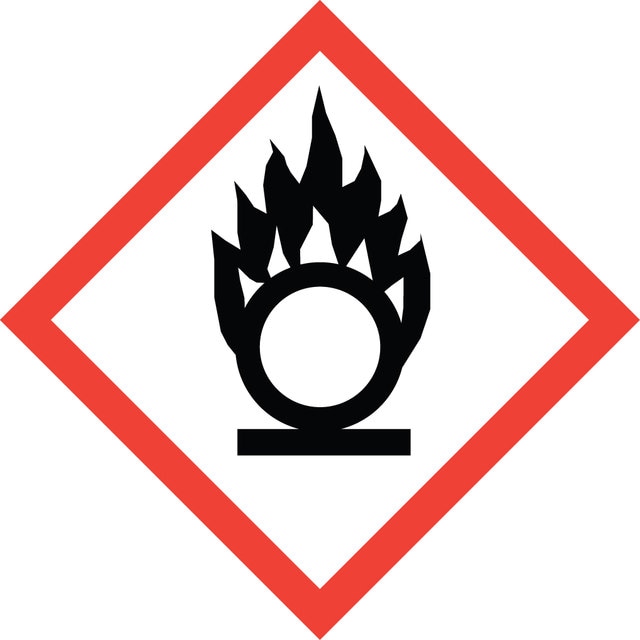
signalword
Danger
Hazard Classifications
Acute Tox. 4 Inhalation - Acute Tox. 4 Oral - Aquatic Acute 1 - Aquatic Chronic 1 - Carc. 2 - Ox. Sol. 2 - Repr. 1A - STOT RE 1
Storage Class
5.1B - Oxidizing hazardous materials
wgk
WGK 3
ppe
Eyeshields, Gloves, type P3 (EN 143) respirator cartridges
Regulatory Information
危险化学品
This item has
Choose from one of the most recent versions:
Already Own This Product?
Find documentation for the products that you have recently purchased in the Document Library.
Elżbieta Horszczaruk et al.
Materials (Basel, Switzerland), 13(21) (2020-11-05)
In recent years, a nano-modification of the cement composites allowed to develop a number of new materials. The use of even small amount of nano-admixture makes possible not only to improve the physico-mechanical properties of the cement materials, but also
Azarcón and empacho.
A Ackerman et al.
Pediatrics, 73(1), 114-115 (1984-01-01)
A Fischbein et al.
JAMA, 247(14), 2007-2009 (1982-04-09)
A case of lead poisoning in a female art conservator is reported. The patient had experienced excessive lead exposure while restoring an antique Peruvian tapestry from the Chancay period (1000 to 1500 AD) using a powdered pigment (cinnabar), which had
[Acute lead tetroxide poisoning].
K Markiewicz et al.
Polskie Archiwum Medycyny Wewnetrznej, 72(3), 115-121 (1984-09-01)
Yangen Zhou et al.
Inorganic chemistry, 51(23), 12594-12596 (2012-11-13)
Pb(3)O(4) could react with organic dyes in aqueous solution under visible light irradiation, in which Pb(3)O(4) was transformed into Pb(3)(CO(3))(2)(OH)(2) along with oxidation of the organic dyes. Cu(2+) has considerable effect on the reaction. In the presence of Cu(2+), MO
Our team of scientists has experience in all areas of research including Life Science, Material Science, Chemical Synthesis, Chromatography, Analytical and many others.
Contact Technical Service




