Skip to Content
Merck
CN

230375

Cobalt(II) nitrate hexahydrate

reagent grade, 98%

Synonym(s):

Cobaltous nitrate, Cobaltous nitrate hexahydrate, Nitric acid, cobalt(II) salt

Sign In to View Organizational & Contract Pricing.

Select a Size


About This Item

Linear Formula:
Co(NO3)2 · 6H2O
CAS Number:
Molecular Weight:
291.03
NACRES:
NA.55
PubChem Substance ID:
UNSPSC Code:
12352302
MDL number:
Assay:
98%
Grade:
reagent grade
Form:
flakes
powder, crystals or chunks
Technical Service
Need help? Our team of experienced scientists is here for you.
Let Us Assist
Technical Service
Need help? Our team of experienced scientists is here for you.
Let Us Assist

Product Name

Cobalt(II) nitrate hexahydrate, reagent grade, 98%

InChI

1S/Co.2NO3.6H2O/c;2*2-1(3)4;;;;;;/h;;;6*1H2/q+2;2*-1;;;;;;

SMILES string

O.O.O.O.O.O.[Co++].[O-][N+]([O-])=O.[O-][N+]([O-])=O

InChI key

QGUAJWGNOXCYJF-UHFFFAOYSA-N

grade

reagent grade

assay

98%

form

flakes
powder, crystals or chunks

reaction suitability

reagent type: catalyst
core: cobalt

pH

4 (20 °C, 100 g/L)

mp

55 °C (lit.)

Quality Level

Looking for similar products? Visit Product Comparison Guide

Application

Cobalt (II) nitrate hexahydrate is used as a catalyst:
  • In the synthesis of 5-carboxanilide-dihydropyrimidinone derivatives from acetoacetanilide, aldehyde, and urea/thiourea by condensation reaction.
  • In the multi-component synthesis of 2-amino-3- cyanopyridine and pyranopyrazole derivatives.
  • Cobalt (II) nitrate hexahydrate can also be used:,In the preparation of nano-Co3O4 by direct thermal decomposition, that are used in electrochemical water splitting and electrochemical sensors.

General description

Cobalt (II) nitrate hexahydrate is a simple, inexpensive and readily available cobalt precursor to develop cobalt-based catalyst for specific organic reactions.

signalword

Danger

Hazard Classifications

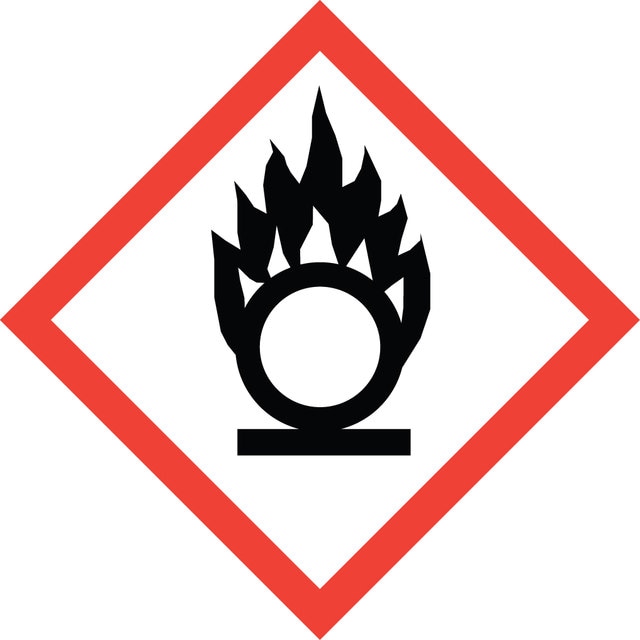
Acute Tox. 4 Oral - Aquatic Acute 1 - Aquatic Chronic 1 - Carc. 1B Inhalation - Eye Dam. 1 - Muta. 2 - Ox. Sol. 2 - Repr. 1B - Resp. Sens. 1 - Skin Sens. 1 - STOT RE 2 Inhalation

target_organs

Lungs

Storage Class

5.1B - Oxidizing hazardous materials

wgk

WGK 3

flash_point_f

Not applicable

flash_point_c

Not applicable

Regulatory Information

危险化学品
This item has

Choose from one of the most recent versions:

Certificates of Analysis (COA)

Lot/Batch Number

Don't see the Right Version?

If you require a particular version, you can look up a specific certificate by the Lot or Batch number.

Already Own This Product?

Find documentation for the products that you have recently purchased in the Document Library.

Visit the Document Library

Some Phosphine Oxide and Arsine Oxide Complexes of Cobalt (II) Nitrate.
Cotton FA, et al.
Inorganic Chemistry, 2(6), 1162-1165 (1963)
Thermal decomposition of cobalt nitrato compounds: Preparation of anhydrous cobalt (II) nitrate and its characterisation by Infrared and Raman spectra.
Ehrhardt C, et al.
Thermochimica Acta, 432(1), 36-40 (2005)
Horacio López-Sandoval et al.
Journal of inorganic biochemistry, 102(5-6), 1267-1276 (2008-02-29)
In this work we present the synthesis, structural and spectroscopic characterisation of a series of cobalt(II) and zinc(II) coordination compounds with benzimidazole (bz) and its 2-benzimidazole derivatives: 2-aminobenzimidazole (2ab), albendazole (abz) and tris(2-benzimidazolylmethyl)amine (ntb). The compounds were evaluated for their
Massimiliano Aschi et al.
Journal of mass spectrometry : JMS, 44(7), 1038-1046 (2009-04-01)
The nature of the ionic species, formed by electrospray ionization (ESI) of Co(NO3)2/CH3OH solutions with a pair of aminoalcohols W and Y, has been investigated by mass spectrometric and computational methods. Collision induced dissociation (CID) of ions, formally corresponding to
William Buchmann et al.
Journal of mass spectrometry : JMS, 42(4), 517-526 (2007-02-27)
The electronebulization of a cobalt(II)/cysteine(Cys) mixture in water/methanol (50/50) produced mainly cobalt-cationized species. Three main groups of the Co-cationized species can be distinguished in the ESI-MS spectrum: (1) the cobalt complexes including the cysteine amino acid only (they can be

Our team of scientists has experience in all areas of research including Life Science, Material Science, Chemical Synthesis, Chromatography, Analytical and many others.

Contact Technical Service