Protection/Deprotection Reagents
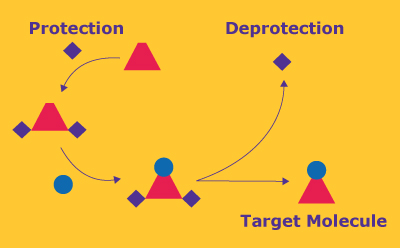
In multi-step organic synthesis, a protecting group is a temporary chemical modification applied to a reactive functional group to prevent it from participating in unintended reactions while transformations are carried out elsewhere in the molecule. A protecting group must be chemoselective, high-yielding, and compatible with the substrate, while the subsequent removal (deprotection) must be equally efficient and leave the rest of the molecule intact. Protecting groups are broadly categorized by the functional group they protect (amines, alcohols, alkynes, ketones, aldehydes, carboxylic acids, phosphates, phosphonates and thiols) and by the conditions required for their removal, such as acid, base, hydrogenolysis, or metal-catalyzed processes. Orthogonal protection strategies, in which two or more protecting groups on different functional groups are removed independently under entirely different conditions, are essential for the total synthesis of complex natural products, peptides, and pharmaceuticals.
Protecting group strategy requires careful consideration of the entire synthetic route, including the stability of the protecting group to all subsequent reaction conditions and the stability of the target molecule during deprotection. Our portfolio covers all major protecting group categories and removal mechanisms, giving synthetic chemists a comprehensive toolkit for multi-step synthesis, solid-phase peptide synthesis (SPPS), and oligonucleotide synthesis.
Products
Amine protecting groups
Amine protecting groups are among the most widely used in organic synthesis and solid phase peptide synthesis (SPPS), with the carbamate-type groups (Boc, Fmoc, and Cbz) being the most common due to their high chemoselectivity and fully orthogonal removal conditions: Boc is cleaved by acid (TFA or HCl), Fmoc by mild base (piperidine), and Cbz by hydrogenolysis (H₂/Pd-C). Beyond carbamates, the Alloc group extends orthogonality further through neutral Pd(0)-catalyzed removal, trityl (Trt) provides steric bulk ideal for primary amines with very mild acid lability, and acetyl or trifluoroacetyl groups serve as alternatives when carbamate-level selectivity is not required. Sulfonamide-based groups add another dimension, tosyl (Ts) forms highly stable sulfonamides requiring harsh reductive or dissolving-metal conditions for removal, while the nosyl groups (p-Ns and o-Ns) are uniquely cleaved under mild thiolate conditions (PhSH/K₂CO₃), making them fully orthogonal to all carbamate protecting groups. Specialized sulfonyl groups such as Mts, Pmc, and Pbf are reserved for arginine guanidine protection in SPPS, where they are removed under strong acid global deprotection conditions. Together, these groups span all major removal mechanisms, giving synthetic chemists a broad toolkit for selectively deprotecting amines at any stage in the synthetic route.
Alkyne protecting groups
Terminal alkynes require protection during multi-step synthesis due to their acidic terminal proton (pKa ~25) and susceptibility to side reactions such as nucleophilic addition and oxidation. Trialkylsilyl groups are the most effective alkyne protecting groups, with trimethylsilyl (TMS), removed by mild fluoride (TBAF) or base (K2CO3/MeOH), and triisopropylsilyl (TIPS), which offers greater steric bulk and improved stability toward fluoride (requiring TBAF/AcOH or HF·pyridine for removal), serving as the most common options.
Carbonyl (aldehyde and ketone) protecting groups
Cyclic acetals, most commonly the 1,3-dioxolane and 1,3-dioxane, are the standard choice for masking aldehydes and ketones, formed under acid catalysis with a diol and Dean–Stark conditions, and removed by dilute aqueous acid (HCl or p-TsOH). Their key synthetic value lies in their exceptional stability toward bases, organometallic reagents, and hydride reducing agents, allowing a wide range of transformations to be performed on the rest of the molecule without disturbing the protected carbonyl. Open-chain dimethyl acetals are a simpler alternative for aldehydes but are less stable than their cyclic counterparts and are best reserved for substrates where cyclic acetal formation is geometrically or sterically disfavored.
Carboxyl protecting groups
Methyl and ethyl esters are the simplest carboxylic acid protecting groups, installed under standard Fischer esterification or with TMS-diazomethane and removed by aqueous base saponification (LiOH or NaOH), making them ideal for straightforward protection when acid or hydrogenolysis conditions are needed elsewhere in the molecule. The tert-butyl esters are acid-labile (TFA or HCl/dioxane) and fully orthogonal to methyl esters, making it the standard choice in peptide synthesis where base-mediated saponification would be incompatible with other functional groups. Benzyl and allyl esters extend the toolkit further providing two additional orthogonal options for complex multistep sequences; benzyl esters are removed by hydrogenolysis (H₂/Pd-C), while allyl esters are cleaved under neutral Pd(0) conditions.
Hydroxyl (alcohol) protecting groups
Silyl ethers (TMS, TBS, TBDPS, and TIPS) are the most widely used alcohol protecting groups, all removed by fluoride sources (TBAF or HF·pyridine) with stability increasing in the order TMS < TBS < TBDPS < TIPS, allowing selective deprotection based on steric bulk. Benzyl (Bn) and p-methoxybenzyl (PMB) ethers offer orthogonal alternatives, with Bn removed by hydrogenolysis and PMB removable by either hydrogenolysis or mild oxidation, making them particularly valuable in polyol and carbohydrate synthesis. Acetal-type groups (THP, MOM, t-Bu ether) and ester-type groups (Ac, Piv) round out the toolkit, covering acid-labile and base-labile removal modes respectively, and providing options when silyl or benzyl protection is incompatible with the synthetic sequence.
Phosphate/phosphonate protecting groups
Phosphate and phosphonate groups are ubiquitous in nucleotides, nucleic acids, phospholipids, and phosphorylated natural products. Unlike amines or alcohols, the phosphate moiety carries two ionizable P–OH protons (pKa ~1 and ~6) and a P=O, all of which may interfere with synthetic transformations, making protection essential in oligonucleotide, phosphopeptide, and phosphonate drug synthesis. The 2-cyanoethyl (CE) group dominates modern automated oligonucleotide synthesis due to its base-labile β-elimination (NH₃/H₂O) removal. Allyl, benzyl and tert-butyl esters are also used as phosphate protecting groups, together covering acid, base, and hydrogenolysis-orthogonal options. Classical phosphotriester groups such as 2-chlorophenyl (OClPh) and phenyl (OPh) are cleaved by oximate reagents or ammonia, while dimethyl (OMe)₂ phosphonate esters are unmasked by the McKenna reaction (TMSBr, then MeOH/H₂O). The pivaloyloxymethyl (POM) group serves as a prodrug strategy, removed enzymatically in vivo.
Thiol protecting groups
Thiol protecting groups are essential in peptide and protein synthesis, where free cysteines are highly reactive toward oxidation, alkylation, and disulfide scrambling during chain assembly. Trityl (Trt) is the most common choice in Fmoc SPPS, offering mild acid lability (dilute TFA) and easy removal, while the acetamidomethyl (Acm) group is stable to both TFA and piperidine and is removed oxidatively with iodine, making it orthogonal to Trt and ideal for directed disulfide bond formation. The S-tert-butyl group provides a third orthogonal option, removed selectively under mild reducing conditions (DTT or TCEP) via thiol-exchange, and is particularly useful when oxidative or acidic removal conditions are incompatible with other protecting groups present in the molecule.
Related resources
- Brochure: Reagents for Chemical Synthesis
Advance chemical synthesis with a comprehensive reagent portfolio supporting precise, reliable transformations across diverse applications.
- Article: Dudley Reagents
Dudley Reagents provide mild protection for alcohols and carboxylic acids in synthesis.
- Article: Trichloroacetimidate Reagents
Trichloroacetimidates are also commonly employed as alcohol alkylation reagents, particularly when existing functionality is not acid sensitive.
- Article: Fmoc Resin Cleavage and Deprotection
Fmoc resin cleavage and deprotection are crucial steps for peptide synthesis, yielding the desired peptide after resin detachment.
- Article: MRT - Mono-Boc-Protection of Diamines
Mono-Boc-protected diamines are versatile building blocks for chemical synthesis. Their production is a lot more challenging than the simple reaction scheme might imply, because the Boc-anhydride reagent cannot differentiate between the two identical amino moieties in the substrate.
- Article: Protected Carbohydrate Building Blocks for More Efficient Syntheses
Carbohydrates and their biologically active glycoconjugate analogs are emerging as an important class of biomolecules.
- Protocol: Protocols for the Fmoc SPPS of Cysteine-Containing Peptides
Overcome challenges in synthesis and disulfide bond formation with protocols for Fmoc solid-phase peptide synthesis of peptides with cysteine and methionine.
- Article: Overcoming Aggregation in Solid-phase Peptide Synthesis
The ease of assembly of a given peptide sequence is hard to predict, which makes peptide synthesis challenging. Review methods and reagents for avoiding aggregation in solid-phase peptide synthesis.