
Extran® lab detergents selection guide
Why a professional lab detergent matters
Laboratory glassware, instruments, and equipment come into contact with a wide range of chemicals, samples, and biological materials during routine laboratory and production processes. Residues remaining after use can contaminate subsequent samples or interfere with analytical procedures, making effective cleaning an important part of laboratory workflows. The type and extent of residues, cleaning procedure, water quality, and surface material can all influence cleaning performance, making the choice of detergent an important consideration for achieving thorough and consistent cleaning.
Extran® labware detergents
Extran® detergents are formulated for cleaning laboratory glassware, instruments, and equipment using either manual or machine-assisted cleaning procedures. The range combines consistent formulations with high solubility and compatibility with a variety of laboratory surfaces, including applications involving hard water and sensitive materials. Extran® detergents also use biodegradable active ingredients and are available in different concentrations and pack sizes to accommodate varying cleaning requirements. For laboratories where cleaning performance needs to be demonstrated and documented, Extran® provides validation support, including a photometric method for assessing nonionic surfactant residues.
Key benefits of Extran® detergents:
- Reliable results: Consistent detergent formulations and cleaning performance support reproducible cleaning processes.
- Environmental protection: Formulations use biodegradable active ingredients.
- Health and safety: Formulations are designed with consideration for safe laboratory use.
- Validation support: Photometric methods and supporting documentation enable assessment and documentation of residue-free cleaning.
- Economy and flexibility: Different formulations, concentrations, and pack sizes accommodate different cleaning procedures and laboratory requirements.
- Hard-water compatibility: Selected formulations are suitable for cleaning applications involving hard water.
- Broad material compatibility: Formulations are available for use with a range of laboratory surfaces, including sensitive materials.
- Regulatory readiness: Cleaning and validation documentation can support laboratories with defined quality and regulatory requirements.
Extran® selection guide
The Extran® range includes formulations designed for different cleaning methods, contamination types, and laboratory materials. The selection guide in the table below provides an overview of the available options and their suitability for specific cleaning requirements.
How to use the selection table
Identify your cleaning method, type of contamination, and material or surface sensitivity, then use these criteria to select the Extran® formulation that best matches your application. The table also indicates formulations with specific characteristics, such as phosphate-free or surfactant-free compositions, where applicable.
Application instructions for Extran® detergents
- Extran® MA 01 (1.07555): Universal detergent for heavy contamination, even in water up to 40 °dH. Suitable for cleaning tables, tiles, floors, and for ultrasonic cleaning. Not suitable for alkali-sensitive materials such as aluminum.
- Extran® MA 02 (1.07553): Universal detergent for gentle but thorough cleaning of precision measuring devices made of glass, quartz, and alkali-sensitive metals. Also suitable for ultrasonic cleaning.
- Extran® MA 05 (1.40000): Universal cleaner for heavy contamination, including glass, quartz, porcelain, nonferrous metals, and rubber, even with very hard water. Also suitable for ultrasonic cleaning. Not suitable for alkali-sensitive materials such as aluminum.
- Extran® AP 11 (1.07558): Gentle cleaner for alkali-sensitive items in dishwashers with liquid dosing. Not foaming.
- Extran® AP 12 (1.07563): Active cleaner for the main wash cycle, including heavily soiled items. Removes dried or burned-on residues. Not foaming. Replaces Extran® AP 13.
- Extran® AP 17 (1.40006): Active cleaner for the main wash cycle, including heavily soiled items in dishwashers with liquid dosing. Not foaming.
- Extran® AP 18 (1.40118): Gentle cleaner for alkali-sensitive items in dishwashers with liquid dosing. Not foaming.
- Extran® AP 21 (1.07559): Pre-wash cleaner for residues of carbonates, hydroxides, proteins, amines, and other contaminants. Suitable for rinsing with a neutralizing effect and for gentle main wash cycles. Helps prevent calcareous deposits.
- Extran® AP 22 (1.07561): Gentle pre-wash and rinsing agent with a neutralizing effect. Also suitable for gentle main wash cycles and helps prevent calcareous deposits.
Extran® validation support
What is cleaning validation?
Cleaning validation provides documented evidence that a defined cleaningprocedure consistently removes residues, such as active ingredients,excipients, process materials, and cleaning-agent residues, to predetermined, acceptable levels. It is a critical requirement inpharmaceutical, biotechnology, and other regulated environments.
Why cleaning validation matters
An inadequately controlled cleaning process can lead to carryover or cross-contamination, triggering investigations, additional cleaning cycles, orequipment downtime. A validated process confirms that your cleaningprocedure and associated analytical methods can detect residues at thelevels you need. Requirements are guided by applicable regulatory,pharmacopoeial, and quality-system standards.
The role of the cleaning detergent
The detergent is a key part of the process. Formulation, concentration,cleaning conditions, solubility, and rinsability all affect how well residuesare removed. Extran® detergents support both manual and machine-assisted cleaning, with formulations for different contamination types andmaterial requirements. Where detergent residues need to be assessed, Extran® also provides validation support, including a photometricapproach for detecting nonionic surfactant residues.
Sampling methods
Two approaches are commonly used:
Swab sampling: Direct sampling of defined surface areas: A moistened swab is applied to a predefined area, then extracted andanalyzed. Best suited to accessible, planar surfaces. Recovery andsuitability should be demonstrated during method validation.
Rinse sampling: A predefined volume of rinse solvent recoversresidues from equipment surfaces for analysis. Useful for large orcomplex systems and hard-to-reach areas. The solvent's ability todissolve and recover target residues should be established.
Validation of the sampling procedure
Before use in cleaning validation, the sampling procedure should be evaluated to demonstrate adequate recovery and reproducibility. The sampling method, solvent, sampling area, extraction procedure, and analytical method should all be appropriate for the residue being investigated and the acceptance criteria of the cleaning process.
Residue analysis of Extran® detergents
Determining residual detergent after cleaning requires an analytical method suited to the detergent's composition and the required detection limit. Because Extran® formulations can contain multiple components, including surfactants and other ingredients, selecting appropriate analytical parameters and establishing acceptance criteria may require consideration of the individual formulation.
The table below summarizes the principal components of selected Extran® products and the corresponding analytical methods for their detection. Spectroquant® photometric methods offer a practical approach for analyzing specific Extran® residues and require a compatible Spectroquant® photometer. Other suitable analytical techniques may be applied where appropriate.
Extran® detergent residues can also be assessed using conductivity, provided the method offers adequate sensitivity for the application. Where lower detection limits are needed, more sensitive techniques such as HPLC or LC-MS may be considered. Parameters shown in bold in the table represent the most sensitive detection approach for the corresponding residue.
The Spectroquant® photometric system
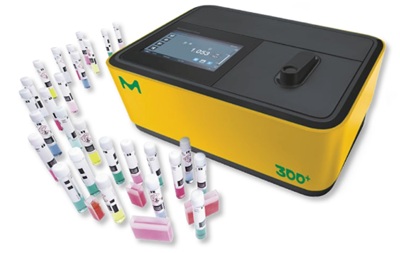
The Spectroquant® photometric system provides a standardized approach for the photometric analysis of detergent residues. Pre-programmed and pre-calibrated methods on Spectroquant® photometers simplify measurement and provide direct results without requiring manual calibration for each test. Ready-to-use test kits contain defined reagents for specific analytical parameters, while the analytical quality assurance (AQA) system and traceable reference materials support verification and documentation of measurement performance.
Key features include:
- Predefined test kits with ready-to-use reagents for specific analytical parameters
- Pre-calibrated methods on Spectroquant® photometers for simplified measurements
- Thermoreactor for applications such as COD and phosphorus
- AQA guidance to support analytical quality control
- Traceable reference materials for verification of measurement performance
Extran® packaging specialties
New 5 L canister
Extran® detergents are available in redesigned packaging formats developed to support safer handling, easier dosing, and more convenient use in laboratory cleaning processes. The updated range includes a 5 L canister for laboratory washer applications and a 1 L bottle for applications requiring smaller volumes.

Extran® 5 L canister for lab washers

Extran® canister in the drawer of the lab washer dosing unit.
Key canister features include:
- Safer handling: Direct connection to the dosing system minimizes contact with acidic or alkaline detergent concentrates.
- Convenient dosing: A standard thread allows connection to compatible laboratory dishwashers without transferring or refilling the detergent.
- Ergonomic design: The lightweight canister and large handle facilitate handling and installation.
- Reduced maintenance: Direct use of the original container can help prevent sediment-related issues associated with repeatedly refilled dosing containers.
- Packaging information: A top-facing label remains visible when the canister is installed in the dosing-unit drawer.
Special safety add-on: Top label for identification and documentation
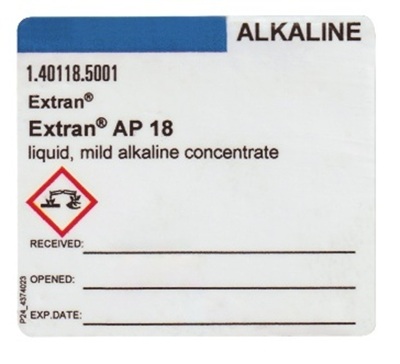
The top label provides information that remains visible after installation in the dosing system, supporting product identification and laboratory documentation. It includes:
- Exact product designation, hazard classification, and applicable pictograms
- Color coding according to the pH of the respective Extran® formulation
- Blank fields for recording information required for good laboratory practice (GLP) documentation using a permanent marker
New 1 L Extran® bottle
The new 1 L Extran® bottle is designed for convenient and controlled handling of concentrated detergents during manual cleaning and other laboratory applications. The high-density polyethylene (HDPE) bottle features an ergonomic, contoured shape that provides a secure grip and facilitates controlled pouring across different hand sizes. Its shatter-resistant construction is suited to routine laboratory use.
Key bottle features include:
- Ergonomic grip: Contoured bottle design supports secure handling for different hand sizes.
- Controlled pouring: The balanced design facilitates controlled dispensing and helps minimize spills.
- Safer handling: The grip and bottle geometry provide greater control when handling concentrated detergent.
- Shatter-resistant material: HDPE construction reduces the risk of breakage during routine laboratory handling.
- Concentrated formulation: Concentrated detergents can reduce the volume of the product required for cleaning applications.
Safety accessories
Dosing accessories and connectivity solutions
Detergent concentrates may be acidic or alkaline and can present handling hazards, particularly when transferred between containers or manually dispensed. Direct connection of detergent bottles or canisters to laboratory washers minimizes manual handling and supports controlled, automated dosing. For applications requiring larger detergent volumes, appropriate withdrawal and connection systems can likewise reduce the need for transferring concentrates and help minimize the risk of spills and user exposure.
We offer a range of withdrawal systems, adapters, taps, and labeling accessories for controlled dispensing and connection of cleaning detergents. These accessories support the use of larger containers while maintaining secure connections and simplifying detergent handling.
Extran® universal adapter
The Extran® universal adapter is designed to connect compatible laboratory dishwashers with the 10 L and 25 L cleaning canisters. The adapter provides a secure connection between the canister and dosing system, helping to minimize spillage and exposure during detergent withdrawal. Its design accommodates different laboratory washer connection configurations, supporting direct machine connectivity across different equipment setups.
Key features include:
- Secure connection: Maintains a tight connection between the detergent canister and laboratory washer.
- Controlled withdrawal: Enables detergent to be dispensed directly from larger containers.
- Reduced handling: Eliminates the need to manually transfer concentrated detergent into smaller dosing containers.
- Spill protection: Helps minimize spillage during connection and detergent withdrawal.
- Equipment compatibility: Universal adapter design accommodates different laboratory dishwasher connection configurations.
Taps, bottle adapters, keys, and labels
Additional accessories are available to support the safe handling, dispensing, and identification of Extran® detergents across different packaging formats. These include taps and bottle adapters for controlled withdrawal, keys for convenient access to dispensing systems, and labels for product identification and documentation. Canister adapters enable direct connection to compatible laboratory dishwashers, while GHS labels support the identification and hazard communication of user-prepared mixtures.
Withdrawal systems for 25 L canisters and 200 L drums
Withdrawal systems are available for Extran® detergents supplied in 25 L canisters and 200 L drums, providing a controlled method for dispensing detergent from large containers into smaller vessels or dosing systems. By reducing manual handling and uncontrolled transfer of concentrated detergents, these systems support safer operation and more efficient cleaning workflows.
Key benefits include:
- Enhanced safety: Reduces direct handling and potential exposure during detergent transfer.
- Process optimization: Supports controlled and consistent withdrawal of detergent.
- Operational flexibility: Facilitates dispensing from different large-volume container formats according to application requirements.
- Resource efficiency: Helps minimize product loss and unnecessary handling during transfer.