Ultra pure High-Temp Reverse Transcriptase (UPRT) and Ultra pure 10x Reverse Transcriptase Buffer (UPRTBF)
Ultra pure High-Temp Reverse Transcriptase (UPRT)
Murine Leukemia Virus (MMLV) Reverse Transcriptase (RT) DNA polymerase uses DNA, single-stranded RNA, or an RNA: DNA hybrid (using a primer) to synthesize a complementary DNA strand. Wild type and traditional MMLV-RT are restricted to lower temperatures (up to 50℃) during cDNA synthesis. For many reverse transcription reactions, temperatures higher than 50℃ are beneficial. Higher temperatures reduce the chances of inhibition due to RNA secondary structures, while at the same time increasing primer binding specificity. These benefits lead to an increase in desired cDNA yield from the reverse transcription reaction. Our Ultra pure High-Temp Reverse Transcriptase Enzyme (UPRT) is an engineered MMLV-RT expressed in E. coli that maintains its performance at elevated temperatures up to 60°C, outcompeting wild-type MMLV reverse transcriptases in both speed and yield.
Applications for Ultra pure Reverse Transcriptase
- Ultra pure (DNA, DNase, RNase, Nickase -free) reduced false positives & false negatives
- Prokaryotic DNA: ≤ 1 copy as E. coli, Eukaryotic DNA: ≤ 0.1 copy as Human, Plasmid DNA: ≤ 10 copies /PCR 40 reactions
- High thermostability (Up to 60℃)
- Fast - short 10 min cDNA step
- Robust – maintains performance in the presence of highly folded RNA
- Increased sensitivity
- High processivity – up to at least 7 kb
- Quality level: MQ300
UPRT Buffer Composition
250 mM Tris -HCl, pH 8.3, 500 mM KCl, 20 mM MgCl2, and 50 mM DTT
Thermostability of UPRT
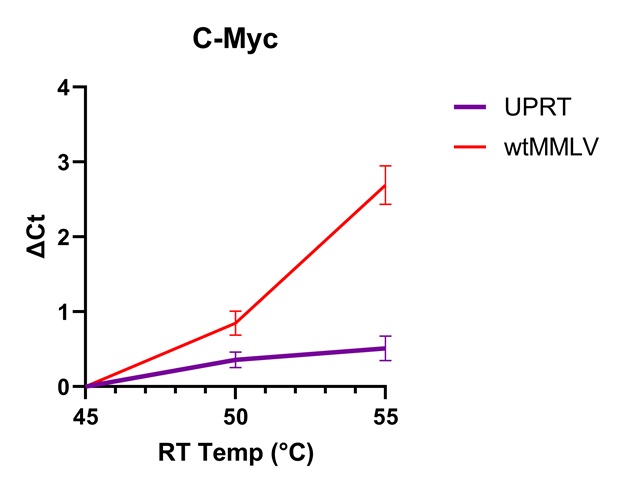
Figure 1. UPRT maintains performance at higher temperatures.2-Step RT-qPCR experiments were performed comparing UPRT to wild type MMLV. UPRT maintains activity through increasing temperatures, whereas wild type does not. Oligo (dT) primers were used in all RT steps (10 min) on HeLa Total RNA. Dual Labeled probes were used in qPCR steps.
Fast cDNA synthesis using UPRT
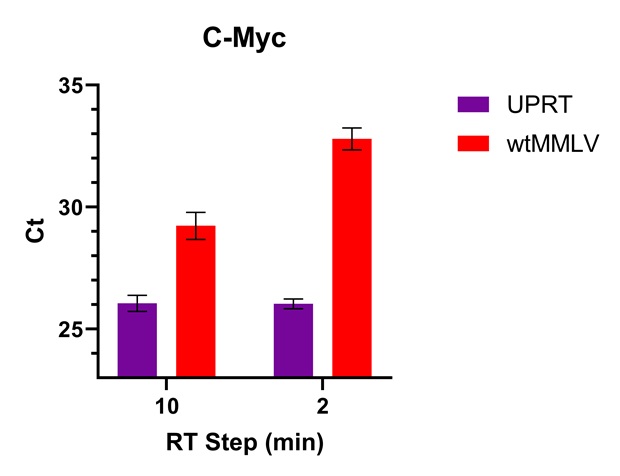
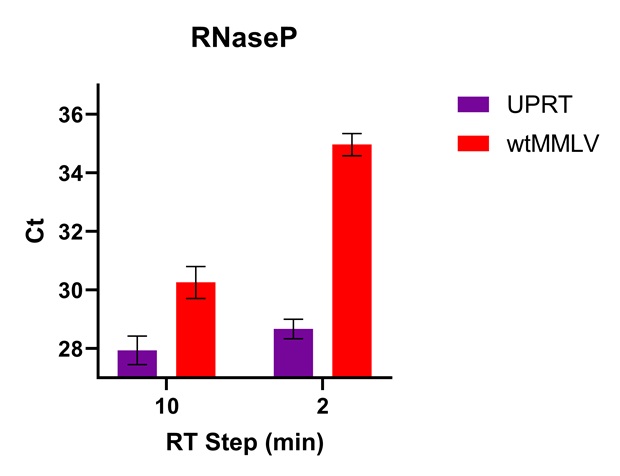
Figure 2. UPRT is capable of fast cDNA synthesis.2-Step RT reactions were stopped at two time points, 2 and 10 minutes, by heat inactivation of RT at 85℃ for 15 minutes. cDNA was added to dual-hydrolysis qPCR at 10% of the reaction volume and analyzed. UPRT was able to complete the reaction in 2 minutes, whereas wtMMLV was not.
Robust cDNA synthesis using UPRT
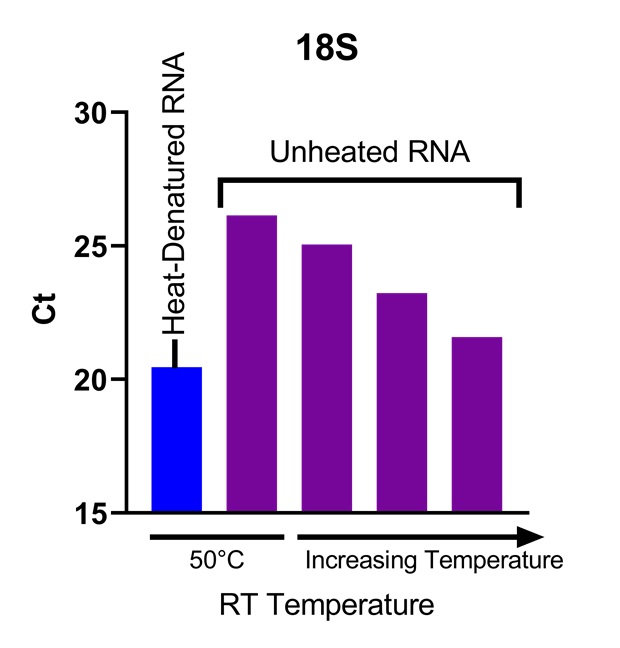
Figure 3. UPRT overcomes difficult templates.Diagnostic reverse transcription relies on RT’s ability to polymerize through the target of interest. Given that RT is usually used as an RDDP, target RNA may be highly structured and difficult to polymerize. In this case, it is important to use an RT that can tackle these difficult templates to avoid false negatives. Ribosomal 18S RNA is highly structured and is more difficult for RT to reverse transcribe. This makes it a perfect template to use for testing RT’s ability to polymerize through difficult templates. In this figure, heat-denatured and unheated HeLa Total RNA were used along with Oligo (dT) to target 18S. Heat-treatment of RNA denatures the secondary structures, making it easier to reverse transcribe. Unheated RNA retains the secondary structures and presents a challenge for RT. UPRT’s increased thermostability allows you to run the RT step at higher temperatures, in turn denaturing some of the 18S RNA and increasing cDNA synthesis.
Increased sensitivity of UPRT
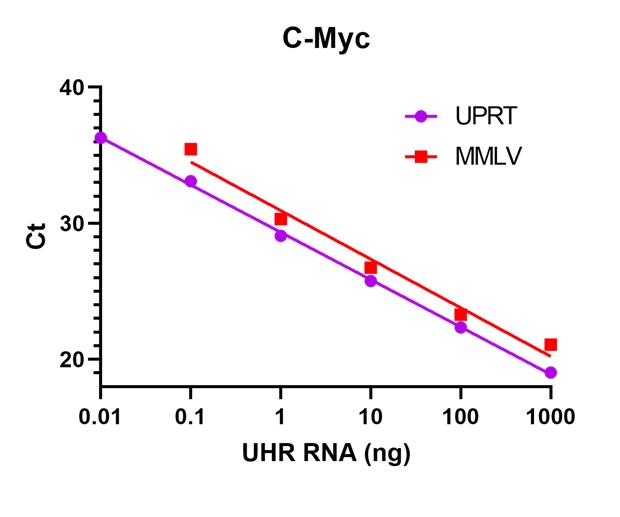
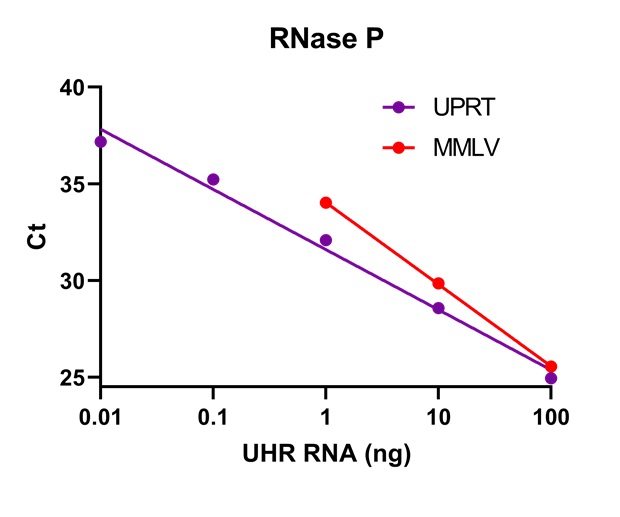
Figure 4.UPRT is engineered for superior performance during reverse transcription reactions, allowing it to detect low levels of RNA template. 2-Step RT-qPCR experiments were performed comparing the performance of UPRT and wtMMLV. Oligo (dT) primers were used in all RT steps (10 min) on UHR Total RNA. Dual Labeled probes were used in qPCR steps.
Unit Definition
One unit incorporates 1 nmole of dTTP into a poly(A): oligo (dT) template: primer polymer in 10 minutes at 37°C.
RT-PCR assays
High-temperature reverse transcription reduces RNA secondary structures and improves primer specificity, supporting robust amplification and consistent results across diverse clinical RNA samples.
RT-qPCR (quantitative PCR)
Enhanced thermal stability enables more efficient cDNA synthesis and lower background, improving sensitivity, linearity, and reproducibility—critical for accurate viral load and gene expression measurements.
First-strand cDNA synthesis for RT-PCR workflows
UPRT delivers high-yield, full-length first-strand cDNA, ensuring reliable downstream PCR performance and minimizing variability between runs and reagent lots.
RNA-Seq library preparation (clinical & translational research)
Improved performance at elevated temperatures enhances transcript coverage and uniformity, particularly for GC-rich or structured RNAs, supporting more accurate transcriptome profiling.
Viral RNA detection and molecular diagnostics
Elevated reaction temperatures improve reverse transcription efficiency of structured viral genomes, increasing assay sensitivity and robustness in infectious disease testing.
Low-input and challenging clinical samples
Superior efficiency with limited or partially degraded RNA enables reliable results from biopsies, FFPE-derived RNA, and other difficult diagnostic sample types.
Ultra pure RT-Enzyme Buffer (UPRTBF)
The Ultra pure RT-Enzyme Buffer (UPRTBF) 10x reaction buffer is manufactured to be nuclease- and DNA-free to reduce the occurrence of false-positives and false-negatives, which allows for improved cDNA synthesis when using UPRT for reverse transcription.
Features
- Low DNA Contamination testing
- Prokaryotic DNA: ≤ 1 copy as E. coli, Eukaryotic DNA: ≤ 0.1 copy as Human, Plasmid DNA: ≤ 10 copies /PCR 40 reactions
- DNase-free, RNase-free, Protease-free
- Suitable for use in Molecular Applications
- For use with UPRT