Co-Culture of MCF-7 Cells and Human Primary Dermal Fibroblasts
Although 2D cell culture is generally accepted and has increased our understanding of fundamental cell biological processes, it has limitations. 3D cell cultures better mimic tissue physiology in multicellular organisms1 and offer an opportunity to better understand complex biology in a physiologically relevant context where 2D models have not been proven successful.
Organoids are in vitro-derived 3D cell aggregates derived from primary tissue or stem cells that can self-organize in three-dimensional culture due to their self-renewal and differentiation capacities. They are physiologically relevant, holding great potential in basic research as well as translational applications.
Normal Human Primary Fibroblasts (NHDF) and MCF-7 cells cultured in PromoCell® Cancer Cell Line Medium XF can be used by researchers as a model for tumor microarchitecture in vitro. Fibroblasts can regulate the growth and differentiation pattern of MCF-7 mammary carcinoma cells through a process mediated by membrane-bound and soluble factor2; therefore, studies on the interplay between fibroblasts and MCF-7 cells, especially in the 3D culture environment, are of particular interest in tumor research.
Here we present a protocol for 3D organoid culture of Primary Human Dermal Fibroblasts (NHDF) and MCF-7 cells using PromoCell® Cancer Cell Line Medium XF.
Section Overview
Cancer Cell Culture Media
A part of the PromoCell® cancer media toolbox, the Cancer Cell Line Medium XF supports the in vitro culture of tumor-driving cancer stem cells and further differentiated cancer cells. However, it is also less stringent to other non-cancer cell types like immune cells, fibroblasts or vascular cell types. The Cancer Cell Line Medium XF provides a serum-free and xenofree culture environment devoid of all stimuli originating from non-defined materials and is particularly useful for researchers relying on well-defined cell culture conditions. The medium does not contain ill-defined components such as fetal calf-serum, extracts or hydrolysates and exhibits very low lot-to lot variability.
General Workflow Overview
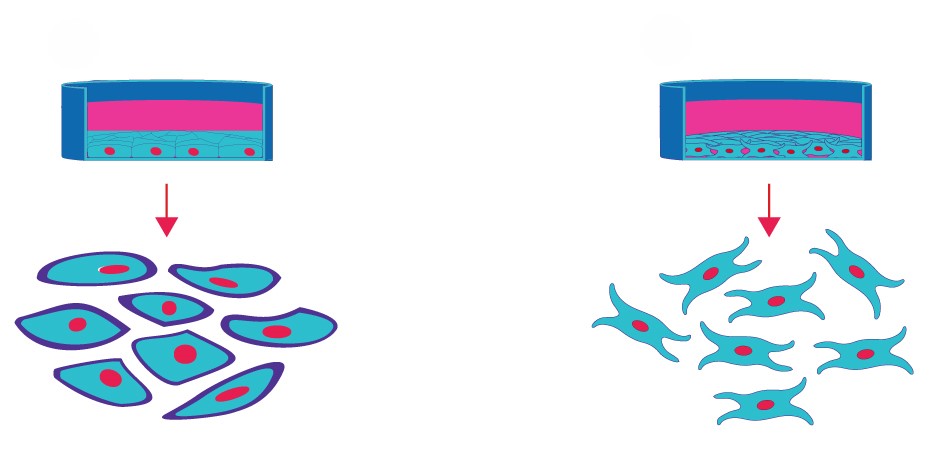
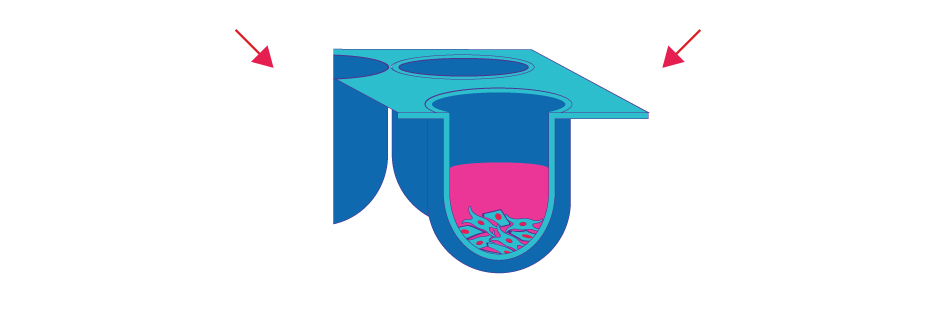

2D Culture of MCF-7 Cells and NHDFs
The protocol describes the expansion of Primary Human Dermal Fibroblasts (NHDF) and MCF-7 cells in our Cancer Cell Line Medium XF and subsequent generation of a 3D organoid co-culture. For the entire protocol, use aseptic techniques and a laminar flow bench.
Materials
- Fibronectin solution, human (F0556)
- Normal Human Dermal Fibroblasts, juvenile foreskin (C-12300)
- MCF-7 cell line (SCC276)
- Culture vessels for adherent cell culture (e.g. Falcon, No. 353004)
- DPBS without Ca⁺⁺/Mg⁺⁺ (59331C)
- Cancer Cell Line Medium XF (C-28077)
Coating of Cell Culture Dishes
Dilute the fibronectin solution to 10 μg/ml in Dulbecco’s PBS without calcium and magnesium. Overlay the culture surface of your tissue culture vessel with an amount of the diluted fibronectin solution sufficient to effectively coat the complete surface. Be sure that the entire surface is covered. Place flasks on a level surface at room temperature for at least 60 minutes.
Plate the Cells
Thaw the cells from cryopreservation or harvest the cells from a pre-existing culture using your standard method. Resuspend the cells in the Cancer Cell Line Medium XF and plate them separately on precoated fibronectin surfaces. Use a plating density of 10,000 cells/cm² for MCF-7 cells and 5,000 cells/cm² for NHDFs.
Let the Cells Grow
Incubate the cells at 37°C and 5% CO₂ until they have reached 70-90% confluence. Change the medium every 2-3 days.
Initiation of Organoid Culture
Use aseptic techniques and a laminar flow bench.
Materials
- Cancer Cell Line Medium XF (C-28077)
- DPBS without Ca⁺⁺/Mg⁺⁺ (59331C)
- Accutase (A6964)
- 96-well suspension culture plate (e.g., M3562)
Detachment of Cells
Once the cells have reached 70-90% confluence, aspirate the medium and wash the culture with ambient tempered PBS without calcium and magnesium. Incubate the cells for 4-10 minutes with 100 μl/cm² Accutase at 37°C. Monitor the detachment process using a microscope. When the cells start to detach, facilitate their complete dislodgement by tapping the flask. Transfer the cell suspensions separately to centrifuge tubes using a 40 μm filter and dilute them 1:1 with the Cancer Cell Line Medium XF.
Note: NHDFs may need 4-5 minutes for complete detachment. MCF-7 should be incubated in Accutase for about 10 minutes for complete disaggregation of cell clumps. Be careful to handle cell suspension with care. Do not over-triturate the cells during the detachment process. A high cell viability is critical for successful organoid aggregation.
Count the Cells
Count your cells using your standard method, such as a hemocytometer or the Scetper™ 3.0 Automated Cell Counter. For optimal results, cell viability should be higher than 90%.
Seed the Cells for Organoid Formation
Spin down each tube for 5 min at 300 x g. Adjust cell concentrations to 1 million cells/ml with Cancer Cell Line Medium XF. Plate an equal number of MCF-7 cells and NHDFs in a 96-well U-bottom suspension culture plate using Cancer Cell Line Medium XF.
Note: The more cells you use, the larger the organoids will be. Up to 3 x 10⁵ cells per well can be plated.
Organoid Formation
Organoids will form spontaneously within 24-48 hours of incubation. To generate tightly packed organoids, cells should be incubated for 4-5 days. Because of high metabolic activity, the color of the medium will turn yellow within one day. Ideally, the medium should be changed each day or at least every two days. To change the medium, take off as much medium as possible using a 200 μl pipet without touching the organoid. Add new medium slowly and carefully. Do not stir or mix the organoids.
3D Organoid Culture in Collagen Gels
Use aseptic techniques and a laminar flow bench.
Materials
- Cancer Cell Line Medium XF (C-28077)
- Nunclon Sphera 24-Well Multidish (Thermo Scientific, No. 174930)
- Collagen solution (e.g. 3D Collagen Cell Culture System, No. ECM675)
Organoids Collection
Transfer the organoid-containing medium from the 96-wells into 15 ml conical tubes using a 1,000 μl pipet. Allow the organoids to settle by gravity sedimentation for 10 minutes at room temperature. Aspirate the supernatant and resuspend the cells in a small volume (e.g., 30-50 μl) of Cancer Cell Line Medium XF per tube. Handle the organoids with care - do not disturb the integrity of the organoid. Generation of single cells should be avoided.
Preparation of Collagen Gel Solution
Prepare a collagen I solution of 2 mg/ml according to the manufacturer’s instructions and keep it on ice. Collagen gel formation is highly dependent on temperature, pH, and the quality of the used collagen. We suggest using the 3D Collagen Cell Culture Kit (ECM675). For organoids containing MCF-7 cells and fibroblasts use the 5x RPMI medium contained in the kit to guarantee physiological conditions.
Initiation of 3D Culture in Collagen Gels
Mix the organoid suspension with the chilled collagen solution. Cell suspension should not be greater than 10% of the final volume. Add 500 μl of the organoid-containing collagen solution per well of a 24-well suspension culture plate. Be careful not to introduce air bubbles in the suspension. Immediately transfer the plate to a 37°C incubator for 60 minutes to initiate polymerization of the collagen. After formation of the gel, cover the collagen gel with culture medium. Incubate cells overnight or several days at 37°C and change the medium daily. Cells can be visualized using phase contrast microscopy and can be fixed and stained within the collagen (Figure 1).
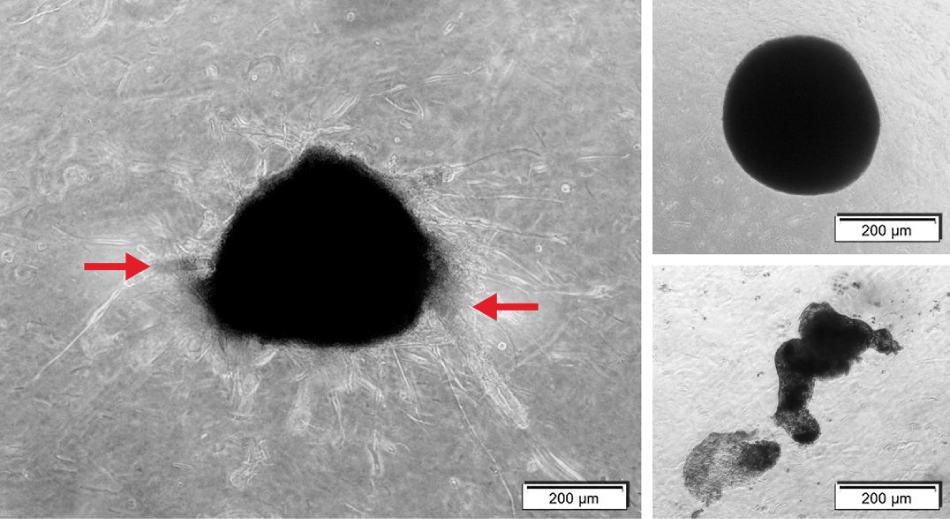
Figure 1.Initiation of organoid culture in collagen gel. A: Organoids containing MCF-7 cells and NHDFs. Organoids show a characteristic sprouting behavior (red arrows) after embedding in the collagen gel. B: Organoids containing solely NHDFs. Organoids are tightly packed showing a round shape with clear edges. Sprouting is not as prominent as in organoids containing both cell types. C: Organoids containing solely MCF-7 cells. In contrast to NHDF-containing organoids, MCF-organoids seem to be loosely aggregated. No sprouting behavior was visible.