
Water for Ion Chromatography (IC)

Ion chromatography (IC) separates and measures ions at very low concentrations, often down to ppb or ppt levels. Since this technique is extremely sensitive to trace‑level contaminants, water quality is critical. Any impurity in the water used for eluents, dilutions or blanks can directly create artifacts, distort baselines or affect quantification.
Section overview
What is ion chromatography?
Ion chromatography (IC) is a type of liquid chromatography used to separate and quantify ions in aqueous samples via an ion-exchange mechanism. It is primarily applied to analyze inorganic anions (such as chloride, nitrite, nitrate, and sulfate) and cations (such as sodium, calcium, ammonium, and potassium) but also extends to polar or ionizable organic molecules, including small organic acids, carbohydrates, proteins, and nucleic acids.
IC is an instrument-driven, highly standardized subset of ion-exchange chromatography, designed for the rapid, routine measurement of small inorganic ions in water, typically using suppressed conductivity detection. In contrast, ion-exchange chromatography (commonly abbreviated as IEX or IEC) is a broader separation technique applicable to larger or more complex charged species (particularly peptides, proteins, and other biomolecules) and employs a wider range of detectors and operating conditions.
While alternative techniques exist for the trace analysis of cations, such as atomic absorption spectroscopy (AAS) or inductively coupled plasma (ICP), IC is considered the gold standard for anion analysis, for which no other rapid analytical method exists. As one of the most established techniques available, IC enables the quantitative determination of anions at trace levels.1
What is ion chromatography used for?
Environmental analysis is one of the biggest applications of IC: it is used to analyze ions in ground and surface water monitoring, or to test whether drinking water conforms to regulatory requirements (e.g. chloride, nitrate, and sulfate levels). IC is also used for quality control and safety testing of food and beverages (e.g. anions, organic acids, nitrite, and phosphate), and to detect contaminants such as perchlorate and chlorate.
Other important fields of application include pharmaceuticals (e.g. counter-ion analysis, cleaning validation), semiconductor and electronics (ultrapure water monitoring, testing etching baths, photoresists and other process chemicals), the petrochemical and power generation industries, as well as biotechnology and life sciences.2
How does ion chromatography work?
Ion chromatography separates ions based on their electrostatic interactions with a stationary phase carrying charged functional groups. In IC, analyte ions are retained though ionic (Coulombic) attraction to the oppositely charged sites in the column. Retention strength depends on the analyte’s charge, size and affinity for the ion-exchange groups.
Components of ion chromatography instrument
Core components of an ion chromatography instrument (Figure 1) include:
Mobile phases
The mobile phases used in IC are usually aqueous (dilute acids, alkalis or salt solutions). Eluents for anions include carbonate/bicarbonate, hydroxides, organic acids or sulfonic acids. Eluents for cations include inorganic acids (nitric, sulfuric or methanesulfonic acid).
Columns
IC columns are typically packed with functionalized, grafted copolymer beads, such as polystyrene divinylbenzene.
For anion analysis, the stationary phase usually carries either strong quaternary ammonium groups (-NR4+) or weaker anion exchange groups based on tertiary amine groups (-NR3).
For cation analysis, a variety of functional groups can be used, including carboxylates (-COO-), sulfonates (-SO3-), phosphonates (-PO32-), or specialized ligands such as crown ethers.
These different chemistries allow IC columns to target a broad range of charged species with high selectivity and efficiency.
Ion suppressors
Suppressors are often used to reduce the background conductivity due to the ions present in the mobile phase (eluent), and to improve the conductivity of the ions being tested. This improves the sensitivity of the analytical method, and the linearity of the calibration curves.
Detectors
Conductivity detection is the most used method in IC. Other detection methods include spectroscopic detection (UV or fluorescence), potentiometric detection, and electrochemical detection (voltammetry, amperometry, coulometry). Mass spectrometry is increasingly coupled to IC, especially for speciation.
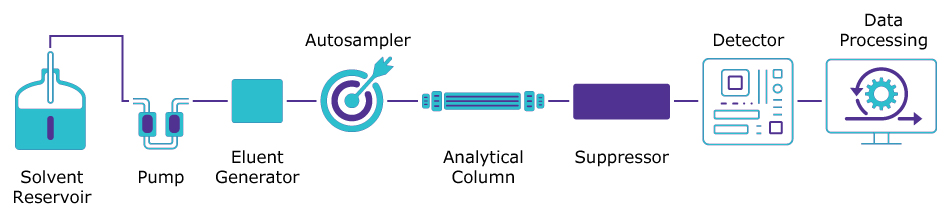
Figure 1.Ion chromatography instrument diagram
Impact of water quality on ion chromatography
Water plays several critical roles throughout the IC workflow.
Water is a key solvent in IC, accounting for over 95% of the mobile phase volume. As such, its purity has a significant impact on analysis quality, directly affecting the accuracy and precision of IC results.
During sample preparation, water is used to extract or dissolve ionic analytes into an aqueous phase, dilute samples to appropriate concentration levels, and adjust the matrix to ensure accurate separation and quantification.
Water also serves as a blank solution and is used to prepare and dilute standards.
Water is sometimes used to regenerate suppressors. In this step, high-purity water is essential to ensure optimal suppressor performance and minimize background noise.
Water quality must therefore be carefully selected to avoid introducing background ions that could compromise detection sensitivity and result accuracy.
Contaminants in water can affect both the IC system and the quality of analytical results. These effects are reviewed below, along with the water purity specifications required for high-quality IC analysis.
Ions
Ions are obvious contaminants to control because they can interfere with samples and standards, as well as the mobile phase. They may cause ghost or false peaks, peak interference and noisy baselines, leading to inaccurate quantification of analytes and poor detection limits. Ions contaminating the mobile phase can increase background conductivity and lead to negative peaks if the sample contains less of a specific ion than the mobile phase. This may be a concern if it overlaps or distorts an analyte peak, leading to biased quantification
In addition, suppressors and eluent generators perform better when the water used is extremely clean. Ion-contaminated water may reduce suppresser efficiency and shorten their lifetime.
Carbonates
Carbon dioxide from the air dissolves in water, forming carbonates, which can interfere with anion IC by distorting the baseline. Carbonates are difficult to control, but using freshly purified water or feeding water directly to the system can minimize their effects.
Organics
Some organics have affinity for the polymer-based IC columns and may adsorb on the resin, affecting its ion-exchange ability. This may lead to unpredictable elution of analytes and eventually reduce the column lifetime.
Small charged organic molecules, such as carboxylates, can also interfere with IC analyses. They may produce extra peaks on the chromatogram or form complexes with the inorganic ions being analyzed.
Particulates
Particles and colloids can increase system background pressure, shorten column lifetime and damage pumps and injectors. Controlling particle levels is even more important with modern high-resolution IC columns with smaller particle size (4 µm).
Bacteria and their by-products
Bacteria can release inorganic ions and small organic acids (acetate, formate, oxalate, pyruvate) that can appear on anion chromatograms or interfere with eluent chemistry. Bacteria also behave as particulates and thus affect the column’s backpressure.
Additional sources of water contamination
Contamination by the container
Plastic containers can release ions. For example, polyethylene may release Ca2+, Mg2+, Na+, while polypropylene may also leach Cl- or SO42-. Careful container selection, thorough cleaning, and rigorous rinsing are essential, as preventing contamination from containers remains inherently challenging.
Contamination from laboratory air
Laboratory air is a source of ionic contaminants that can dissolve into high-purity water and interfere with IC results. These contaminants include:
Carbonate and bicarbonate from CO₂ absorption
Ammonium from ammonia vapors
Chloride, sulfate, nitrate, sodium and potassium from airborne dust, acidic gases human activity, and building materials
This is illustrated in Figure 2, which shows a shift in a calibration curve caused by sodium ion contamination from laboratory air.3 To minimize these risks, samples and standards should always be prepared and stored in tightly closed containers, with minimal exposure to open air and for as short a time as possible.
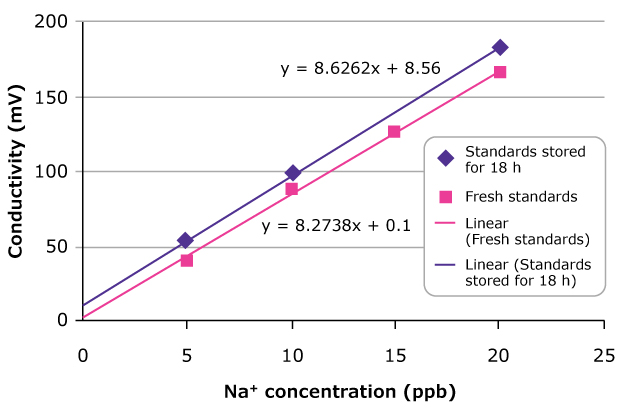
Figure 2.Comparison of sodium calibration curves, either freshly prepared (pink squares) or stored overnight for 18 hours in analytical vials (purple diamonds). The diluted sodium standards that were stored show consistently higher conductivity, indicating contamination.
Lab water system for ion chromatography
Ultrapure (Type 1) water, with a resistivity of 18.2 MΩ•cm (“ion-free”) and TOC < 5 ppb, is recommended for ion chromatography. A 0.22 µm screen filter at the outlet of the water purification system ensures the removal of particulates or bacteria.
For trace or ultra-trace IC, a purification unit (Milli-Q® IQ Element water purification unit) containing an ion-exchange cartridge combined with a 0.1 µm filter may be placed at the outlet of the water purification system.
A range of water purification solutions adapted to the needs of scientists working with IC is available.