产品名称
Anti-Wilm′s Tumor Protein Rabbit pAb, liquid, Calbiochem®
biological source
rabbit
antibody form
affinity isolated antibody
antibody product type
primary antibodies
clone
polyclonal
form
liquid
contains
≤0.1% sodium azide as preservative
species reactivity
mouse, human, rat
manufacturer/tradename
Calbiochem®
storage condition
OK to freeze
isotype
IgG
shipped in
wet ice
storage temp.
2-8°C
target post-translational modification
unmodified
Quality Level
Gene Information
human ... WT1(7490)
Analysis Note
Positive Control
Wilm′s tumor tissue
Wilm′s tumor tissue
Application

Immunoblotting (see comments)
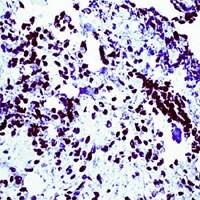
Paraffin Sections (1:100, heat pre-treatment required)
Immunoprecipitation (see comments)
Disclaimer
Toxicity: Standard Handling (A)
General description
Immunoaffinity purified rabbit polyclonal antibody. Recognizes the ~47-55 kDa Wilm′s tumor protein.
Recognizes the ~47-55 kDa Wilm′s tumor protein in Wilm′s tumor tissue.
This Anti-Wilm′s Tumor Protein Rabbit pAb is validated for use in Immunoblotting, Paraffin Sections, Immunoprecipitation for the detection of Wilm′s Tumor Protein.
Immunogen
Human
a synthetic peptide corresponding to amino acids from the C-terminus of human Wilm′s tumor protein
Other Notes
Huff, V. 1998. Am. J. Med. Genet.79, 260.
Staining of formalin-fixed, paraffin-embedded tissues requires antigen retrieval by boiling tissue sections in 10 mM citrate buffer, pH 6.0 for 10-20 min, followed by cooling at room temp for 20 min. This antibody is also reported to work for immunoblotting and immunoprecipitation. Antibody should be titrated for optimal results in individual systems.
Packaging
Please refer to vial label for lot-specific concentration.
Physical form
In 10 mM PBS, 0.2% BSA, pH 7.6.
Preparation Note
Following initial use, aliquot and freeze (-20°C) for long-term storage.
Legal Information
CALBIOCHEM is a registered trademark of Merck KGaA, Darmstadt, Germany
未找到合适的产品?
试试我们的产品选型工具.
存储类别
10 - Combustible liquids
wgk
WGK 1
flash_point_f
Not applicable
flash_point_c
Not applicable
Noortje A M Bax et al.
Developmental dynamics : an official publication of the American Association of Anatomists, 239(8), 2307-2317 (2010-07-27)
Platelet-derived growth factor receptor alpha (Pdgfralpha) identifies cardiac progenitor cells in the posterior part of the second heart field. We aim to elucidate the role of Pdgfralpha in this region. Hearts of Pdgfralpha-deficient mouse embryos (E9.5-E14.5) showed cardiac malformations consisting
Caitlin M Braitsch et al.
Journal of molecular and cellular cardiology, 65, 108-119 (2013-10-22)
During embryonic heart development, the transcription factors Tcf21, Wt1, and Tbx18 regulate activation and differentiation of epicardium-derived cells, including fibroblast lineages. Expression of these epicardial progenitor factors and localization of cardiac fibrosis were examined in mouse models of cardiovascular disease
Tomonori Kanazawa et al.
Developmental dynamics : an official publication of the American Association of Anatomists, 239(4), 1145-1154 (2010-03-18)
Hepatocyte nuclear factor 4 alpha (Hnf4alpha) is a transcription factor required for embryogenesis and organogenesis. In the adult kidney, Hnf4alpha is expressed at a high level in proximal tubules. Although its expression begins from the embryonic period, its function in
Noortje A M Bax et al.
Developmental dynamics : an official publication of the American Association of Anatomists, 238(10), 2658-2669 (2009-08-26)
For the establishment of a fully functional septated heart, addition of myocardium from second heart field-derived structures is important. Platelet-derived growth factors (PDGFs) are known for their role in cardiovascular development. In this study, we aim to elucidate this role
Timo H Lüdtke et al.
American journal of physiology. Lung cellular and molecular physiology, 316(5), L767-L783 (2019-02-01)
The mesothelial lining of the lung, the visceral pleura, and of the heart, the epicardium, derive from a common multipotent precursor tissue, the mesothelium of the embryonic thoracic cavity that also contributes to organ-specific mesenchymal cell types. Insight into mesothelial
我们的科学家团队拥有各种研究领域经验,包括生命科学、材料科学、化学合成、色谱、分析及许多其他领域.
联系客户支持