
NA13

Anti-Replication Protein A (Ab-1) Mouse mAb (RPA70-9)
liquid, clone RPA70-9, Calbiochem®
别名:
Anti-RP-A
登录并加购,请在购物车里查看协议价、货期和发货地。
选择规格
变更视图
关于此项目
NACRES:
NA.41
UNSPSC Code:
12352203
Clone:
RPA70-9, monoclonal
Species reactivity:
human, yeast
Application:
—
Citations:
23
biological source
mouse
Quality Segment
antibody form
purified antibody
antibody product type
primary antibodies
clone
RPA70-9, monoclonal
form
liquid
contains
≤0.1% sodium azide as preservative
species reactivity
human, yeast
manufacturer/tradename
Calbiochem®
storage condition
do not freeze
dilution
(Frozen Sections (2.5 µg/mL)
Immunoblotting (1-5 µg/mL)
Immunofluorescence (2.5 µg/mL)
Immunoprecipitation (1 µg/reaction)
Paraffin Sections (2.5 µg/mL, no pre-treatment required))
isotype
IgG2a
shipped in
wet ice
storage temp.
2-8°C
target post-translational modification
unmodified
Gene Information
human ... RPA1(6117)
General description
Purified mouse monoclonal antibody generated by immunizing BALB/c mice with the specified immunogen and fusing splenocytes with the NS1 myeloma cell line. Recognizes the ~70 kDa Replication Protein A.
Recognizes the ~70 kDa subunit of replication protein A in HeLa and u293 cells and colon carcinoma tissue.
This Anti-Replication Protein A (Ab-1) Mouse mAb (RPA70-9) is validated for use in Frozen Sections, Immunoblotting, IF, IP, Paraffin Sections for the detection of Replication Protein A (Ab-1).
Immunogen
Epitope: Within the p70 subunit of replication protein A
Human
replication protein A purified from U293 cells
Application
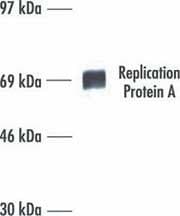
Frozen Sections (2.5 g/ml)
Immunoblotting (1-5 g/ml)
Immunofluorescence (2.5 g/ml)
Immunoprecipitation (1 g/reaction)
Paraffin Sections (2.5 g/ml, no pre-treatment required)
Packaging
Please refer to vial label for lot-specific concentration.
Physical form
In 0.05 M sodium phosphate buffer, 0.2% gelatin.
Analysis Note
Positive Control
HeLa or U293 cells or colon carcinoma tissue
HeLa or U293 cells or colon carcinoma tissue
Other Notes
Din, S., et al. 1990. Genes Dev.4, 968.
Brill, S.J. and Stillman, B., 1989. Nature342, 92.
Stillman, B., 1989. Annu. Rev. Cell. Biol.5, 197.
Tsurimoto, T. and Stillman, B., 1989. EMBO J.8, 3883.
Wobbe, C.R., et al. 1987. Proc. Natl. Acad. Sci. USA84, 1834.
Brill, S.J. and Stillman, B., 1989. Nature342, 92.
Stillman, B., 1989. Annu. Rev. Cell. Biol.5, 197.
Tsurimoto, T. and Stillman, B., 1989. EMBO J.8, 3883.
Wobbe, C.R., et al. 1987. Proc. Natl. Acad. Sci. USA84, 1834.
Specific for the p70 subunit of replication protein A. This antibody can be used as a marker for proliferation. Antibody should be titrated for optimal results in individual systems.
Legal Information
CALBIOCHEM is a registered trademark of Merck KGaA, Darmstadt, Germany
Disclaimer
Toxicity: Standard Handling (A)
Still not finding the right product?
试用我们的 产品选型工具 工具缩小选择范围
存储类别
11 - Combustible Solids
wgk
WGK 1
flash_point_f
Not applicable
flash_point_c
Not applicable