

biological source
mouse
Quality Segment
antibody form
purified antibody
antibody product type
primary antibodies
clone
22C2, monoclonal
form
liquid
contains
≤0.1% sodium azide as preservative
species reactivity
human
manufacturer/tradename
Calbiochem®
storage condition
do not freeze
isotype
IgG1
shipped in
wet ice
storage temp.
2-8°C
target post-translational modification
unmodified
Gene Information
human ... MTOR(2475)
General description
Purified mouse monoclonal antibody generated by immunizing mice with the specified immunogen and fusing splenocytes with SpAG8 mouse myeloma cells. Recognizes the ~290 kDa mTOR/FRAP protein.
Recognizes the ~290 kDa mTOR protein in HEK293 and Jurkat cells.
This Anti-mTOR/FRAP (Ab-2) Mouse mAb (22C2) is validated for use in Immunoblotting, Immunoprecipitation for the detection of mTOR/FRAP (Ab-2).
Immunogen
Human
a synthetic peptide corresponding to amino acids 230-240 of human TOR
Application
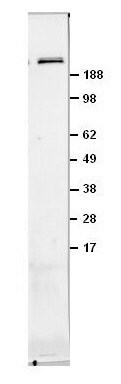
Immunoblotting (1.7 g/ml, see application references)
Immunoprecipitation (1-10 g/ml, see application references)
Packaging
Please refer to vial label for lot-specific concentration.
Physical form
In 50 mM sodium phosphate buffer, 0.2% gelatin.
Analysis Note
Positive Control
Jurkat or HeLa cells
Jurkat or HeLa cells
Other Notes
Kimura N et al. 2003. Genes Cells8, 65.
Sekulic A et al. 2000. Cancer Res.60, 3504.
Hosoi, H. 1999. Cancer Res.59, 886.
Alarcon, C.M., et al. 1996. Genes Dev.10, 279.
Freeman, K., and Livi, G.P. 1996. Gene172, 143.
Hosoi, H., et al. 1996. AACR 87th Ann. Mtg. Abstract 3445.
Cardenas, M.E., and Heitman, J. 1995. EMBO J.14, 5892.
Lorenz, M.C., and Heitman, J. 1995. J. Biol. Chem.270, 27531.
Sabatini, D.M., et al. 1995. J. Biol. Chem.270, 20875.
Zheng, X.F., et al. 1995. Cell82, 121.
Brown, E.J., et al. 1994. Nature369, 756.
Sabatini, D.M., et al. 1994. Cell78, 35.
Stan, R., et al. 1994. J. Biol. Chem.269, 32027.
Kunz, J., et al. 1993. Cell73, 585.
Heitman, J., et al. 1991. Science253, 905.
Sekulic A et al. 2000. Cancer Res.60, 3504.
Hosoi, H. 1999. Cancer Res.59, 886.
Alarcon, C.M., et al. 1996. Genes Dev.10, 279.
Freeman, K., and Livi, G.P. 1996. Gene172, 143.
Hosoi, H., et al. 1996. AACR 87th Ann. Mtg. Abstract 3445.
Cardenas, M.E., and Heitman, J. 1995. EMBO J.14, 5892.
Lorenz, M.C., and Heitman, J. 1995. J. Biol. Chem.270, 27531.
Sabatini, D.M., et al. 1995. J. Biol. Chem.270, 20875.
Zheng, X.F., et al. 1995. Cell82, 121.
Brown, E.J., et al. 1994. Nature369, 756.
Sabatini, D.M., et al. 1994. Cell78, 35.
Stan, R., et al. 1994. J. Biol. Chem.269, 32027.
Kunz, J., et al. 1993. Cell73, 585.
Heitman, J., et al. 1991. Science253, 905.
The immunogen sequence is 100% conserved in mouse and rat, but cross-reactivity has not been tested. Antibody should be titrated for optimal results in individual systems.
Legal Information
CALBIOCHEM is a registered trademark of Merck KGaA, Darmstadt, Germany
Disclaimer
Toxicity: Standard Handling (A)
Still not finding the right product?
试用我们的 产品选型工具 工具缩小选择范围
存储类别
11 - Combustible Solids
怎么回事?
WGK 1
闪点 (F)
Not applicable
闪点 (°C)
Not applicable