
85228-M

硝酸银
puriss. p.a., ≥99.5% (AT)
别名:
硝酸银(I)盐
登录 查看组织和合同定价。
选择规格
变更视图
关于此项目
线性分子式:
AgNO3
化学文摘社编号:
分子量:
169.87
NACRES:
NA.21
PubChem Substance ID:
UNSPSC Code:
12352302
EC Number:
231-853-9
MDL number:
Assay:
≥99.5% (AT)
Form:
solid
vapor density
5.8 (vs air)
grade
puriss. p.a.
assay
≥99.5% (AT)
form
solid
mp
212 °C (dec.) (lit.)
anion traces
chloride (Cl-): ≤5 mg/kg, sulfate (SO42-): ≤20 mg/kg
cation traces
Ca: ≤10 mg/kg, Cd: ≤1 mg/kg, Co: ≤5 mg/kg, Cr: ≤5 mg/kg, Cu: ≤2 mg/kg, Fe: ≤2 mg/kg, K: ≤50 mg/kg, Mg: ≤5 mg/kg, Mn: ≤5 mg/kg, Na: ≤50 mg/kg, Ni: ≤5 mg/kg, Pb: ≤5 mg/kg, Zn: ≤1 mg/kg
SMILES string
[O-][N+]([O-])=O.[Ag+]
InChI
1S/Ag.NO3/c;2-1(3)4/q+1;-1
InChI key
SQGYOTSLMSWVJD-UHFFFAOYSA-N
Application
- Photochemical Synthesis of Silver Nanoparticles: Silver nitrate is pivotal in the photochemical synthesis of silver nanoparticles using UV pulsed laser irradiations. The presence of surfactant additives influences the morphology and stability of the synthesized nanoparticles, which have applications in catalysis, sensing, and biomedical fields. This method provides a controlled approach to nanoparticle synthesis, essential for advanced material science and nanotechnology research (Qazi, Journal of New Materials for Electrochemical Systems, 2021).
Still not finding the right product?
Explore all of our products under 硝酸银
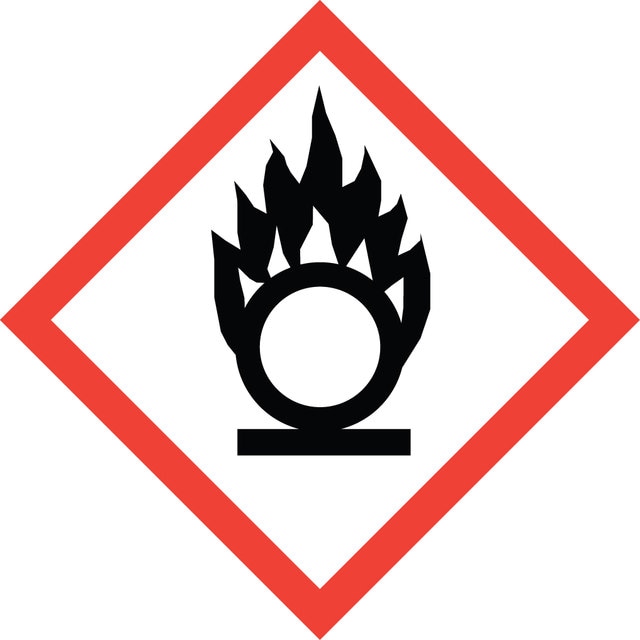



signalword
Danger
Hazard Classifications
Aquatic Acute 1 - Aquatic Chronic 1 - Eye Dam. 1 - Met. Corr. 1 - Ox. Sol. 2 - Repr. 1B - Skin Corr. 1A
存储类别
5.1B - Oxidizing hazardous materials
wgk
WGK 3
flash_point_f
Not applicable
flash_point_c
Not applicable