Photometric Determination of Phosphate in Soil
Introduction
Phosphorus is an essential element commonly present in soil as phosphate and plays an important role in biochemical processes. Its concentration is a key parameter in agricultural and environmental analysis, as increased phosphate levels are associated with enhanced plant growth and can contribute to eutrophication of surface waters.1 In soils, phosphate is often present in insoluble forms, bound to calcium, iron, or aluminum, or incorporated into organic matter. Therefore, its determination requires appropriate extraction or conversion to measurable forms.2
A range of analytical methods has been developed for phosphate determination, including titrimetry, chromatography, and spectrophotometry. Among these, spectrophotometric methods based on molybdate chemistry, particularly those involving molybdovanadate complexes, are widely used due to their sensitivity and suitability for routine analysis.2
Experimental
This application note details the photometric determination of phosphate in soils after its extraction analogous LUFA.3
Method
In sulfuric solution orthophosphate ions react with ammonium vanadate and ammonium heptamolybdate to form orange-yellow molybdovanadophosphoric acid that is determined photometrically (“VM” method).
The method is analogous to APHA 4500-P C.
Measuring Range
Applicable Sample
Soil samples
Reagents, Instruments, and Materials
Test /Reagent Kit(s)
For the measurement, the following Spectroquant® test kit is necessary.
- Spectroquant® Phosphate Test (1.14842)
Instrument(s) & Devices
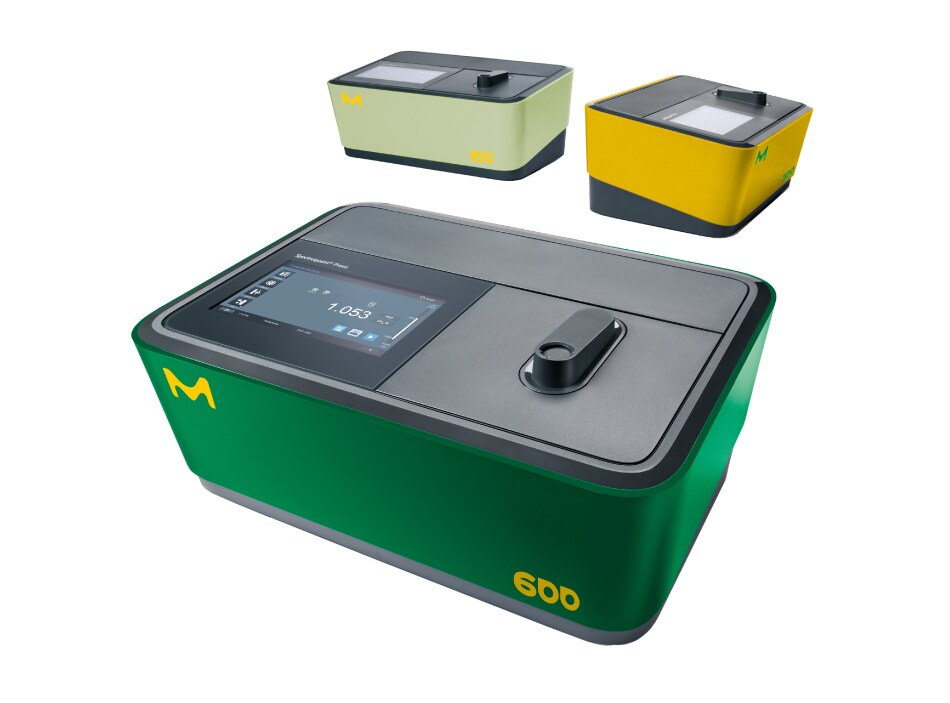
For the measurement one of the following Spectroquant® photometers is necessary:
- Spectroquant® VIS Spectrophotometer Prove 100 plus (173026)
- Spectroquant® UV/VIS Spectrophotometer Prove 300 plus (173027)
- Spectroquant® UV/VIS Spectrophotometer Prove 600 plus (173028)
- Spectroquant® Colorimeter Move 100 (1.73632)
Note: Also, legacy Spectroquant® instruments are suitable.
Software for Data Transfer
Optional Spectroquant® Prove Connect to LIMS software package (Y.11086) to transfer your data into an existing LIMS system.
Instrument Accessories
- Rectangular cells 10 mm (1.14946)
Other Reagents and Accessories
- Calcium acetate for soil analysis (1.09325)
- Water suitable for UV/Vis spectroscopy, EMSURE® (1.16754)
- Acetic acid 100 % for analysis (1.00063)
- Analytical balance
- Standard laboratory glassware (e.g., glass beakers) and pipettes
- Shaker or stirring plate
- sieve
- Spatula
- Drying kiln
- Charcoal activated for soil test
- Folded filter
Analytical Procedure
For more information on the measurement, see the packaging insert for the test.
Reagent Preparation
Calcium acetate lactate (CAL) extraction solution:
- Dissolve 15.4 g calcium lactate for soil analysis and 15.4 g calcium acetate for soil analysis separately in 300 mL of water for analysis whilst warming.
- Combine the two solutions in a 1-L volumetric flask and add 17.9 mL acetic acid 100%.
- Allow to cool, make up to the mark with water for analysis and mix well.
Sample Preparation
- Air-dry the soil sample, subsequent to removing course particles such as stones and plant material.
- Sieve the sample through 2 mm mesh.
- Place 5 g of sample in an Erlenmeyer flask of approx. 300 mL volume and add 100 mL of extraction solution.
- Shake the closed flask for 90 minutes at 175 shakes per minute.
- Filter the extract through a folded filter and dispose of the first 10 mL filtrate.
Using Cat. No. 1.14842: Procedure and Measurement
Determine with the above-mentioned test kits as P2O5. Samples containing more than 14 mg/L P2O5 should be diluted with extraction solution. If the extract has a yellow color, it should be measured, without the addition of reagent, as a blank and the result subtracted from the sample value. Measurement should be carried out in 10-mm rectangular cells against a blank comprising extraction solution and reagents in equal proportions.
For more information on the measurement, see the packaging insert for the test..
Procedure
- Pipette 5.0 mL Pretreated sample into a test tube.
- Add 1.2 mL Reagent PO4-1 with a pipette and mix.
- Fill the sample into a rectangular cell and measure in the photometer.
Measurement
- Certain photometers may require a blank (preparation as per measurement sample, but with distilled water instead of sample).
- For photometric measurement the cells must be clean. Wipe, if necessary, with a clean dry cloth.
- Measurement of turbid solutions yields false-high readings.
- The pH of the measurement solution must be within the range 0.5 - 1.0.
- The color of the measurement solution remains stable for at least 60 min.
Hints for Measurement
- It is recommended to zero the method for each new working day. To do this, open the method by inserting the barcode, tap the <Settings> button and select the <ZERO ADJUSTMENT> menu item. Fill the same cell which will be used for the sample measurement with distilled water. After prompting, insert the filled rectangular cell into the cell compartment. The zero adjustment is performed automatically. Confirm the performance of the zero-adjustment procedure by clicking on <OK>.
- After the zero adjustment, fill the measurement sample into the same or a matched rectangular cell and insert the cell into the cell compartment. The measurement starts automatically.
Hint: The above written measurement description is only valid for the Spectroquant® Prove (plus) series photometer. If a different instrument is used, please consult the corresponding instrument manual for more details on how to perform the measurement.
Analytical Quality Assurance
Analytical quality assurance (AQA) is recommended before each measurement series.
To check the photometric measurement system (test reagents, measurement device, handling) and the mode of working, a diluted phosphate standard solution containing 15.0 mg/L PO4-P (46.0 mg/l PO43-) can be used.
Sample-dependent interferences (matrix effects) can be determined by means of standard addition or dilution.
To view additional notes, visit SigmaAldrich.com/qa-test-kits.
Calculation
Phosphate content in mg/kg P2O5 = (analysis value in mg/L P2O5 x 100)/(weight of sample in g)