
Skip to Content
Merck
CN

D68401

2,4-Dichloro-1-nitrobenzene

97%

Synonym(s):

1,3-Dichloro-4-nitrobenzene, asym.-Nitro-m-dichlorobenzene

Sign In to View Organizational & Contract Pricing.

Select a Size


About This Item

Linear Formula:
Cl2C6H3NO2
CAS Number:
Molecular Weight:
192.00
EC Number:
210-248-3
UNSPSC Code:
12352100
PubChem Substance ID:
Beilstein/REAXYS Number:
1451655
MDL number:
Assay:
97%
Form:
solid
Technical Service
Need help? Our team of experienced scientists is here for you.
Let Us Assist
Technical Service
Need help? Our team of experienced scientists is here for you.
Let Us Assist

assay

97%

form

solid

bp

258 °C (lit.)

mp

29-32 °C (lit.)

SMILES string

[O-][N+](=O)c1ccc(Cl)cc1Cl

InChI

1S/C6H3Cl2NO2/c7-4-1-2-6(9(10)11)5(8)3-4/h1-3H

InChI key

QUIMTLZDMCNYGY-UHFFFAOYSA-N
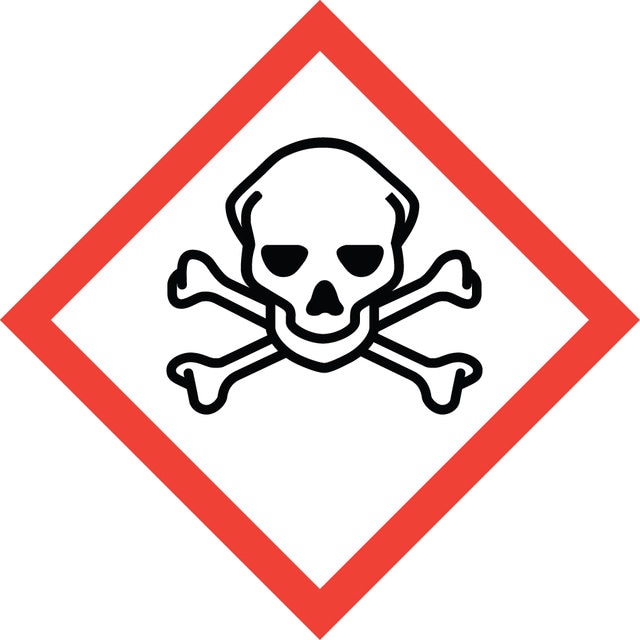
signalword

Danger

Hazard Classifications

Acute Tox. 3 Dermal - Acute Tox. 4 Oral - Aquatic Chronic 2 - Carc. 1B - Muta. 2 - Skin Sens. 1B

Storage Class

6.1C - Combustible acute toxic Cat.3 / toxic compounds or compounds which causing chronic effects

wgk

WGK 3

ppe

dust mask type N95 (US), Eyeshields, Gloves

Regulatory Information

新产品

This item has


Choose from one of the most recent versions:

Certificates of Analysis (COA)

Lot/Batch Number

Don't see the Right Version?

If you require a particular version, you can look up a specific certificate by the Lot or Batch number.

Already Own This Product?

Find documentation for the products that you have recently purchased in the Document Library.

Visit the Document Library

Maja Aleksic et al.
Toxicology in vitro : an international journal published in association with BIBRA, 22(5), 1169-1176 (2008-04-29)
A large proportion of allergic skin reactions are considered to be the result of skin exposure to small organic chemicals that possess the intrinsic ability to covalently modify skin proteins, either directly or following activation. In the absence of information
Makoto Ohnishi et al.
The Journal of toxicological sciences, 34(2), 233-237 (2009-04-02)
Oral administration of 2,4-dichloro-1-nitrobenzene (2,4-DCNB) causes kidney tumors in the rat. The objective of the present study was to identify the chemical structure of 2,4-DCNB metabolites in urine. Urine from 2,4-DCNB fed rats was more yellow than urine from control
P A Botham et al.
The British journal of dermatology, 117(1), 1-9 (1987-07-01)
The fate of 2,4-dinitrochlorobenzene, a potent contact sensitizing chemical, and 2,4-dichloronitrobenzene, a non-sensitizer, was compared following their application to the skin of BALB/c mice. Although both chemicals were able to bind to protein in vitro and were capable of being
Hirokazu Kano et al.
Archives of toxicology, 86(11), 1763-1772 (2012-06-26)
Carcinogenicity and chronic toxicity of 2,4-dichloro-1-nitrobenzene (2,4-DCNB) were examined by dietary administration to F344/DuCrj rats and Crj:BDF(1) mice of both sexes for 2 years. Dietary administration commenced when the animals were 6 weeks old. The dietary concentration of 2,4-DCNB was 0 (control)
Bruno Miguel Neves et al.
Toxicology letters, 177(1), 74-82 (2008-02-19)
The development of non-animal methods for skin sensitization testing is an urgent challenge. Some of the most promising in vitro approaches are based on the analysis of phenotypical and functional modifications induced by sensitizers in dendritic cell models. In this

Global Trade Item Number

SKUGTIN
D68401-25G04061832108940
D68401-100G04061833587935

Our team of scientists has experience in all areas of research including Life Science, Material Science, Chemical Synthesis, Chromatography, Analytical and many others.

Contact Technical Service

