
Photometric Determination of Boron in Soil By Azomethine H or Curcumin Methods
Introduction
The determination of boron in soil is important for assessing soil fertility and plant-available micronutrient levels, particularly in agricultural systems where both deficiency and excess can impact crop performance. Boron is typically present in soils at concentrations ranging from approximately 5 to 150 mg/kg, with plant-available levels required to be maintained within a narrow range to avoid deficiency or toxicity.1
In soil systems, boron predominantly exists as boric acid or borate species, with its availability influenced by factors such as soil pH, texture, and organic matter content. Plants take up soil boron in the form of boric acid (H₃BO₃) under acidic conditions or as tetrahydroxyborate [B(OH)₄]⁻ at neutral to alkaline pH. Accurate quantification of this fraction is therefore necessary to evaluate boron availability across different soil matrices.2
A variety of analytical methods are available for boron determination, including ICP, AAS, and mass spectrometry techniques. However, these often require expensive instrumentation and complex sample preparation. In contrast, spectrophotometric methods are widely used for routine analysis due to their simplicity, low cost, and availability. These methods are based on the formation of colored complexes between boron species and specific reagents, with azomethine H and curcumin among the most commonly applied.3
Experimental
This application note details the photometric determination of boron in soils, using the curcumin method, after its extraction.
Method
Azomethine H method (used in Boron Cell Test 1.00826): In a weakly acidic solution borate reacts with azomethine H to form a yellow compound that is determined photometrically.
The method is analogous to DIN 38405-17.
Curcumin method (used in Boron Test 1.14839): In acidic solution borate ions react with a diol to form chelates that are selectively extracted. In the extract the chelates react with curcumin to form a red complex that is determined photometrically.
Measuring Range
Applicable Sample
Soil samples
Reagents, Instruments, and Materials
Test /Reagent Kit(s)
For the measurement one of the following Spectroquant® test kits is necessary.
*not compatible with Move 100
Instrument(s) & Devices
For the measurement one of the following Spectroquant® photometers is necessary:
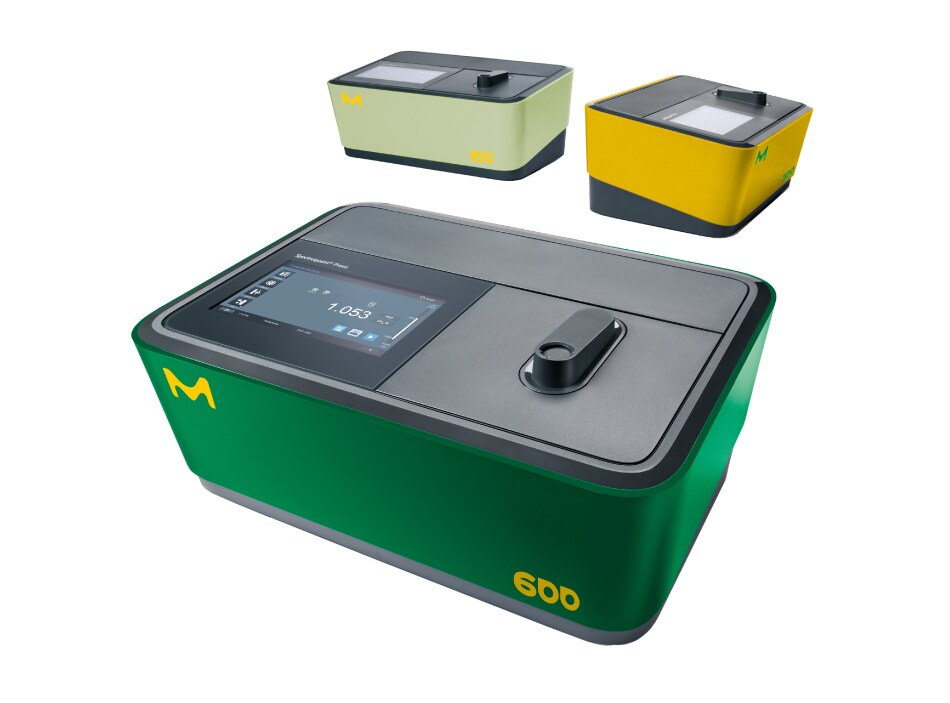
- Spectroquant® VIS Spectrophotometer Prove 100 plus (1.73026)
- Spectroquant® UV/VIS Spectrophotometer Prove 300 plus (1.73027)
- Spectroquant® UV/VIS Spectrophotometer Prove 600 plus (1.73028)
- Spectroquant® Colorimeter Move 100 (1.73632)
Note: Also, legacy Spectroquant® instruments are suitable.
Software for Data Transfer
Optional Spectroquant® Prove Connect to LIMS software package (Y.11086) to transfer your data into an existing LIMS system.
Instrument Accessories
Other Reagents and Accessories
- Water for analysis (1.16754)
- Acetic acid 100 % for analysis (1.00063)
- Ammonium nitrate for analysis (1.01188)
- Ammonium fluoride for analysis (1.01164)
- Titriplex® III for analysis (1.08418)
- Nitric acid 0.1 mol/L (1.09964)
- Analytical balance
- Standard laboratory glassware (e.g., glass beakers) and pipettes
- Sieve
- Polyethylene bag
- Water bath
- Folded filter
Analytical Procedure
Extraction Solution
- Dissolve 6 g acetic acid 100 % for analysis, 10 g ammonium nitrate for analysis, 0.28 g ammonium fluoride for analysis, 0.19 g Titriplex® III for analysis and 65 mL 0.1 M nitric acid with water for analysis in a 500-mL volumetric flask, mix and fill up to volume with water for analysis.
Sample Preparation
- Place 20 g of dried and sieved sample of soil in a polyethylene bag (alternative to glass due to the B - content) with 40 mL extraction solution in a boiling water bath for 5 minutes.
- After cooling, filter through a folded filter. If the filtrate is not clear, it should be re-filtered.
Using Cat. No. 1.00826: Procedure and Measurement
For more information on the measurement, see the packaging insert for the test.
Procedure
- Pipette 1.0 mL Reagent B-1K into a reaction cell and mix.
- Add 4.0 mL Pretreated sample with pipette, close the cell, and shake (15 - 40 °C) until the reagent is completely dissolved.
- Leave to stand for 60 min (reaction time), then measure the sample in the photometer.
Measurement
- For photometric measurement the cells must be clean. Wipe, if necessary, with a clean dry cloth.
- Measurement of turbid solutions yields false-high readings.
- The pH of the measurement solution must be within the range 5.2 - 6.0.
- The color of the measurement solution remains stable for at least 60 min after the end of the reaction time stated above.
- The reaction cell contains a lyophilized reagent whose appearance and shape may change during storage. This has no effect on the functionality of the boron cell test and does not represent a reduction in quality.
Hints for Measurement
- It is recommended to zero the method each new working day. To do this, open the method, either by manually selecting the method or by inserting a barcoded cell. Tap the <Settings> button and select the <ZERO ADJUSTMENT> menu item. After prompting, insert the 16 mm zero cell through the corresponding opening. The zero adjustment is performed automatically. Confirm the performance of the zero-adjustment procedure by clicking on <OK>.
- After the zero has been performed, insert the barcoded Spectroquant® round cell through the corresponding opening, ensuring that the white position mark on the cell is aligned with the positioning mark on the spectrophotometer. The measurement starts automatically.
- Read off the result in mg/L from the display.
Hint: The above written measurement description is only valid for the Spectroquant® Prove (plus) series photometer. If a different instrument is used, please consult the corresponding instrument manual for more details on how to perform the measurement.
Using Cat. No. 1.14839: Procedure and Measurement
For more information on the measurement see the packaging insert for the test.
Procedure
- Pipette 5.0 mL Pretreated sample into a test tube with screw cap.
- Add 1.0 ml Reagent B-1 with a pipette and mix. The pH must be below 1. Check with MQuant® pH-indicator strips. Adjust the pH, if necessary, by adding reagent B-1 dropwise.
- Add 1.5 mL Reagent B-2 carefully with a pipette (Attention! The reagent contains chloroform!), close the test tube tightly, and shake vigorously for 1 min à lower (organic) phase = extract
- Withdraw 0.50 mL Extract with pipette and transfer to the second test tube.
- Add 0.80 mL Reagent B-3 (Hold the bottle vertically while adding the reagent!) to the second tube with pipette, close tightly, and mix.
- Add 4 drops Reagent B-4 (Hold the bottle vertically while adding the reagent!) to the second tube, close tightly, and mix.
- Carefully (Attention! The reagent contains concentrated sulfuric acid! Wear eye protection!) add 18 drops Reagent B-5 (Hold the bottle vertically while adding the reagent! The bottle containing the reagent B-5 may become discolored. Any discoloration has no negative impact on the functionality of the test.) to the second tube, close tightly, and mix.
- Leave to stand for 12 min (reaction time A).
- Add 6.0 mL Reagent B-6 to the second test tube with pipette, close tightly, and mix.
- Leave to stand for 2 min (reaction time B), then fill the sample into a 10-mm cell, and measure in the photometer.
Note: Due to the temperature dependence of the color reaction, both the sample and the reagents should have a temperature of at least 20 °C.
Measurement
- Certain photometers may require a blank (preparation as per measurement sample, but with distilled water instead of sample).
- The blank is yellow in color. Certain photometers may require a blank (preparation as per measurement sample, but with distilled water instead of sample).
- For photometric measurement the cells must be clean. Wipe, if necessary, with a clean dry cloth.
- Measurement of turbid solutions yields false-high readings.
- The color of the measurement solution remains stable for at least 60 min after the end of the reaction time B stated above.
Hints for Measurement
- It is recommended to zero the method for each new working day. To do this, open the method by inserting the barcode, tap the <Settings> button and select the <ZERO ADJUSTMENT> menu item. Fill the same cell which will be used for the sample measurement with distilled water. After prompting, insert the filled rectangular cell into the cell compartment. The zero adjustment is performed automatically. Confirm the performance of the zero-adjustment procedure by clicking on <OK>.
- After the zero adjustment, fill the measurement sample into the same or a matched rectangular cell and insert the cell into the cell compartment. The measurement starts automatically.
- Read off the result in mg/L from the display.
Hint: The above written measurement description is only valid for the Spectroquant® Prove (plus) series photometer. If a different instrument is used, please consult the corresponding instrument manual for more details on how to perform the measurement.
Analytical Quality Assurance
Analytical quality assurance (AQA) is recommended before each measurement series.
To check the photometric measurement system (test reagents, measurement device, handling) and the mode of working, a diluted boron standard solution containing 1.00 mg/L B or 0.400 mg/L B, respectively can be used.
Sample-dependent interferences (matrix effects) can be determined by means of standard addition or dilution.
To view additional notes, visit SigmaAldrich.com/qa-test-kits.
Calculation
Boron content in mg/kg B = analysis value in mg/L B x 2