Organoid Immunohistochemistry with Recombinant Antibodies
Organoids are three-dimensional structures generated from either pluripotent stem cells or adult stem cells that contain multiple cell types that interact with each other and grow into functional “miniature organs”. Organoids are therefore ideal for applications like organ development, disease modeling, and drug testing. They can be engineered to replicate specific disease conditions, helping researchers study the progression of disease and design novel therapeutic modalities. Organoids can serve as vital tools to aid in our understanding of how genetic and environmental factors affect development as well as for the design and development of personalized treatments.
Our ZooMAb® recombinant monoclonal antibodies, produced using a proprietary B-cell immortalization technique and high-yield expression system, are vital for characterizing organoids. They provide consistent performance across different experimental conditions and offer high specificity and sensitivity that allows for precise detection of target proteins in biological samples. ZooMAb® antibodies are offered in biocide-free and animal product-free format and are ideal as a greener alternative to traditional antibodies; they are supplied in a lyophilized (freeze-dried) format that increases stability and enables ambient shipping, reducing costs, and environmental impact.
The future of organoid research is bright with rapid development in recombinant antibody technology to study disease modeling, drug testing, developmental abnormalities, and immunotherapeutic applications.
Section Overview
- Using ZooMAb® Antibodies to Study Organoids
- Immunohistochemistry on Organoids
- Protocol for Harvesting, Embedding, Sectioning, and Staining of Organoids
- Selected Organoid IHC Images
- Organoid Staining Practical Tips
- Antibodies Validated for Organoid Use
Using ZooMAb® Antibodies to Study Organoids
ZooMAb® recombinant antibodies can be used to identify specific cell types during organoid development, study time-dependent expression of specific proteins, and analyze the interaction of multiple cell types during development. Recombinant antibodies are also helpful in evaluating the efficacy of therapeutic agents, such as immune checkpoint inhibitors that target abnormal pathways, and in designing personalized therapies.
Immunohistochemistry on Organoids
Immunohistochemistry (IHC) is one of the most used techniques to evaluate organoid composition and is useful for studying the location, distribution, and interaction of specific proteins while preserving their 3D structure. It is a non-destructive technique that does not disrupt the organoid’s complex architecture and allows for detection of proteins in their near native state and offers a more accurate modeling of 3D structures. IHC also helps to compare protein expression patterns in organoids with native tissues.
In organoids derived from disease tissues, IHC technique can highlight differences in protein expression that correlates with disease progression and assess response to therapeutic intervention. Another advantage of IHC technique is that by using serial sections of the same organoid, researchers can apply different antibodies to multiple slides and obtain more comprehensive datasets.
Protocol for Harvesting, Embedding, Sectioning, and Staining of Organoids
Materials
- Cultured Organoids
- Corning® Matrigel® (CLS354234)
- Ca2+ and Mg2+ free Dulbecco's Phosphate Buffered Saline (TMS-012)
- Corning® Cell Recovery Solution (CLS354253)
- Paraformaldehyde (P6148)
- Triton® X-100 (X100)
- Tris-Buffered Saline with Tween-20 (T9039)
- PBS
- Tissue-Tek® Cryomold®
- Tissue-Tek® OCT Compound
- PAP Pen (Z672548)
- Normal Serum (Same Species as Secondary Antibody)
- Primary and Secondary Antibodies
- DAPI (D9542)
Harvesting Organoids
Remove media from the wells. Wash Corning® Matrigel® domes with 500 µl of Ca2+ and Mg2+ free Dulbecco's Phosphate Buffered Saline (DPBS) at room temperature and remove DPBS.
- Add 500 µl of full-strength Corning® Cell Recovery Solution into wells containing 50 µl Matrigel® dome with organoids (Matrigel® to Cell Recovery Solution ratio 1:10). Scrape off the Matrigel® dome containing organoids with a P1000 pipette tip and transfer Organoid-Matrigel®-Cell Recovery Solution mixture into a 1.5 mL tube. Organoids from 3 wells of 24-well plate may be combined into single 1.5 mL tube.
- Place the tube containing Organoid-Matrigel®-Cell Recovery Solution on ice for about 1 hour. Invert the tube 4 to 5 times every 10 to 15 minutes to facilitate digestion of Matrigel®.
- Centrifuge the tube at 10,000 x g for 1 min and remove as much of the supernatant as possible. Now the organoids can be used for embedding for sectioning, RNA isolation, or preparation of cell lysates for Western Blotting or ELISA applications.
Embedding Organoids
- Fix organoid with 4% Paraformaldehyde (PFA) at 4 °C in Eppendorf tubes. The volume of 4% PFA added will depend on the amount of organoids used.
- Fix organoids for 30 min at 4 °C (or on ice).
- NOTE: Organoids may become very sticky post fixation. Hence, it is recommended to rinse pipette tips with 0.1% BSA before pipetting the fixed organoids. Alternatively, you can also rinse the pipette tip with 0.2% Triton® X-100 in 1x Tris-Buffered Saline with Tween-20 (TBST).
- Remove 4% PFA and wash organoids 3 times with 1X Phosphate-Buffered Saline (PBS). Organoids can be kept at 4 °C for up to a month before staining.
- Remove PBS and immerse organoids for overnight in 30% sucrose solution in 1X PBS.
- Remove 30% sucrose solution carefully without disturbing the organoid pellet.
- Cut the tip of a P200 pipette tip so organoid shape will not be disturbed during the transferring process.
Sectioning Organoids
- Carefully transfer organoid to the center of a Cryomold®. (Cryomold® from Tissue-Tek® may be used). Remove any excess 30% sucrose solution with an uncut pipette tip.
- Add optimal cutting temperature (OCT) reagent slowly starting on one side of the Cryomold® to avoid disturbing the organoids clumps in the center. Let the OCT reagent equilibrate with the organoids at room temperature for at least 20 to 30 minutes. This equilibration step is important to prevent cracking of the section during sectioning.
- Place the Cryomold® containing organoid either on dry ice or directly at -80 °C to freeze the block. Section when needed. Organoids embedded in OCT can be kept at -80 °C for up to 4 to 5 years when sealed properly in the box.
- When needed, section organoids at 8-10 mm thickness. Keep sections on slides at -80 °C.
- Thaw slides at room temperature for 5 minutes prior to staining.
- Permeabilize the slides containing organoid sections with 0.3% Triton® X-100 in 1X TBST for 10 min. Carefully wash the slides in a plastic Coplin jar with 1X TBST. Repeat 3 times.
Staining Organoid Sections
- Draw a circle around the organoid section with a PAP pen to prevent liquid leaking from the slide. This also allows the staining of multiple antibodies on the same slide.
- Block the organoid sections with 5% Normal Serum (use serum from the same species as secondary antibody) in TBST at room temperature for 1-2 hours.
- Prepare primary antibodies or directly conjugated antibodies in Blocking Buffer. Their volume will depend on the section size circled by the PAP pen. Volumes typically range from 50 to 200 mL.
- Remove the Blocking Buffer from wells and add primary antibodies. Incubate overnight at 4 °C.
- Next day, wash 3-5 times with Washing Buffer (1X TBST) for 5-10 minutes each wash. If there are any higher background issues, increasing the washing steps will help minimize this.
- If using unconjugated primary antibodies, prepare secondary antibodies in Washing Buffer, otherwise skip to 22.
- Add secondary antibodies. Incubate at room temperature for 2 to 4 hours.
- Remove secondary antibodies, wash 3-5 times with Washing Buffer for 5-10 minutes each wash.
- Counterstain with DAPI (5 mg/mL in Washing Buffer) for 10-15 minutes.
- Wash 2-3 times with Washing Buffer.
Mount with antifade mounting media and store slides at 4 °C.
Selected Organoid IHC Images
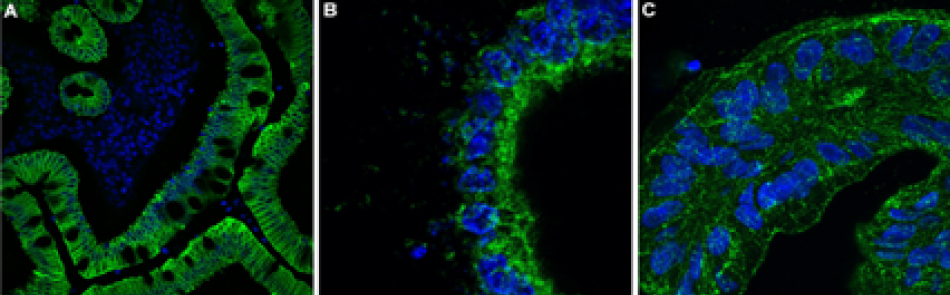
Figure 1.Formalin Fixed Paraffin Embedded (FFPE) human small intestine tissue sections prepared using heat-induced epitope retrieval (HIER) (A); (B) 4% PFA-fixed, frozen proliferative duodenum intestinal organoid (Cat. No. SCC322, 3dGRO® Duodenum Intestinal Organoids, Age 21 (Prep 87-D)); and (C) differentiated duodenum intestinal organoid were treated with permeabilization buffer containing 1% goat serum and 0.3% Triton™ X-100. Immunostaining was performed using a 1:100 dilution of Cat. No. ZRB1599, Anti-Cytokeratin 19, clone 1B12 ZooMAb® Rabbit Monoclonal. Reactivity was detected using Goat Anti-Rabbit IgG-Alexa Fluor™ 488 (Green). Nucleus is stained with DAPI (Blue). Cytoplasmic/membranous staining was observed in glandular cells of human small intestine sections (A). Similar staining was observed in both proliferative duodenum intestinal organoid (B) and differentiated duodenum intestinal organoid (C).

Figure 2.Formalin Fixed Paraffin Embedded (FFPE) human small intestine tissue sections were prepared using heat-induced epitope retrieval (HIER) (A); 4% PFA-fixed, frozen proliferative duodenum intestinal organoid (Cat. No. SCC322, 3dGRO® Duodenum Intestinal Organoids, Age 21 (Prep 87-D)) (B); and differentiated duodenum intestinal organoid were treated with permeabilization buffer containing 1% goat serum and 0.3% Triton™ X-100. Immunostaining was performed using a 1:100 dilution of Cat. No. ZRB1599, Anti-E-Cadherin, clone 1G14 ZooMAb® Rabbit Monoclonal. Reactivity was detected using Goat Anti-Rabbit IgG-Alexa Fluor™ 488 (Green). Nuclei are stained with DAPI (Blue). Cytoplasmic/membranous staining was observed in glandular cells of human small intestine sections (A). Similar staining was observed in both proliferative duodenum intestinal organoid (B) and differentiated duodenum intestinal organoid (C).
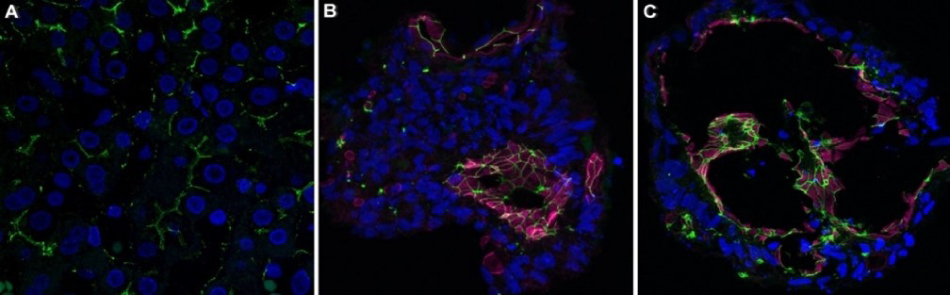
Figure 3.Formalin Fixed Paraffin Embedded (FFPE) human liver tissue sections were prepared using heat-induced epitope retrieval (HIER) (A); 4% PFA-fixed, frozen iPSC-derived liver organoid progenitors (Cat. No. SCC572, 3dGRO® Human iPSC Derived Liver Organoid Progenitors) (B); and mature liver organoids (C) were treated with permeabilization buffer containing 1% goat serum and 0.3% Triton™ X-100. Immunostaining was performed using a 1:100 dilution of Cat. No. ZMS1539, Anti-ZO-1, clone 5G6.1 ZooMAb® Mouse Monoclonal. Reactivity was detected using a Goat Anti-Mouse IgG-Alexa Fluor™ 488 (Green). Nucleus was stained with DAPI (Blue). F-Actin was stained with phalloidin (Magenta). Membranous staining was observed in hepatocyte cell junctions of human liver tissue sections (A). Cell junction staining was observed in iPSC-derived liver organoid progenitors (B) and in mature liver organoids (C).
Organoid Staining Practical Tips
- Organoids are delicate 3D structures. It is best to use cut pipette tips and perform gentle pipetting throughout the process.
- A positive and negative control help give a better evaluation of results.
- It is best to optimize each step of the protocol, as experimental conditions may vary based on the type of organoid and the antibody used.
- Keep Matrigel® on ice to prevent any polymerization.
- Always titrate the antibody to assess the optimal dilution for the specific organoid to reduce background.
- Since organoids tend to sink to the bottom of the tube, invert the tubes gently to obtain a homogeneous suspension of organoids before distributing organoids into replicate wells.
- Organoids can be heterogeneous, and the complex 3D arrangement that makes uniform staining somewhat challenging, so optimizing the permeabilization and incubation periods should be considered. Longer incubation periods may be required due to the density of organoids.