BIOshell™ U/HPLC Columns
Introduction
The BIOshell™ product line showcases advanced U/HPLC columns featuring Fused-Core® technology, also known as superficially porous particles (SPP) or core shell, meticulously designed for the rapid and high-resolution separation of proteins, peptides, oligonucleotides, glycans, and other large molecules. As the pharmaceutical and biotechnology industries evolve, the demand for effective separation techniques to resolve complex structural variants is increasingly critical. BIOshell™ columns are engineered to meet these challenges, providing reliable solutions that enhance the efficiency and effectiveness of laboratory workflows.
Extended pH Stability Columns
BIOshell™ columns are designed to offer extended pH stability, making them suitable for a variety of challenging analytical conditions. For instance, all BIOshell™ ES-C18 and ES-CN (Cyano) columns can withstand low pH environments, remaining stable at pH 1. This feature is particularly advantageous for applications involving acidic mobile phases, where many conventional columns may degrade or lose performance over time. The robust construction and specialized bonding of BIOshell™ columns ensure that they maintain consistent retention times and peak shapes, even under harsh conditions. This stability is crucial for reliable results in biopharmaceutical analysis, where maintaining the integrity of the stationary phase is essential for reproducible separations.
BIOshell™ columns with Positively Charged Surface (PCS) Endcapping
The BIOshell™ columns featuring a positively charged surface (PCS mentioned in phase description), are specifically designed to enhance the separation of negatively charged biomolecule or other basic compounds, such as proteins and nucleic acids. The unique PCS technology provides a strong electrostatic interaction between the column surface and the analytes, leading to improved retention and resolution. This characteristic is particularly beneficial for applications involving complex biological samples, where traditional columns may struggle to achieve optimal separation. The positively charged surface ensures consistent performance across a range of pH conditions, making these columns ideal for various analytical methods in biopharmaceutical research and development. By utilizing PCS columns, researchers can achieve more reliable and reproducible results in their analytical workflows.
Key Features
- Superior Performance: Utilizing superficially porous particle (SPP) technology, BIOshell™ columns deliver faster separations with exceptional efficiency and resolution. This attribute is particularly beneficial for large biomolecule analysis, which requires precise and efficient methods.
- Versatile Applications: BIOshell™ columns are suitable for a wide range of applications, including:
- Top-down analysis of intact proteins, monoclonal antibodies (mAbs), and antibody-drug conjugates (ADCs).
- Bottom-up peptide mapping for primary structure confirmation.
- High-resolution separation of released N- and O-linked glycans. - Temperature Stability: Columns are temperature stable up to 90 °C, making them compatible with various UHPLC, HPLC, and mass spectrometry (MS) applications.
- Reduced Backpressure: The particle design of BIOshell™ columns results in lower backpressure compared to fully porous particles (FPP), enabling seamless integration into existing workflows.
Importance of Correct Pore Size Selection
Selecting the appropriate pore size for chromatography columns is crucial for achieving optimal separation and resolution for a given sample. A general rule of thumb is that the pore size should be at least ten times larger than the Stokes radius of the molecule being analyzed. This attribute ensures that the molecules can freely diffuse into the pores, allowing for effective interaction with the stationary phase, optimal retention, and improved separation.
For example, larger biomolecules of interest, such as antibodies or protein complexes, require columns with larger pore sizes (e.g., 1000 Å) in order to avoid restricted diffusion to facilitate their entry into the pores and separation. Conversely, smaller peptides may be more effectively separated using columns with smaller pore sizes (e.g., 160 Å) and, by that, typically higher surface area. This careful consideration of pore size relative to the molecular size is essential for maximizing resolution and minimizing peak broadening, ultimately leading to more accurate analytical results.
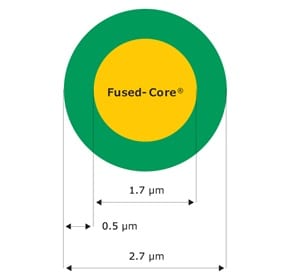
- Pore Size: 1000 Å
- Modifications: C4 & ES-C18, Diphenyl
- Applications: Designed for large biomolecules, providing unrestricted access and improved peak resolution. Ideal for applications involving monoclonal antibodies (mAbs), antibody drug conjugates (ADC) and large protein complexes.
BIOshell™ A400 Protein U/HPLC Columns
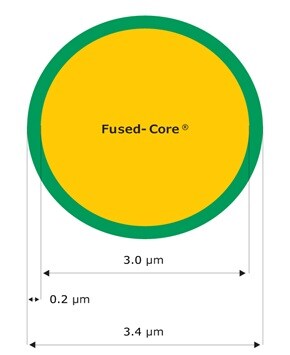
- Pore Size: 400 Å
- Modifications: C4 and ES-C18
- Applications: Facilitates fast separations of proteins with superior peak shape and efficiency. The shallow, porous shell design minimizes mass transfer effects, making it ideal for high-throughput applications.
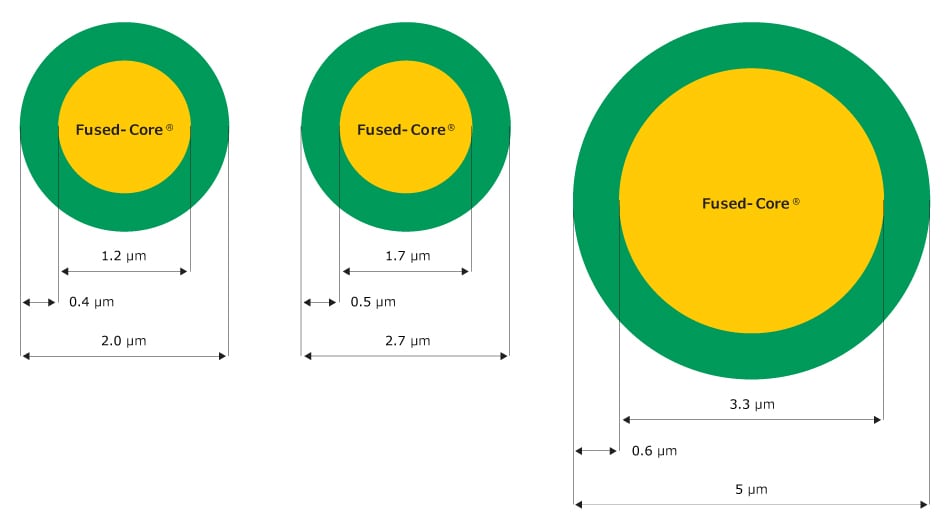
BIOshell™ A160 Peptide U/HPLC Columns
- Pore Size: 160 Å
- Modifications: ES-CN (cyano), ES-C18, PCS-C18, and Phenyl-Hexyl
- Applications: Offers high-resolution peptide separations with various particle sizes, ensuring optimal performance for complex proteomic analyses and post-translational modification studies.
BIOshell™ Glycan U/HPLC Columns
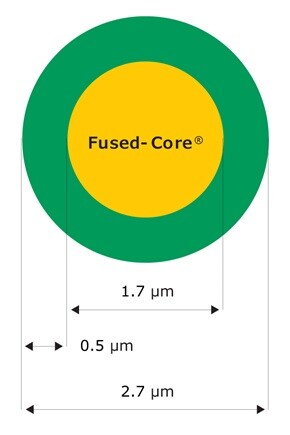
- Pore Size: 90 Å
- Modification: Penta-hydroxy
- Applications: Optimized for the resolution of oligosaccharides through hydrophilic interaction liquid chromatography (HILIC). This column enhances the analysis of glycosylation patterns in biopharmaceuticals.
BIOshell™ Guard Columns
To prevent analytical column fouling from strongly retained compounds, the use of BIOshell™ guard columns is recommended. These ultra-low dispersion columns are simple to install and operate capable of tolerating backpressures up to 1000 bar. These guard columns ensure the longevity and performance of the analytical columns, allowing for more efficient, uninterrupted workflows. Guard columns are available for all BIOshell™ analytical geometries (2.1, 3.0, and 4.6 mm I.D.) and phase chemistry.
Application Areas of BIOshell™ Columns
- Protein purification: Achieve high purity and resolution in the analysis of complex protein samples, critical for biopharmaceutical development.
- Peptide mapping: Confirm primary structures of proteins through effective peptide separation, essential for understanding protein function and interaction.
- Glycan analysis: Resolve complex glycosylation patterns in biotherapeutics, enhancing insights into drug efficacy and safety.
- Oligonucleotide analysis: Resolve impurities, truncation (n-1), and elongation (n+1) species enabling accurate oligo sequence analysis.
Explore BIOshell™ application examples