Separation of polar analytes using supercritical fluid chromatography (SFC) with zwitterionic phase modified Fused-Core® particles
Abstract
This study explores the use of supercritical fluid chromatography (SFC) for the efficient separation of polar analytes (nucleosides) and small peptides using a zwitterionic HILIC HPLC column packed with 2.7 µm superficially porous particles (SPP) in a bioinert column hardware. By optimizing the mobile phase composition and column temperature, the impact of these parameters on the development of efficient SFC methods for biologically relevant polar compounds is demonstrated.
Section overview
Introduction
Supercritical fluid chromatography (SFC) is a powerful analytical technique that typically combines high separation efficiency with reduced organic solvent consumption compared with conventional liquid chromatography (LC). Using carbon dioxide as the primary component of the mobile phase, SFC offers low mobile-phase viscosity and high compressibility enabling rapid mass transfer, high linear velocities, and excellent chromatographic performance while reducing the consumption of organic solvents.
To enhance the elution of polar analytes such as peptides and other biologically relevant compounds, organic cosolvents are introduced to increase the polarity and elution strength of the mobile phase. Without sufficient cosolvent, strong interactions between analytes and the stationary phase can lead to excessive retention and poor peak shapes. Ethanol (LogP = –0.32) and methanol (LogP = –0.82) are commonly used cosolvents in supercritical fluid chromatography. Owing to its higher polarity, methanol provides greater solvent strength for many hydrophilic analytes, although the overall effect depends on the analyte and stationary phase. The ratio of carbon dioxide to cosolvent plays a critical role in determining chromatographic behavior by influencing the physicochemical properties of the mobile phase, including viscosity and diffusivity. Low cosolvent percentages generally result in lower viscosity and higher diffusivity, allowing rapid mass transfer and efficient separations. Conversely, increasing the cosolvent content raises mobile-phase viscosity and reduces diffusivity, which may compromise separation efficiency under certain conditions. Therefore, optimizing the mobile phase composition by balancing the proportions of carbon dioxide and cosolvent is essential to achieve adequate elution of polar compounds while maintaining high chromatographic performance. Aqueous buffer salts can be incorporated into the organic cosolvent to further increase elution strength, enhance cosolvent-analyte solubility, and reduce secondary interactions with charged functional groups on the stationary phase. Previous preliminary studies (results not shown) have indicated that buffer concentration significantly influences the retention of polar and charged analytes, enabling the exploitation of ion-exchange mechanisms.
In this study, 2.7 µm Fused-Core® superficially porous particles (SPP) with a 160 Å pore size, functionalized with phosphorylcholine (PC) zwitterionic ligands (Figure 1), were packed into a 150 × 4.6 mm INERTProve™ bioinert column hardware. Although primarily designed for hydrophilic interaction liquid chromatography (HILIC), this column also enables effective separation of polar analytes by SFC when coupled to a photodiode array detector. The combination of the low viscosity of carbon dioxide and the high-efficiency Fused-Core® particles enabled fast separations while maintaining relatively low system backpressure. The study investigated suitable mobile phase compositions with varying proportions of carbon dioxide and methanol as the organic cosolvent, as well as different aqueous buffer concentrations in the cosolvent. Additionally, temperature was also evaluated because it influences mobile phase properties and chromatographic selectivity, making it an important parameter to be considered during method development for SFC separations of polar compounds. A polar test mix (nucleosides) and a small peptide test mix were used as model probe analytes to evaluate chromatographic performance.
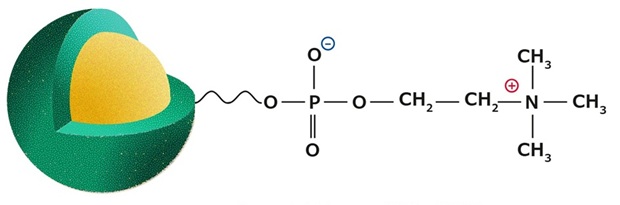
Figure 1.Illustration of the Ascentis® Express ZIC®-cHILIC stationary phase.
Experimental
Standard preparation
Individual stock solutions of each analyte were prepared at 1 mg/mL in methanol. Aliquots of each stock were then combined and diluted with the organic portion of the mobile phase to produce a mixed working solutions in which each analyte was present at a final concentration of 125 µg/mL (Table 1).
The following test mixtures were prepared:
- Polar test mix stock solution (nucleosides): 2-deoxyuridine, uridine, benzyltrimethylammonium chloride (BTMA), cytidine, phenyldodecane (void marker).
- Peptide mix stock solution: angiotensin III, angiotensin II, somatostatin, bradykinin, phenyldodecane (void marker).
SFC method
Standard solutions were analyzed using an Ascentis® Express 160 Å ZIC®-cHILIC (2.7 µm) column housed in a INERTProve™ bioinert hardware. The chromatographic conditions are summarized in Table 1.
Results and discussion
To evaluate the performance of SFC for the separation of hydrophilic compounds, a polar test mix with nucleosides and a mix with four small peptides were analyzed using a zwitterionic HILIC column packed with 2.7 µm Fused-Core® particles in a bioinert column hardware.
The polar analytes investigated in this study are listed in Table 2 together with their respective hydrophilicity values (LogP). Phenyldodecane was used as the void marker. The effects of mobile phase composition, particularly the ratio of carbon dioxide to the organic cosolvent, and buffer concentration was investigated under varying injection volumes. Additionally, the effect of column temperature on chromatographic resolution and selectivity was evaluated during the method development.
Buffer and mobile phase optimization
Initial trials using 5% aqueous 5 mM ammonium acetate in methanol as the cosolvent resulted in excessive retention and poor peak shapes for analytes such as cytidine and benzyltrimethylammonium chloride (BTMA) (data not shown). To improve chromatographic performance, the buffer concentration was increased to 260 mM ammonium acetate in water in the cosolvent while still maintaining a 5% aqueous buffer content in methanol. The higher buffer concentration was intended to suppress secondary ionic interactions between the zwitterionic stationary phase and analytes.
Furthermore, optimization of the appropriate carbon dioxide-to-organic cosolvent ratio was critical to balance chromatographic resolution of all analytes with the favorable mass transfer benefits associated with CO₂. Figure 2 illustrates the effect of different injection volumes (0.5–5 µL) on theoretical plate number (N) at two mobile phase compositions, using 5% aqueous 260 mM ammonium acetate in methanol as the cosolvent.
At 80% cosolvent (Figure 2A), 2-deoxyuridine and benzyl trimethylammonium chloride coeluted, indicating that the high cosolvent (buffer) concentration reduced chromatographic selectivity and led to the early elution of the quaternary ammonium compound (BTMA). In addition, increasing the injection volume resulted in a decline in chromatographic efficiency for both 2-deoxyuridine and BTMA. Reducing the cosolvent to 45% (Figure 2B) increased the overall chromatographic efficiency significantly, as indicated by higher theoretical plate numbers (N), restored baseline separation, and resulted in higher and more consistent efficiency for all compounds.
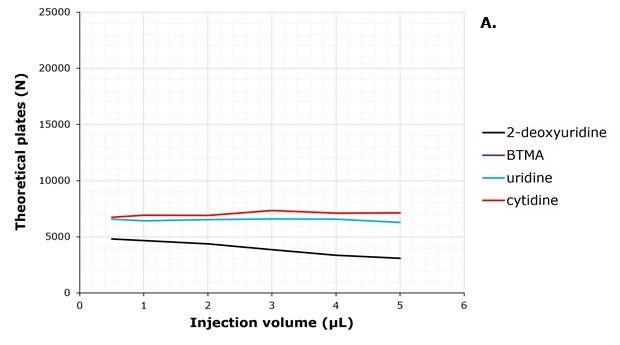
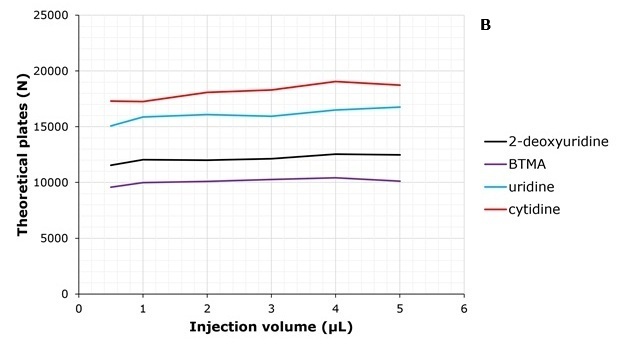
Figure 2.Effect of injection volumes on theoretical plate number (N) at two mobile phase compositions using 5% aqueous 260 mM ammonium acetate in methanol as the cosolvent. (A) Mobile phase containing 80% cosolvent with 20% carbon dioxide (B) Mobile phase containing 45% cosolvent and 55% carbon dioxide.
*Note BTMA and 2-deoxyuridine coelute under the 80% cosolvent condition.
Temperature optimization
Notably, decreasing the injection volume had little impact on the theoretical plate count number, an effect commonly observed in HILIC separations, where large injection volumes may disrupt the water-enriched layer on the stationary phase, leading to poor peak shape and reduced efficiency.1,2 Temperature also had a significant impact on the SFC separation. Figure 3 illustrates the separation of the polar test mix at varying oven temperatures. At ambient temperature, 2-deoxyuridine and BTMA were not resolved. However, increasing the column temperature to 30 °C enabled the detection of both peaks, although the resolution remained below 0.5. Increasing the temperature further to 40 °C improved resolution to 1.37, and at 60 °C, a resolution of 3.8 was achieved. As the temperature increased, the viscosity of the CO₂–methanol mobile phase decreased, contributing to improved mass transfer and sharper peaks.
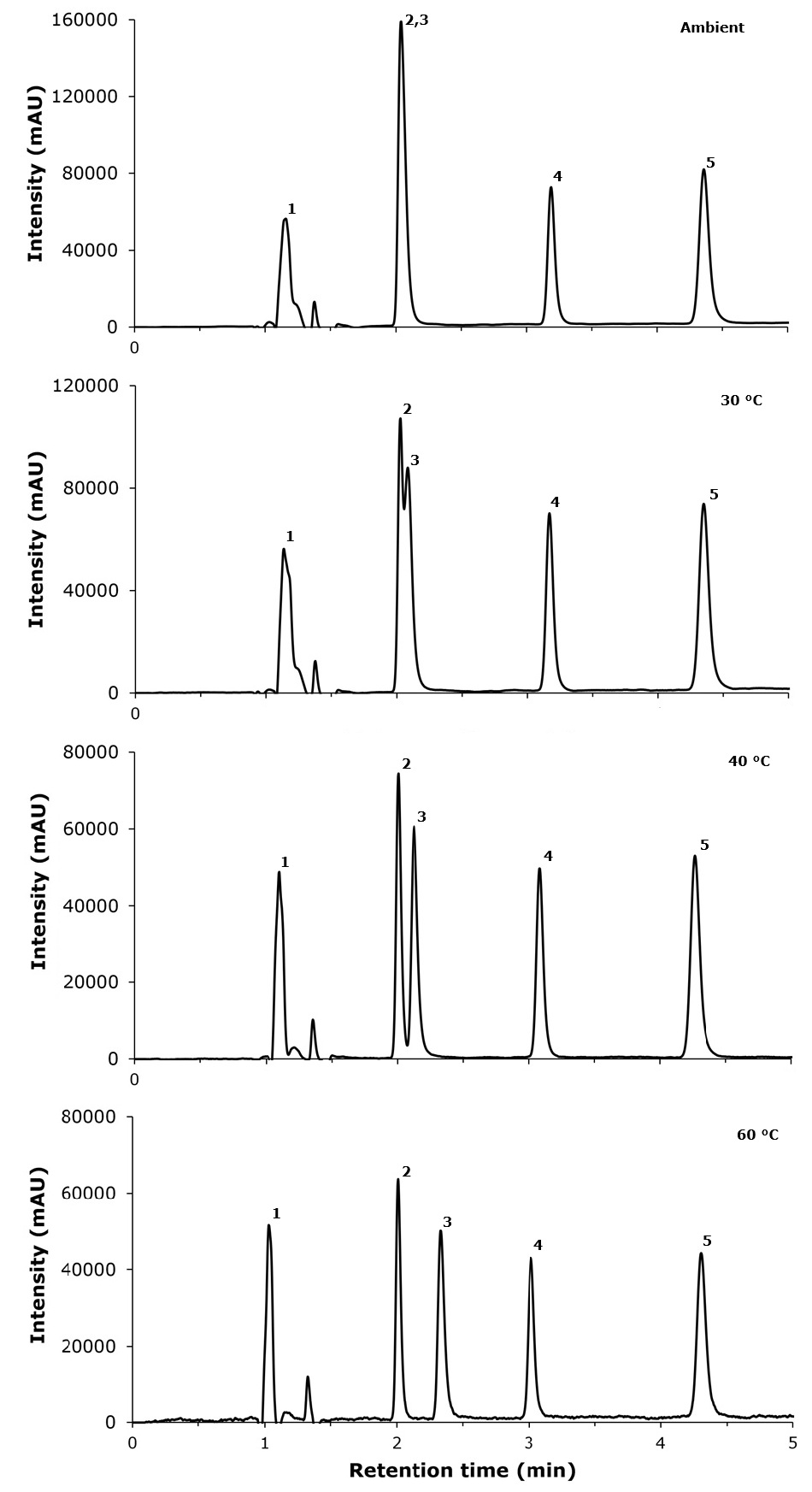
Figure 3.Separations of polar analytes on an Ascentis® Express ZIC®-cHILIC (2.7 µm) INERTProve™ 150 x 4.6 mm column at room temperature (ambient), 30, 40, and 60 °C using a mobile phase containing 45% cosolvent and 55% carbon dioxide. (Peak IDs: 1. phenyldodecane, 2. 2-deoxyuridine, 3. BTMA, 4. uridine, 5. cytidine)
Separation of peptide mix
For the second part of this study, peptides (angiotensin III, angiotensin II, somatostatin, and bradykinin) were selected to represent a diverse range of polarities, charges, and molecular weights (Table 3), making them suitable model analyte for evaluating the performance of SFC in the separation of biologically relevant polar compounds. Their LogP values range from moderately hydrophilic (angiotensin III, LogP ≈ –0.5) to highly hydrophilic (bradykinin, LogP ≈ –4.8), reflecting increasing aqueous solubility and generally decreasing affinity for non-polar phases such as C18. This range of hydrophilicity provided a suitable test system for evaluating CO₂-based separations and assessing mobile phase optimization.
The separation of the peptides was primarily driven by differences in their hydrophilicity, as reflected in the reverse elution order. Angiotensin III and angiotensin II eluted within the first two minutes, followed by somatostatin, while bradykinin (the most hydrophilic peptide) eluted last. Phenyldodecane was again used as the void marker (Figure 4).
Angiotensin II and angiotensin III differ by a single N-terminal aspartate residue, making angiotensin II considerably more polar due to the presence of aspartic acid (Asp).
Under the selected mobile phase conditions, these peptides exhibited the greatest temperature-dependent selectivity. At 30 °C, the two peptides co-eluted. As the temperature increased to 45 °C and 60 °C, the resolution (Rs) improved to 0.77 and 1.38, respectively, reflecting partial and near-baseline resolution. At 85 °C, the resolution further increased to 1.67, achieving baseline resolution of the two peptides. This trend highlights how increasing temperature decreases the viscosity of the CO₂–methanol mobile phase, thereby increasing diffusivity. The resulting improvement in mass transfer influences selectivity and can ultimately enhance separation performance in CO₂-based chromatographic systems.
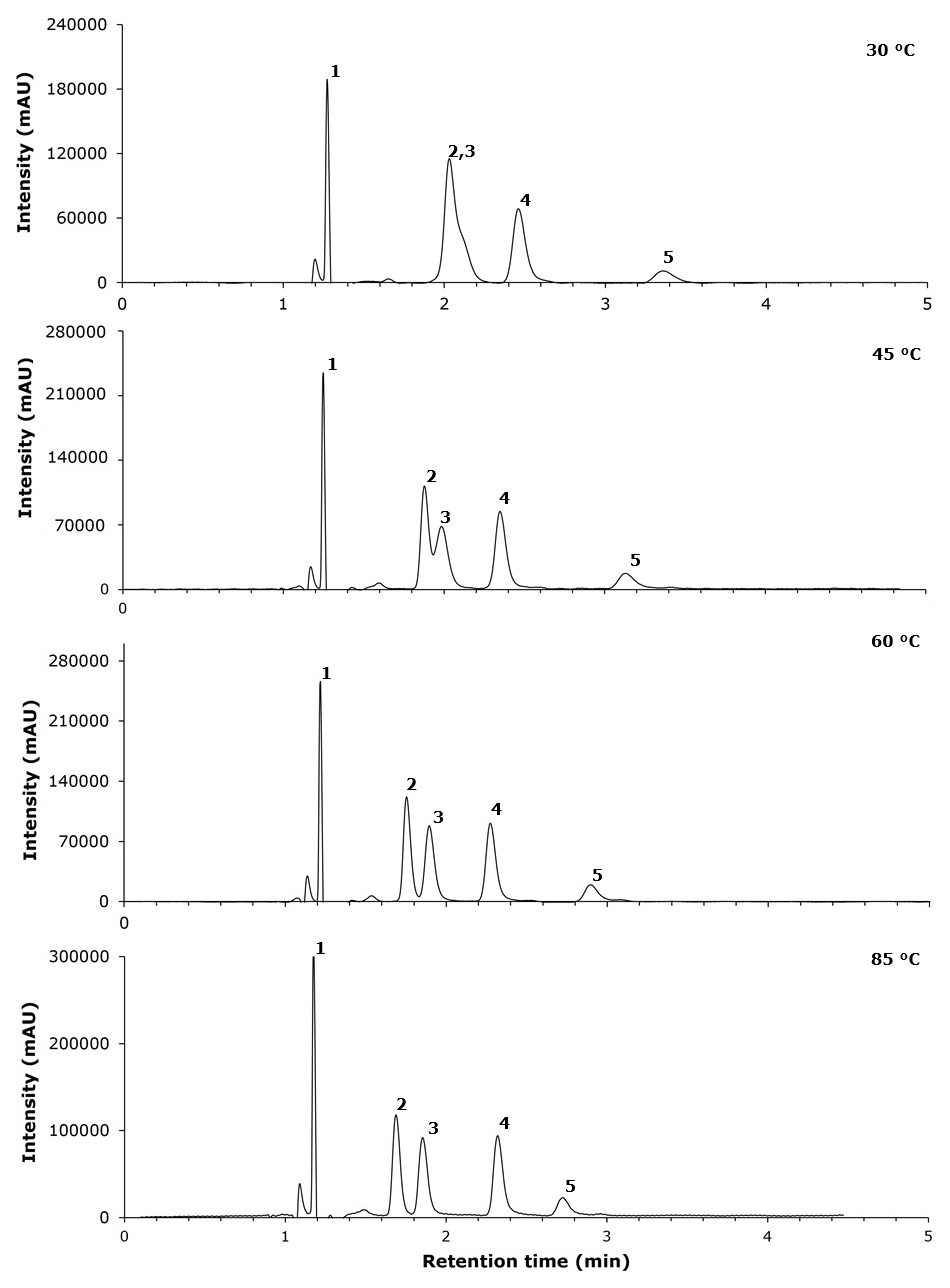
Figure 4.Separations of peptides on an Ascentis® Express ZIC®-cHILIC (2.7 µm) INERTProve™ column (150 x 4.6 mm) at column temperatures of 30, 45, 60, and 85 °C. (Peak IDs: 1. phenyldodecane (void marker), 2. angiotensin III, 3. angiotensin II, 4. somatostatin, 5. bradykinin
Conclusion
This study demonstrates the applicability and effectiveness of supercritical fluid chromatography for the separation of polar analytes such as nucleosides and small- to medium- sized peptides using the zwitterionic HILIC column packed with 2.7 µm superficially porous Ascentis® Express ZIC®-cHILIC particles in a bioinert INERTProve™ hardware. By optimizing the mobile phase composition, specifically the ratio of carbon dioxide to organic cosolvent and the buffer concentration, efficient separations were achieved despite the inherent challenges associated with the non-polar nature of CO₂.
Elevated column temperatures reduced the viscosity of the mobile phase, enhancing mass transfer and in turn improving analyte-stationary phase interactions. These thermal effects significantly improved chromatographic resolution, especially for hydrophilic and charged species. These findings underscore the importance of optimizing mobile phase composition and column temperature in developing high-efficiency SFC methods for biologically relevant polar compounds. To further enhance the method’s utility and sustainability, future investigations should focus on the use of less toxic cosolvents (e.g. ethanol instead of methanol) or more sustainable solvents (biobased HPLC solvents), as well as further minimizing organic solvent/mobile phase consumption (e.g. by reducing column dimensions and leveraging predictive modeling to streamline method optimization).