
Trace Metal Impurity Panels for High-Purity Inorganics
Introduction
Not all “99.9% purity” materials perform alike. In high‑purity inorganics, undetected variations in total metal impurities (TMI) limits and incomplete panel‑based purity testing can allow trace metals at ppm levels to act as dopants or catalysts, altering electrical, optical, and catalytic behavior. Without comprehensive metal screening and clearly defined total metal impurities (TMI)‑based assessments, these small impurities can remain undetected, leading to performance drift, lot‑to‑lot variability, or unexpected failures downstream due to insufficient impurity evaluation in high‑purity materials.
Trace-metal-impurity panels play a central role in determining whether high‑purity inorganics behave consistently across critical applications. Achieving predictable performance depends on comprehensive trace-metal panels and ICP‑MS impurity profiling, which reveal elements that basic purity listings fail to capture. As TMI limits become tighter across industries, panel‑based purity testing and impurity panel testing in high‑purity materials enable more accurate assessment of contamination risks. These tools together support trace metals testing for reliable performance, ensuring that ppm‑level impurities no longer drive unexpected variability in advanced material workflows.
Panel‑Based Purity Testing Built with Defined TMI Limits
For our Sigma-Aldrich® brand, we take a strict, systematic approach to panel-based purity testing. Our purity listings are based on maximum allowable TMI across defined panels of elements. A product meets its purity listing only if the sum of trace metals in the relevant panel stays below the specified TMI limit. If an element is a major component of the material, it is excluded from TMI determination; everything else in the panel counts toward the total.
Our purity grades are defined by panel‑based TMI limits, measured across 32, 34, or 16 metals, depending on the material’s composition.
Many market offerings test only five or eight elements. In contrast, our wider panels measure a much more comprehensive range of metals to reduce hidden variability and to identify performance‑critical impurities that smaller test sets often overlook.
Our Testing Approach for High‑Purity Inorganics Analysis
We use inductively coupled plasma optical emission spectroscopy (ICP-OES) and inductively coupled plasma mass spectrometry (ICP-MS) for sensitive multi-element quantification, with careful sample preparation so analysis reflects the product accurately. To ensure the certificate of analysis reflects the product you receive, we follow a consistent quality‑control process designed to maintain data accuracy, purity confidence, and reliability for high‑purity inorganics:
- Calibration to the matrix (external standards or method of standard additions)
- Pre- and post-digestion spikes (acceptable spike recoveries indicate robust method performance)
- Duplicates (reproducibility and bulk uniformity)
- Detection and reporting rigor (instrument detection limits and method reporting limits)
The result is trace metals data that is both comprehensive, thanks to our broader panels, and dependable, supported by rigorous methods and quality control.
Broader Trace Metals Testing for Reliable Performance
1. Mn powder with elevated Fe: We tested our ≥99.9% Mn powder (463728) and Competitor A’s “99.9%” Mn powder tested on a narrower panel.
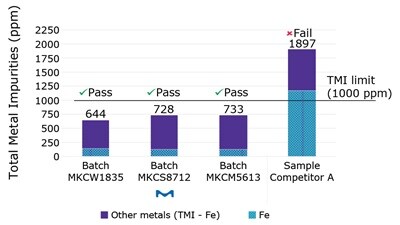
Figure 1.Comparative TMI analysis between our and Competitor A's manganese (Mn) powders.
- What we found: Our batches had <1000 ppm TMI and <150 ppm Fe. Competitor A exceeded the general panel threshold due to iron (~1170 ppm) that was not tested in their panel.
- Why it matters: Fe acts as an unintended dopant in manganese systems, shifting magnetic behavior and corrosion response. In alloying or powder metallurgy, the ppm level Fe can nudge intermetallic formation and mechanical properties away from design intent. In manganese-based battery cathodes, Fe can catalyze corrosion.1
- Outcome: The broader panel, which includes Fe, identifies impurity levels that may influence material performance and provides clearer insight into potential sources of variability within defined process parameters.
2. Neodymium oxide powder with elevated Sm: We tested our 99.99% Nd2O3 powder (203858) and Competitor B’s “99.99%” Nd2O3 powder tested on a narrower panel.
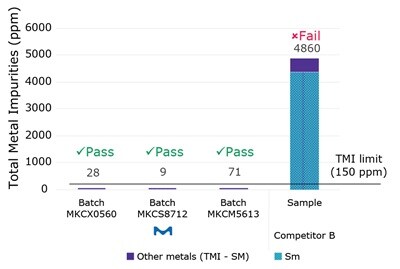
Figure 2.Comparative TMI analysis between our and Competitor B's neodymium dioxide (Nd₂O₃) powders.
- What we found: Our batches passed the rare earth major panel with <150 ppm TMI. Competitor B showed samarium well above our panel threshold (~4860 ppm).
- Why it matters: Nd and Sm are chemically compatible but differ in optical, magnetic, and microstructural effects. Trace Sm can change photoemission, weaken magnetic responses, and alter grain behavior in Nd doped glasses/ceramics.2
- Outcome: Quantifying the full rare earth panel detects major impurities that could cause product failures downstream.
3. Pt wire with elevated Cu and W: We tested our 99.99% Pt wire (357367) and Competitor C’s “99.99%” Pt wire tested on a narrower panel.
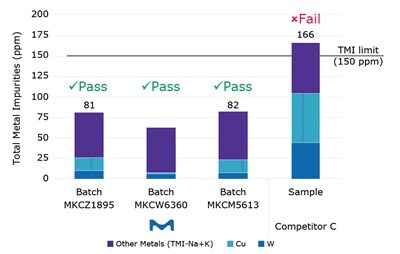
Figure 3.Comparative TMI analysis between our and Competitor C's Pt wires.
- What we found: Our batches were well below the 150 ppm TMI limit. Competitor C exceeded thresholds due to copper and tungsten.
- Why it matters: Cu and W can affect stability and catalytic performance, potentially impacting sensitive electrochemical measurements.3,4
- Outcome: Our wider panel reveals cross metal interactions that can impact performance.
From Nominal Purity to Predictable Outcomes Through Impurity Panel Testing
For users of high-purity inorganics, the value of trace metals testing is measured in process stability, device performance, and total cost of ownership. Our TMI‑based method uses broad‑panel trace metal analysis to minimize hidden variability and identify performance‑critical impurities that limited testing often misses, supporting more reliable high‑purity inorganics.
When evaluating trace metals purity consider the following parameters:
- The TMI panel used for trace metals analysis should be clearly specified.
- The TMI limit associated with the stated purity grade must be defined.
- Supporting QC data, including spike recoveries and duplicate analyses, should be documented.
Understanding these factors helps distinguish nominal purity from predictable performance, and it is why our high-purity inorganics are engineered for consistent, reliable outcomes in demanding applications.
Conclusion
In high‑purity inorganics, trace metals can subtly affect process stability, product quality, and downstream performance. Our TMI‑based purity approach uses broader analytical panels and stricter limits supported by disciplined ICP‑OES and ICP‑MS analysis to give a clearer picture of impurity levels. While narrow testing can miss performance‑critical metals, wide‑panel trace metal analysis identifies what matters most and helps maintain lot‑to‑lot consistency in demanding applications. This approach supports more reliable results in catalysis, electronics, pharmaceutical synthesis, battery materials, and other high‑precision fields. The outcome is improved stability, reduced variability, and more predictable performance to streamline workflows and reduce overall costs.
To view our complete portfolio, please visit our High Purity Inorganics for Advanced Applications webpage.