
UV-Vis Absorption Analysis of HPLC Solvents following Chinese Pharmacopeia 2025
Abstract
According to the tests and criteria described in the Chinese Pharmacopeia (Ch.P.) 2025, the UV-visible absorbance of methanol and acetonitrile, two commonly used solvents in high-performance liquid chromatography (HPLC), was analyzed using a Spectroquant® Prove 600 plus spectrophotometer. The obtained results demonstrated that the spectrophotometer was suitable for this assessment and that both investigated solvent samples complied with the requirements of Ch. P. 2025.
Section Overview
Introduction
The quality of chromatography solvents is crucial in high-performance liquid chromatography (HPLC) as solvent-related impurities can significantly affect the accuracy and reproducibility of analytical results.1,2 Use of solvents that do not meet specified purity standards can lead to inaccurate peak identification and quantification, thereby compromising the integrity of the analysis. Fulfilment of the relevant pharmacopoeia standards therefore supports the reliability of analytical procedures, and the acceptability of data submitted for regulatory evaluation.3
Volume 4 of the 2025 edition of the Chinese Pharmacopoeia (Ch. P. 2025) specifies requirements for UV-Vis absorbance of selected organic solvents intended for use as mobile phases in HPLC.4-6 In addition, Ch. P. 2025 defines instruments to be utilized for absorbance measurements. The general rule 0401 on UV-VIS spectrophotometry provides detailed instrument verification steps and acceptable deviation ranges for the instrument's wavelength and absorbance accuracy, along with examination of stray light.
In this application, an internal procedure was applied to test the performance of a Spectroquant® Prove 600 plus spectrophotometer using a Spectroquant® certified UV-Vis reference material. Subsequently, in a second set of experiments performed according to Ch. P. 2025, the UV-visible absorbance of Sigma-Aldrich® branded solvents (acetonitrile and methanol) was determined at specific wavelengths and wavelength ranges defined in the Ch. P. and compared with the pharmacopeial acceptance criteria.
Experimental
Reagents, Instruments, and Materials
Test/Reagent Kits
- Spectroquant® certified UV-VIS reference material (1.74067)
- Ultra-pure water e.g. from a water purification system such as Milli-Q® IQ 7000 Ultrapure (ZIQ7000T0C)
Instruments & Devices
A Spectroquant® Prove 600 plus was utilized in this work. In general, the analysis can be conducted using one of the following Spectroquant® photometers:
- Spectroquant® UV/VIS Spectrophotometer Prove 300 plus (1.73027)
- Spectroquant® UV/VIS Spectrophotometer Prove 600 plus (1.73028)
Note: This application note pertains to the above listed photometers and all discontinued instruments from the Spectroquant® Prove 300 and 600 series.
Software for Data Transfer
Optional: Spectroquant® Prove Connect to LIMS software package (Y.11086) to transfer data to an existing LIMS system
Instrument Accessories
- Rectangular cell quartz 10 mm (1.00784)
Test Samples
Methanol and acetonitrile, which are among the most frequently employed solvents in high performance liquid chromatography, were prioritized in this study. The two solvents are generally available in high purity, typically exceeding 99.9%, and provide excellent performance in HPLC and LC-MS analyses owing to their chemical properties, low viscosity, evaporation residue, and favorable UV transmittance.
Two HPLC suitable Sigma-Aldrich® branded solvents were selected as representative examples for this UV transmission/absorbance investigation (Table 1).
Test Conditions and Acceptance Criteria
Applied wavelengths and acceptance criteria defined in the CH.P. are listed in Table 2.
Analytical Procedure
Instrument Assessment
The performance of the Spectroquant® Prove 600 plus system was verified following the procedure described in ASTM E275-08 standard using a Spectroquant® certified UV-VIS reference material (1.74067). The ASTM standard is largely consistent with the requirements of the Chinese Pharmacopoeia general rule 0401, and provides equivalent validity for the confirmation of instrument accuracy.6,7 Wavelength accuracy and precision/reproducibility, photometric accuracy, photometric precision/reproducibility at 1.0 AU and stray light were tested and documented.
Sample Measurements
Absorbance Measurement at a Single Wavelength
- For equipment setup and preheating please refer to the photometers manual.
- Zeroing: Rinse a 10 mm quartz cuvette three times with ultra-pure water. Then add water to approximately 70% of the cuvette volume and seal with cover. Wipe the surface of the cuvette with lint-free paper and insert it into the testing position of the instrument. Set the detection wavelength according to Table 2, then press the zero button to zero the instrument. Remove the cuvette and discard the water sample.
- Sampling: Add 50 mL of the solvent to be tested into a 200 mL glass bottle, shake, then discard. Repeat the rinsing operation three times. Then add 150 mL of the test sample into the bottle.
- Sample addition: Fill the cuvette to about 70% of its volume with the test sample, shake, then discard. Repeat the rinsing operation three times. Then refill with the test sample to approximately 70% of the cuvette volume.
- Testing: Record the values of three consecutive tests.
Absorbance Measurement over a Wavelength Range
- For equipment set up and preheating please refer to the manual.
- Zeroing: Rinse a 10 mm quartz cuvette three times with ultra-pure water. Then add water to approximately 70% of the cuvette volume and seal with cover. Wipe the surface of the cuvette with lint-free paper and insert it into the testing position of the instrument. Set the detection wavelength range according to Table 2. Set the sensitivity to 0.001. Then press the zero button to zero the instrument. Remove the cuvette and discard the water sample.
- Sampling: Add 50 mL of the solvent to be tested into a 200 mL glass bottle, shake, then discard. Repeat the rinsing operation three times. Then add 150 mL of the test sample into the bottle.
- Sample addition: Fill the cuvette to about 70% of its volume with the test sample, shake, then discard. Repeat the rinsing operation three times. Then refill with test sample to approximately 70% of the cuvette volume.
- Testing: Record the data and ensure its accuracy, completeness and validity.
Results & Discussion
Test Results Methanol
The test results obtained for the methanol sample (Cat. No 34860-1L-R, lot no. WXBF6766V) analyzed at different wavelengths are listed in Table 3. The respective data for the wavelength range from 260-400 nm is displayed in Figure 1.
The results indicate that the absorbance of the tested methanol meets the requirements of Ch. P. 2025 for all investigated wavelengths.

Figure 1.Absorbance scanning curve for methanol in the range of 260-400 nm. (Horizontal axis: wavelength (nm), vertical axis: absorbance).
Test Results Acetonitrile
The test results obtained for the acetonitrile sample (Cat. No. 34851-1L, Lot No. WXBF6715V) analyzed at different wavelengths are listed in Table 4. The respective data for the wavelength range from 240-400 nm is displayed in Figure 2.
The results indicate that the absorbance of the tested acetonitrile meets the requirements of Ch.P. 2025 for all investigated wavelengths.
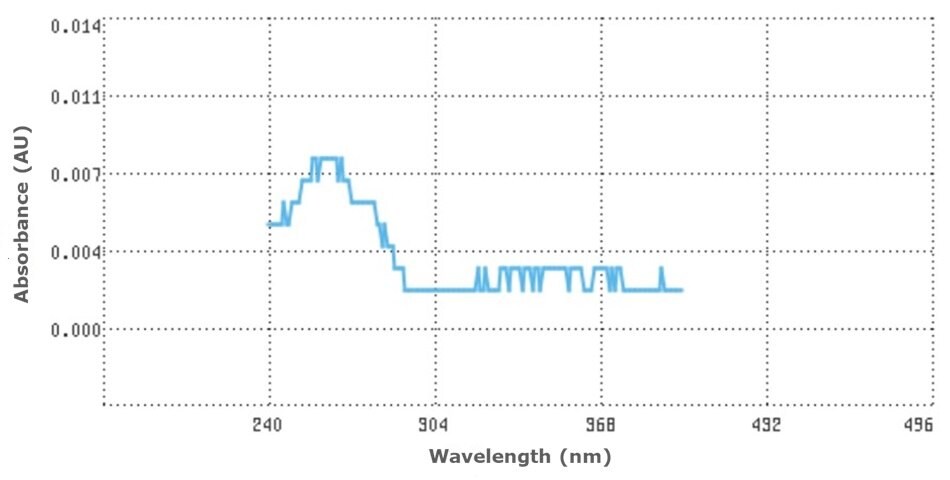
Figure 2.Absorbance scanning curve for acetonitrile in the range of 240-400 nm. (Horizontal axis: wavelength (nm), vertical axis: absorbance).
Conclusion
The instrument assessment performed with a UV-Vis reference material demonstrated that the Spectroquant® Prove 600 Plus is suitable for this solvent criteria assessment. The results showed that both investigated Sigma-Aldrich® branded solvents methanol and acetonitrile complied with and exceeded the new UV absorption requirements set by Ch.P. 2025.
Solvents and Reagents
如要继续阅读,请登录或创建帐户。
暂无帐户?