Skip to Content
Merck
CN

216666

Tetrakis(triphenylphosphine)palladium(0)

99%, solid

Synonym(s):

Palladium-tetrakis(triphenylphosphine), Pd(PPh3)4

Sign In to View Organizational & Contract Pricing.

Select a Size


About This Item

Linear Formula:
Pd[(C6H5)3P]4
CAS Number:
Molecular Weight:
1155.56
NACRES:
NA.22
PubChem Substance ID:
UNSPSC Code:
12352103
EC Number:
238-086-9
MDL number:
Beilstein/REAXYS Number:
6704828
Technical Service
Need help? Our team of experienced scientists is here for you.
Let Us Assist
Technical Service
Need help? Our team of experienced scientists is here for you.
Let Us Assist

Product Name

Tetrakis(triphenylphosphine)palladium(0), 99%

InChI key

NFHFRUOZVGFOOS-UHFFFAOYSA-N

InChI

1S/4C18H15P.Pd/c4*1-4-10-16(11-5-1)19(17-12-6-2-7-13-17)18-14-8-3-9-15-18;/h4*1-15H;

SMILES string

[Pd].c1ccc(cc1)P(c2ccccc2)c3ccccc3.c4ccc(cc4)P(c5ccccc5)c6ccccc6.c7ccc(cc7)P(c8ccccc8)c9ccccc9.c%10ccc(cc%10)P(c%11ccccc%11)c%12ccccc%12

assay

99%

form

solid

reaction suitability

core: palladium
reaction type: Cross Couplings
reaction type: Heck Reaction
reaction type: Hiyama Coupling
reaction type: Negishi Coupling
reaction type: Sonogashira Coupling
reaction type: Stille Coupling
reaction type: Suzuki-Miyaura Coupling
reagent type: catalyst
reaction type: Buchwald-Hartwig Cross Coupling Reaction

parameter

air sensitive

storage temp.

2-8°C

Quality Level

Looking for similar products? Visit Product Comparison Guide

Application

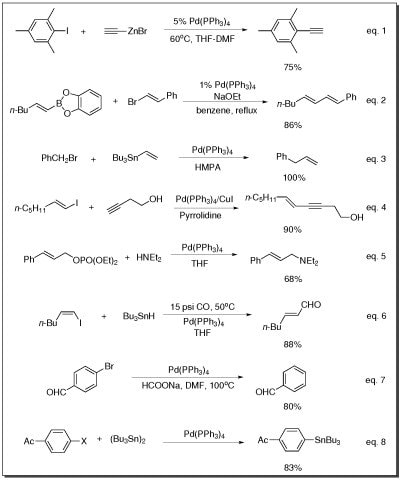
Tetrakis(triphenylphosphine)palladium(0) can be used as a catalyst in:


  • Negishi coupling (eq. 1), Suzuki coupling (eq. 2), Stille coupling (eq. 3), Sonogashira coupling reaction (eq. 4), and Buchwald-Hartwig amination reaction (eq. 5)
  • The carbonylation of vinyl iodides (eq. 6)
  • The reduction reaction of aryl bromides (eq. 7)
  • Carbon-tin bond formation (eq. 8)
Triphenyl Phosphine Catalyst

General description

Palladium-tetrakis(triphenylphosphine) (Pd(PPh3)4) iscoordination complex of palladium and is widely used palladium cross-coupling catalyst. These applications include Negishi coupling, Suzuki coupling, Stille coupling, Sonogashira coupling, and Buchwald-Hartwig amination reactions.


Tetrakis(triphenylphosphine)palladium(0) (Pd(PPh3)4) is a commonly used palladium(0) complex in chemical synthesis. It plays a vital role as a catalyst in various organic reactions, especially C-C, C-N, C-O, and C-heteroatom cross-coupling reactions. Pd(PPh3)4 finds extensive application in carbon-carbon bond-forming reactions such as the famous Heck, Suzuki-Miyaura, and Stille reactions. These reactions involve the coupling of aryl, alkyl, or vinyl halides with other organic compounds to yield valuable products. The catalytic cycle involves the oxidative addition of the organic halide to palladium(0), transmetalation with a suitable organometallic reagent or boronic acid, and reductive elimination to form the desired product. Pd(PPh3)4 has also been utilized in various other transformations including allylic substitutions, nucleophilic additions to alkenes and alkynes, and cycloadditions.

pictograms

Exclamation mark

signalword

Warning

hcodes

Hazard Classifications

Acute Tox. 4 Oral

Storage Class

11 - Combustible Solids

wgk

WGK 3

flash_point_f

Not applicable

flash_point_c

Not applicable

ppe

Eyeshields, Gloves, type N95 (US)


Choose from one of the most recent versions:

Certificates of Analysis (COA)

Lot/Batch Number

Don't see the Right Version?

If you require a particular version, you can look up a specific certificate by the Lot or Batch number.

Already Own This Product?

Find documentation for the products that you have recently purchased in the Document Library.

Visit the Document Library

  1. Which document(s) contains shelf-life or expiration date information for a given product?

    If available for a given product, the recommended re-test date or the expiration date can be found on the Certificate of Analysis.

  2. How do I get lot-specific information or a Certificate of Analysis?

    The lot specific COA document can be found by entering the lot number above under the "Documents" section.

  3. The color of Product 216666, Pd tetrakis(triphenylphosphine)Cl was a yellow or gold color, but now my material has turned a tan, brown, or green color.  Is it still good to use?

    A change in color of the material indicates oxidation and it will no longer be active as a catalyst.

  4. How do I find price and availability?

    There are several ways to find pricing and availability for our products. Once you log onto our website, you will find the price and availability displayed on the product detail page. You can contact any of our Customer Sales and Service offices to receive a quote.  USA customers:  1-800-325-3010 or view local office numbers.

  5. What is the Department of Transportation shipping information for this product?

    Transportation information can be found in Section 14 of the product's (M)SDS.To access the shipping information for this material, use the link on the product detail page for the product. 

  6. My question is not addressed here, how can I contact Technical Service for assistance?

    Ask a Scientist here.

Alami, F.; Ferri, F. et al.
Tetrahedron Letters, 34, 6403-6403 (1993)
Hong-Lei Xu et al.
Nature communications, 11(1), 5286-5286 (2020-10-22)
Sandwich-type clusters with the planar fragment containing a heterometallic sheet have remained elusive. In this work, we introduce the [K(2,2,2-crypt)]4{(Ge9)2[η6-Ge(PdPPh3)3]} complex that contains a heterometallic sandwich fragment. The title compound is structurally characterized by means of single-crystal X-ray diffraction, which
Palladium-catalyzed formylation of organic halides with carbon monoxide and tin hydride.
V P Baillargeon et al.
Journal of the American Chemical Society, 108(3), 452-461 (1986-02-01)
Milstein, D.; Still, J. K.
Journal of the American Chemical Society, 101, 4992-4992 (1979)
Miyaura, M.; Suzuki, A.
Journal of the American Chemical Society, 107, 972-972 (1985)

Articles

Effective in key synthesis reactions like Knoevenagel condensation, thalidomide synthesis, and Suzuki coupling for sustainable chemical transformations.

Our team of scientists has experience in all areas of research including Life Science, Material Science, Chemical Synthesis, Chromatography, Analytical and many others.

Contact Technical Service