330744

Tetrapropylammonium perruthenate
97%
Synonym(s):
TPAP
Sign In to View Organizational & Contract Pricing.
Select a Size
Change View
About This Item
Linear Formula:
(CH3CH2CH2)4NRuO4
CAS Number:
Molecular Weight:
351.43
NACRES:
NA.22
PubChem Substance ID:
UNSPSC Code:
12352116
MDL number:
Assay:
97%
Form:
solid
Quality Segment
assay
97%
form
solid
reaction suitability
core: ammonium, reaction type: phase-transfer, reagent type: oxidant
mp
~160 °C (dec.) (lit.)
functional group
amine
SMILES string
[O-][Ru](=O)(=O)=O.CCC[N+](CCC)(CCC)CCC
InChI
1S/C12H28N.4O.Ru/c1-5-9-13(10-6-2,11-7-3)12-8-4;;;;;/h5-12H2,1-4H3;;;;;/q+1;;;;-1;
InChI key
NQSIKKSFBQCBSI-UHFFFAOYSA-N
General description
Tetrapropylammonium perruthenate is a mild oxidizing agent used for the oxidation of alcohols to corresponding carbonyl compounds. It is a non-volatile, air-stable, and readily soluble reagent, which can be used either stoichiometrically or catalytically with a suitable co-oxidant.
Application
Tetrapropylammonium perruthenate (TPAP) can be used as a catalyst:
TPAP can also be used as an oxidizing reagent:
- For the conversion of sulfides to sulfones by oxidation reaction.
- In the isomerization of allylic alcohols into the corresponding saturated carbonyl derivatives.
- Along with N-methylmorpholine N-oxide (NMO) for the cleavage of glycol to carboxylic acids.
TPAP can also be used as an oxidizing reagent:
- For the oxidation of benzyl alcohol to benzaldehyde and steroidal alcohols to corresponding ketones.
- To convert N,N′-dihydroxyimidazolidines to nitronyl nitroxide free radicals.
- To oxidize hydroxyl-substituted tri-n-butylammonium trifluoroborates to aldehydes and ketones without concomitant cleavage of the carbon-boron bond.
Flash Point (°F)
Not applicable
Flash Point (°C)
Not applicable
PPE (personal protective equipment)
Eyeshields, Gloves, type P3 (EN 143) respirator cartridges

Signal Word
Danger
Hazard Codes
Precautionary Statements
Hazard Classifications
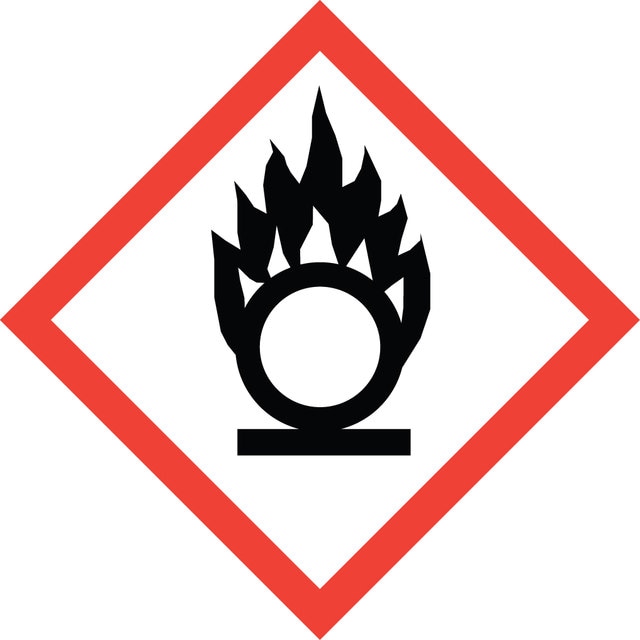
Eye Irrit. 2 - Ox. Sol. 2 - Skin Irrit. 2
Storage Class
5.1B - Oxidizing hazardous materials
Choose from one of the most recent versions:
Already Own This Product?
Find documentation for the products that you have recently purchased in the Document Library.