
35170

2,4-Dichloroaniline
≥97.0% (GC)
Sign In to View Organizational & Contract Pricing.
Select a Size
Change View
About This Item
Linear Formula:
Cl2C6H3NH2
CAS Number:
Molecular Weight:
162.02
UNSPSC Code:
12352100
NACRES:
NA.22
PubChem Substance ID:
EC Number:
209-057-8
Beilstein/REAXYS Number:
386422
MDL number:
assay
≥97.0% (GC)
bp
245 °C (lit.)
mp
59-62 °C (lit.), 60-65 °C
solubility
methanol: soluble, clear, very faintly brownish-yellow
SMILES string
Nc1ccc(Cl)cc1Cl
InChI
1S/C6H5Cl2N/c7-4-1-2-6(9)5(8)3-4/h1-3H,9H2
InChI key
KQCMTOWTPBNWDB-UHFFFAOYSA-N
General description
2,4-Dichloroaniline is an organic xenobiotic compound and its acute toxicity, modes of action and physicochemical properties towards the freshwater crustacean amphipod Gammarus pulex has been investigated. Biodegradation of 2,4-dichloroaniline by new strain Delftia tsuruhatensis H1 has been reported. The electrochemical oxidation of 2,4-dichloroaniline was studied in acetonitrile solution. Quantitative method for the detection of 2,4-dichloroaniline in environmental water samples by solid-phase microextraction (SPME) in gas chromatography–mass spectrometry has been reported.
Still not finding the right product?
Explore all of our products under 2,4-Dichloroaniline
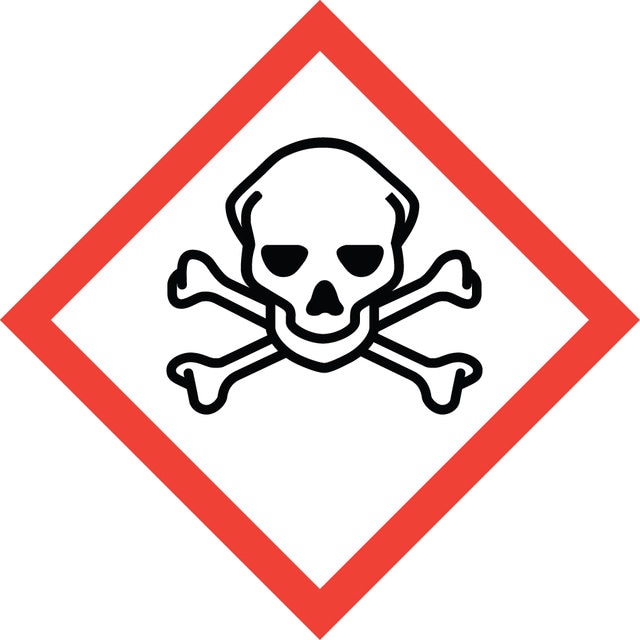

signalword
Danger
hcodes
Hazard Classifications
Acute Tox. 3 Dermal - Acute Tox. 3 Inhalation - Acute Tox. 4 Oral - Aquatic Chronic 2
Storage Class
6.1A - Combustible acute toxic Cat. 1 and 2 / very toxic hazardous materials
wgk
WGK 3
flash_point_f
239.0 °F - closed cup
flash_point_c
115 °C - closed cup
Regulatory Information
新产品
This item has
Choose from one of the most recent versions:
Already Own This Product?
Find documentation for the products that you have recently purchased in the Document Library.
The electrochemical oxidation of 4-chloroaniline, 2, 4-dichloroaniline and 2, 4, 6-trichloroaniline in acetonitrile solution.
Kadar M, et al.
Electrochimica Acta, 46(9), 1297-1306 (2001)
Determination of aromatic amines by solid-phase microextraction and gas chromatography−mass spectrometry in water samples.
Muller L, et al.
Journal of Chromatography A, 791(1), 221-230 (1997)
N Sundaraganesan et al.
Spectrochimica acta. Part A, Molecular and biomolecular spectroscopy, 73(1), 11-19 (2009-03-03)
In this work, the experimental and theoretical study on molecular structure and vibrational spectra of 2,4-dichloroaniline (2,4-DCA) were studied. The Fourier transform infrared (gas phase) and Fourier transform Raman spectra of 2,4-DCA were recorded. The molecular geometry and vibrational frequencies