
Sign In to View Organizational & Contract Pricing.
Select a Size
About This Item
Linear Formula:
[(CH3)3Si]2CHCl
CAS Number:
Molecular Weight:
194.85
UNSPSC Code:
12352103
NACRES:
NA.22
PubChem Substance ID:
MDL number:
Beilstein/REAXYS Number:
1736681
assay
97%
form
liquid
InChI key
XNJGZHVYPBNLEB-UHFFFAOYSA-N
InChI
1S/C7H19ClSi2/c1-9(2,3)7(8)10(4,5)6/h7H,1-6H3
SMILES string
C[Si](C)(C)C(Cl)[Si](C)(C)C
Quality Level
bp
57-60 °C/15 mmHg (lit.)
density
0.892 g/mL at 25 °C (lit.)
functional group
chloro
Related Categories
Application
Chlorobis(trimethylsilyl)methane can be used as a reagent for the preparation of:
- Para-bis(trimethylsilyl)ethylstyrene (PBTES) monomer, which is used to synthesize corresponding network polymer of styrene.
- Bis(trimethylsilyl)methyl magnesium chloride (Grignard reagent), which is used in the synthesis of bis(trimethylsilyl) allyl compounds by reacting with alkenyl bromide via the Kumada coupling reaction.
- N-[Bis(trimethylsilyl)methyl]heterocumulenes.
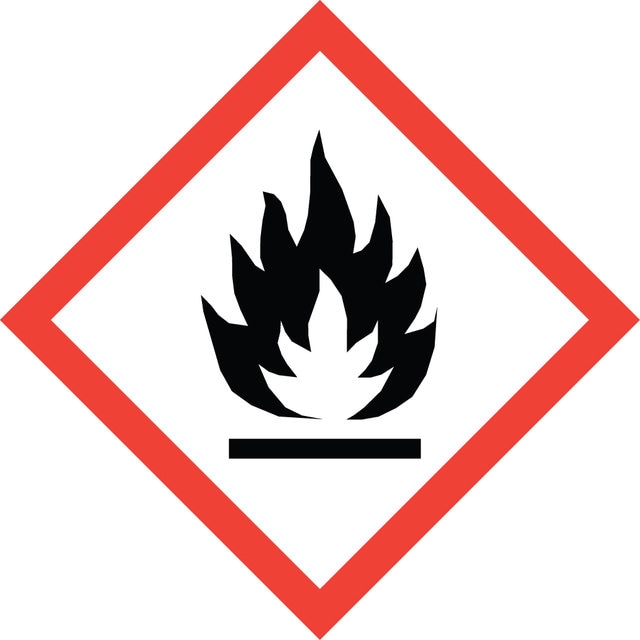
signalword
Warning
hcodes
Hazard Classifications
Eye Irrit. 2 - Flam. Liq. 3 - Skin Irrit. 2 - STOT SE 3
target_organs
Respiratory system
Storage Class
3 - Flammable liquids
wgk
WGK 3
flash_point_f
118.4 °F - closed cup
flash_point_c
48 °C - closed cup
ppe
Eyeshields, Faceshields, Gloves, type ABEK (EN14387) respirator filter
Regulatory Information
危险化学品
This item has
Choose from one of the most recent versions:
Already Own This Product?
Find documentation for the products that you have recently purchased in the Document Library.
Synthesis of some silyl mono-and polystyrenes with new properties
Assadi, MG and Hosseinzadeh, F
Designed Monomers and Polymers, 13(2), 181-191 (2010)
Synthesis and Reactivity of N-[Bis (trimethylsilyl) methyl] heterocumulenes
Barbaro G, et al.
The Journal of Organic Chemistry, 60(19), 6032-6039 (1995)
David R Williams et al.
Organic letters, 8(20), 4393-4396 (2006-09-22)
Allylation reagents, which possess geminal bis-trimethylsilyl substitution, are readily prepared from E- or Z-alkenyl bromides. The reactivity of 3,3-bis(trimethylsilyl)-2-methyl-1-propene (1) is described and predominantly provides ene reactions with aldehydes to give alcohol 2 in the presence of BF3.OEt2. Alternatively, Sakurai
Our team of scientists has experience in all areas of research including Life Science, Material Science, Chemical Synthesis, Chromatography, Analytical and many others.
Contact Technical Service
