Sign In to View Organizational & Contract Pricing.
Select a Size
About This Item
Empirical Formula (Hill Notation):
C6H4BClO2
CAS Number:
Molecular Weight:
154.36
UNSPSC Code:
12352101
NACRES:
NA.22
PubChem Substance ID:
MDL number:
Beilstein/REAXYS Number:
2093985
Product Name
B-Chlorocatecholborane, 97%
InChI
1S/C6H4BClO2/c8-7-9-5-3-1-2-4-6(5)10-7/h1-4H
SMILES string
Clb1oc2ccccc2o1
InChI key
AZYGEWXDKHFOKB-UHFFFAOYSA-N
assay
97%
form
solid
mp
56-58 °C (lit.)
Quality Level
Looking for similar products? Visit Product Comparison Guide
Related Categories
Application
B-Chlorocatecholborane can be used:
- To prepare 2-arachidonoylglycerol by acetal cleavage of cis-arachidonoylbenzylidene glycerol.
- To prepare metal boryl complexes (Rh and Ir complexes) through oxidative addition.
- To remove the trityl group in one of the key steps for the synthesis of (−)-dictyostatin.
General description
B-Chlorocatecholborane is a boron reagent and a Lewis acid, known to facilitate the borylative cyclization of alkynes to yield the borylated heterocycles. It is also used in the preparation of lactones, and thiophenes.
signalword
Danger
hcodes
Hazard Classifications
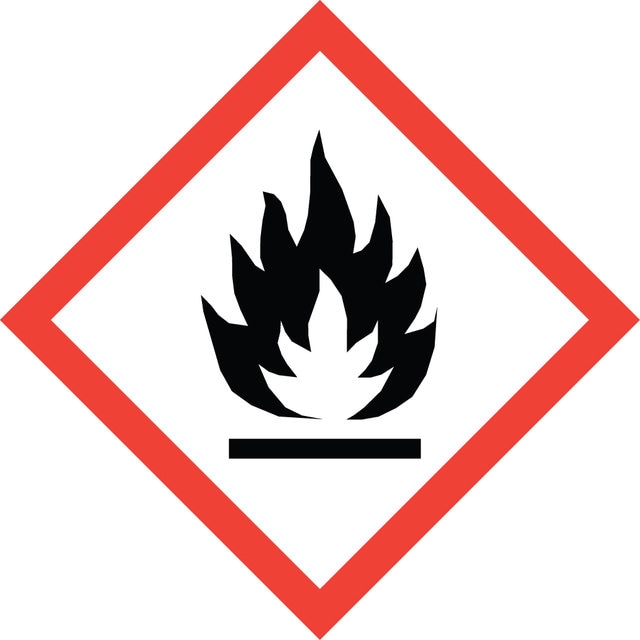
Flam. Sol. 1 - Skin Corr. 1B - STOT SE 3
target_organs
Respiratory system
supp_hazards
Storage Class
4.1B - Flammable solid hazardous materials
wgk
WGK 3
flash_point_f
140.0 °F - closed cup
flash_point_c
60 °C - closed cup
ppe
Eyeshields, Faceshields, Gloves, type P3 (EN 143) respirator cartridges
Choose from one of the most recent versions:
Already Own This Product?
Find documentation for the products that you have recently purchased in the Document Library.
Synthesis of rhodium and iridium boryl complexes via oxidative addition of haloboranes
Souza FES, et al.
Inorgorganica Chimica Acta, 358(5), 1501-1509 (2005)
Mild acetal cleavage using B-chlorocatecholborane in the synthesis of rearrangement-sensitive 2-arachidonoylglycerol
Roche MJ, et al.
Tetrahedron Letters, 53(30), 3825-3827 (2012)
Tetrahedron Letters, 26, 1411-1411 (1985)
Synthesis and biological evaluation of (−)-dictyostatin and stereoisomers
Shin Y, et al.
Tetrahedron, 63(35), 8537-8562 (2007)
Kang Yuan et al.
Organic letters, 19(6), 1462-1465 (2017-03-08)
We report here a facile B(C6F5)3 catalyzed trans-aminoboration of internal alkynes, furnishing 3-position borylated indoles at ambient temperature. This reaction proceeds with the breaking of a B-N bond and the formation of N-C and B-C bonds to produce indole and
Our team of scientists has experience in all areas of research including Life Science, Material Science, Chemical Synthesis, Chromatography, Analytical and many others.
Contact Technical Service