Skip to Content
Merck
CN

372862

Sodium perborate monohydrate

powder

Sign In to View Organizational & Contract Pricing.

Select a Size


About This Item

Linear Formula:
BNaO3 · H2O
CAS Number:
Molecular Weight:
99.81
NACRES:
NA.23
PubChem Substance ID:
UNSPSC Code:
12352302
EC Number:
231-556-4
MDL number:
Form:
powder
Technical Service
Need help? Our team of experienced scientists is here for you.
Let Us Assist
Technical Service
Need help? Our team of experienced scientists is here for you.
Let Us Assist

InChI key

VBLJKTBPWITVTE-UHFFFAOYSA-N

InChI

1S/BO3.Na.H2O/c2-1-3-4-1;;/h;;1H2/q-1;+1;

SMILES string

[Na+].[H]O[H].[O-]B1OO1

form

powder

reaction suitability

core: sodium

concentration

10.3-11.4% B (by NaOH, titration)

Quality Level

signalword

Danger

Hazard Classifications

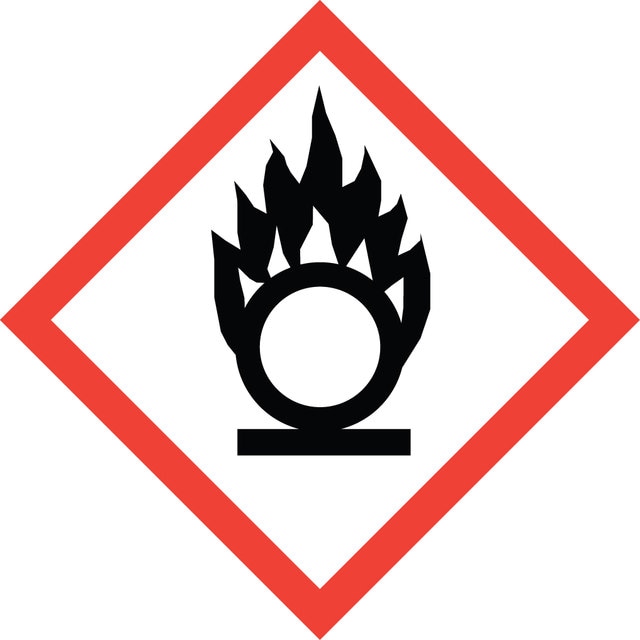
Acute Tox. 4 Oral - Eye Dam. 1 - Ox. Sol. 3 - Repr. 1B - STOT SE 3

target_organs

Respiratory system

Storage Class

5.1B - Oxidizing hazardous materials

wgk

WGK 1

flash_point_f

Not applicable

flash_point_c

Not applicable

Regulatory Information

危险化学品
This item has

Choose from one of the most recent versions:

Certificates of Analysis (COA)

Lot/Batch Number

Don't see the Right Version?

If you require a particular version, you can look up a specific certificate by the Lot or Batch number.

Already Own This Product?

Find documentation for the products that you have recently purchased in the Document Library.

Visit the Document Library

Benjamin Martin-Biedma et al.
Journal of endodontics, 36(2), 334-337 (2010-02-02)
This in vitro study compared the tooth color and the ultrastructure of internal dental tissues before and after internal bleaching. Sodium perborate was placed in the pulp chamber of endodontically treated molars and sealed with intermediate restorative material. The test
M R Fernández et al.
International endodontic journal, 43(2), 102-108 (2010-01-19)
To evaluate the cytotoxicity and genotoxicity of sodium percarbonate (SPC) in comparison with bleaching agents used on discoloured pulpless teeth. The cytotoxicity and genotoxicity of bleaching agents were evaluated both in their pure form as well as at concentrations commonly
Divya S Sharma et al.
The Journal of clinical pediatric dentistry, 35(4), 349-352 (2011-11-04)
The odd attracts society in odd manner, as is the case when a patient with discolored tooth smiles. Because of that, pediatric patients have psychological impact. Trauma and pulpal necrosis are the most common causes for discoloration of teeth. If
Milton Carlos Kuga et al.
Dental traumatology : official publication of International Association for Dental Traumatology, 28(3), 238-242 (2011-11-22)
To compare the fracture resistance of bovine teeth after intracoronal bleaching with sodium percarbonate (SPC) or sodium perborate (SP) mixed with water or 20% hydrogen peroxide (HP). Fifty extracted bovine teeth were divided into four experimental groups (G1-G4) and one
Viviane Maia Barreto de Oliveira et al.
Gerodontology, 28(2), 134-139 (2009-09-29)
To determine the effectiveness of a denture cleanser in reducing the concentration of volatile sulphur compounds (VSC) and its antimicrobial action. Micro-organisms from the denture biofilm can cause local and systemic disease and halitosis. Denture cleansers are important adjuncts in

Articles

Oxidation and reduction reactions are some of the most common transformations encountered in organic synthesis

Our team of scientists has experience in all areas of research including Life Science, Material Science, Chemical Synthesis, Chromatography, Analytical and many others.

Contact Technical Service