
413364

3-(Triethoxysilyl)propyl isocyanate
95%
Synonym(s):
Triethoxy(3-isocyanatopropyl)silane, (3-Isocyanatopropyl)triethoxysilane
Sign In to View Organizational & Contract Pricing.
Select a Size
Change View
About This Item
Linear Formula:
(C2H5O)3Si(CH2)3NCO
CAS Number:
Molecular Weight:
247.36
UNSPSC Code:
12352103
NACRES:
NA.22
PubChem Substance ID:
EC Number:
246-467-6
Beilstein/REAXYS Number:
4404652
MDL number:
Quality Segment
assay
95%
form
liquid
refractive index
n
bp
283 °C (lit.)
density
0.999 g/mL at 25 °C (lit.)
functional group
amine, isocyanate
SMILES string
CCO[Si](CCCN=C=O)(OCC)OCC
InChI
1S/C10H21NO4Si/c1-4-13-16(14-5-2,15-6-3)9-7-8-11-10-12/h4-9H2,1-3H3
InChI key
FRGPKMWIYVTFIQ-UHFFFAOYSA-N
Application
3-(Triethoxysilyl)propyl isocyanate can be used:
- As a bifunctional reagent (isocyanate and ethoxysilyl groups) for the immobilization of cellulose derivatives onto silica matrix to generate bonded type of chiral stationary phases (CSPs).
- To convert 5-amino-1,10-phenanthroline into 5-(N,N-bis-3-(triethoxysilyl)propyl)-ureyl-1,10-phenanthroline, a hydrolysable sol–gel precursor.
- To synthesize ruthenium bipyridyl tethered porous organosilica(Ru-POS) for organo-photocatalysis.
- To synthesize nanoparticle-supported oxime palladacycle catalyst for Suzuki-Miyaura cross-coupling reaction.
3-(triethoxysilyl)propyl isocyanate (TEPI) was used as a spacer reagent to prepare cellulose based chiral stationary phases (CSPs). TEPI may be used to modify 2-hydroxynicotinic acid to prepare luminescent hybrid materials.2 Luminescent inorganic-organic hybrid materials were prepared by grafting the isocynate with the ortho aminobenzoic acid derivative. TEPI may also be used to prepare 5-(N,N-bis-3-(triethoxysilyl)propyl)ureyl-1,10- phenanthroline (phen-Si).
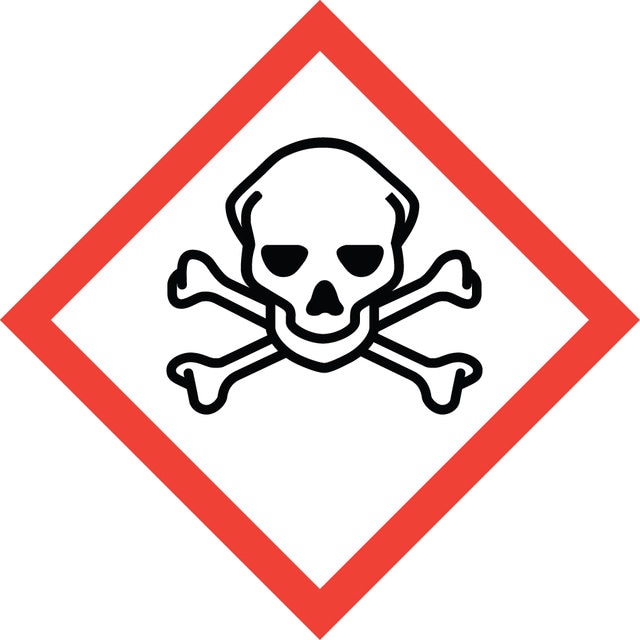


signalword
Danger
Hazard Classifications
Acute Tox. 1 Inhalation - Acute Tox. 4 Dermal - Acute Tox. 4 Oral - Eye Dam. 1 - Resp. Sens. 1 - Skin Corr. 1B - Skin Sens. 1
Storage Class
6.1A - Combustible acute toxic Cat. 1 and 2 / very toxic hazardous materials
wgk
WGK 3
flash_point_f
223.7 °F - closed cup
flash_point_c
106.5 °C - closed cup
ppe
Faceshields, Gloves, Goggles, type ABEK (EN14387) respirator filter
Choose from one of the most recent versions:
Already Own This Product?
Find documentation for the products that you have recently purchased in the Document Library.