427292

1-Bromo-2-butyne
≥98%
Synonym(s):
1-(Bromomethyl)-2-methylacetylene, 2-Butyn-1-yl bromide, 2-Butynyl bromide, 4-Bromobut-2-yne
Sign In to View Organizational & Contract Pricing.
Select a Size
Change View
About This Item
Linear Formula:
CH3C≡CCH2Br
CAS Number:
Molecular Weight:
132.99
UNSPSC Code:
12352100
NACRES:
NA.22
PubChem Substance ID:
MDL number:
Beilstein/REAXYS Number:
605306
Assay:
≥98%
Form:
liquid
Quality Segment
assay
≥98%
form
liquid
refractive index
n
bp
40-41 °C/20 mmHg (lit.)
density
1.519 g/mL at 25 °C (lit.)
functional group
alkyl halide, bromo
SMILES string
CC#CCBr
InChI
1S/C4H5Br/c1-2-3-4-5/h4H2,1H3
InChI key
LNNXOEHOXSYWLD-UHFFFAOYSA-N
General description
1-Bromo-2-butyne is a propargyl bromide derivative. It is one of the constitutional isomer of bromo butyne. Its Br-loss threshold photoionization breakdown diagram has been analyzed to derive dissociative photoionization thresholds to C4H5+ production. It participates in the preparation of linagliptin.
Application
1-Bromo-2-butyne was used in the alkylation of L -tryptophan methyl ester. It was used as a source to generate CH3CCCH2 radicals to investigate the reaction kinetics of these radicals with NO and NO2.
It may be used in the synthesis of the following:
It may be used in the synthesis of the following:
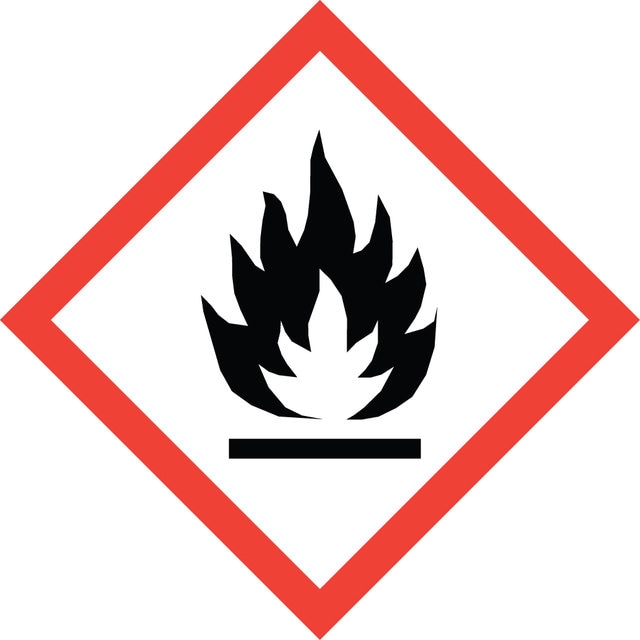
Signal Word
Warning
Hazard Codes
Hazard Classifications
Flam. Liq. 3
Storage Class
3 - Flammable liquids
WGK
WGK 3
Flash Point (°F)
96.8 °F - closed cup
Flash Point (°C)
36 °C - closed cup
PPE (personal protective equipment)
Eyeshields, Faceshields, Gloves, type ABEK (EN14387) respirator filter
Choose from one of the most recent versions:
Already Own This Product?
Find documentation for the products that you have recently purchased in the Document Library.