
Skip to Content
Merck
CN

483060

Sodium dichromate dihydrate

99.995% trace metals basis

Synonym(s):

Sodium bichromate

Sign In to View Organizational & Contract Pricing.

Select a Size


About This Item

Linear Formula:
Na2Cr2O7 · 2H2O
CAS Number:
Molecular Weight:
298.00
UNSPSC Code:
12352302
PubChem Substance ID:
EC Number:
234-190-3
MDL number:
Technical Service
Need help? Our team of experienced scientists is here for you.
Let Us Assist
Technical Service
Need help? Our team of experienced scientists is here for you.
Let Us Assist

InChI key

JYDRNIYTFCBIFC-UHFFFAOYSA-N

InChI

1S/2Cr.2Na.2H2O.7O/h;;;;2*1H2;;;;;;;/q;;2*+1;;;;;;;;2*-1

SMILES string

O.O.[Na+].[Na+].[O-][Cr](=O)(=O)O[Cr]([O-])(=O)=O

assay

99.995% trace metals basis

form

crystalline

reaction suitability

reagent type: oxidant

mp

91 °C (lit.)

Looking for similar products? Visit Product Comparison Guide
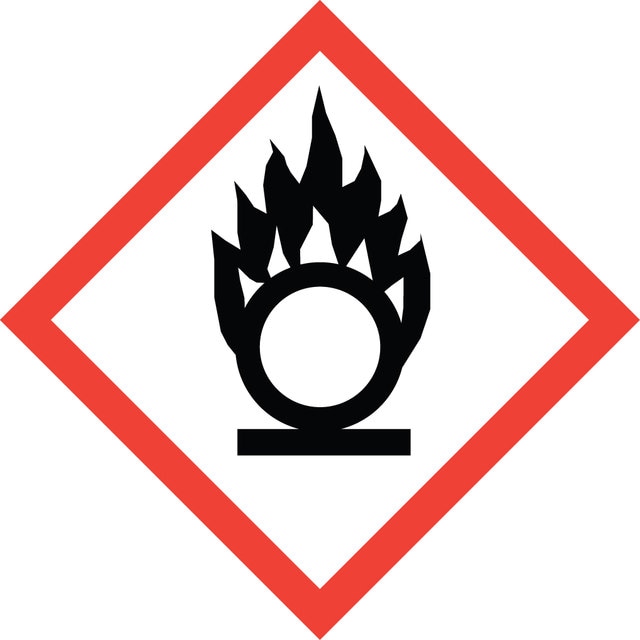
signalword

Danger

Hazard Classifications

Acute Tox. 2 Inhalation - Acute Tox. 3 Oral - Acute Tox. 4 Dermal - Aquatic Acute 1 - Aquatic Chronic 1 - Carc. 1B - Eye Dam. 1 - Muta. 1B - Ox. Sol. 2 - Repr. 1B - Resp. Sens. 1 - Skin Corr. 1B - Skin Sens. 1 - STOT RE 1 Inhalation

Storage Class

5.1B - Oxidizing hazardous materials

wgk

WGK 3

flash_point_f

Not applicable

flash_point_c

Not applicable

ppe

Eyeshields, Faceshields, Gloves, type P3 (EN 143) respirator cartridges

Regulatory Information

新产品
This item has

Choose from one of the most recent versions:

Certificates of Analysis (COA)

Lot/Batch Number

Don't see the Right Version?

If you require a particular version, you can look up a specific certificate by the Lot or Batch number.

Already Own This Product?

Find documentation for the products that you have recently purchased in the Document Library.

Visit the Document Library

M Rajasimman et al.
Journal of hazardous materials, 168(1), 291-297 (2009-03-17)
The emulsion liquid membrane technique was used for the extraction of hexavalent chromium ions from aqueous solution of waste sodium dichromate recovered from the pharmaceutical industry wastewater. The liquid membrane used was composed of kerosene oil as the solvent, Span-80
Bradley J Collins et al.
Toxicological sciences : an official journal of the Society of Toxicology, 118(2), 368-379 (2010-09-17)
In National Toxicology Program 2-year studies, hexavalent chromium [Cr(VI)] administered in drinking water was clearly carcinogenic in male and female rats and mice, resulting in small intestine epithelial neoplasms in mice at a dose equivalent to or within an order
Pulane E Molokwane et al.
Water research, 42(17), 4538-4548 (2008-09-02)
A mixed-culture of bacteria collected from a wastewater treatment plant in Brits, North-West Province (South Africa) biocatalytically reduced Cr(VI) at much higher concentrations than previously observed in cultures isolated in North America. Cr(VI) reduction rate up to 8 times higher
Huoy-Rou Chang et al.
Toxicology in vitro : an international journal published in association with BIBRA, 25(1), 1-6 (2010-07-06)
Chromium (Cr) is considered to be a risk factor to the cardiovascular effects of fine particulate matter components to PM2.5 from traffic in highway patrol officers. RKIP (raf kinase inhibitor protein) is a physiological inhibitor of GRK-2 (G-protein-coupled receptor kinase
N J Hodges et al.
Toxicology, 197(2), 101-112 (2004-03-09)
Changes in the components of the Jun N-terminal kinase (JNK) signalling pathway were investigated in human A549 lung carcinoma cells treated with sodium dichromate. Sodium dichromate (100 microM, 0-6h) failed to activate nuclear factor kappa B (NF-kappaB) as determined by

Our team of scientists has experience in all areas of research including Life Science, Material Science, Chemical Synthesis, Chromatography, Analytical and many others.

Contact Technical Service



