
72262

Nickel (IV) oxide
technical, ~30% active peroxide basis
Synonym(s):
Nickel dioxide, Nickel oxide
Sign In to View Organizational & Contract Pricing.
Select a Size
Change View
About This Item
Empirical Formula (Hill Notation):
NiO2
CAS Number:
Molecular Weight:
90.69
NACRES:
NA.22
PubChem Substance ID:
UNSPSC Code:
12352000
EC Number:
234-823-3
MDL number:
Quality Segment
grade
technical
form
powder
reaction suitability
core: nickel, reagent type: catalyst, reagent type: oxidant
concentration
~30% (active peroxide)
SMILES string
O=[Ni]O[Ni]=O
InChI
1S/2Ni.3O
InChI key
PZFKDUMHDHEBLD-UHFFFAOYSA-N
Application
Catalyst for:
Used to study differences in reactivity trends for carbon monoxide catalyzed oxidation caused by anionic transition metal oxide clusters
Reagent:
- One-dimensional oxide-metal hybrid structures and site-specific enhanced reactivity for CO oxidation
- Microwave induced catalytic degradation of crystal violet
Used to study differences in reactivity trends for carbon monoxide catalyzed oxidation caused by anionic transition metal oxide clusters
Reagent:
- For solvent-free oxidation of alcohols†
- For chemoselective oxidation of organic compounds using inductive heating
- To improve the synthesis of methoxy cephalosporin′s intermediate
Other Notes
Oxidant for the transformation of alcohols into acids and hydrazones into diazoalkanes
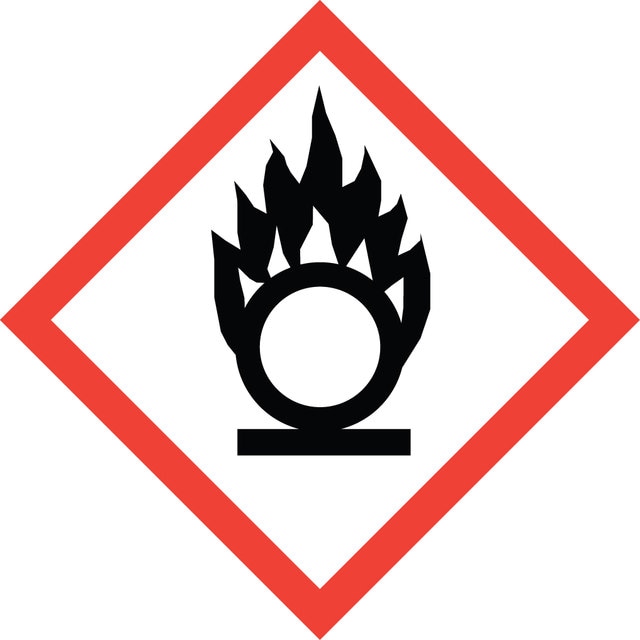


Signal Word
Danger
Hazard Codes
Precautionary Statements
Hazard Classifications
Aquatic Chronic 4 - Carc. 1A Inhalation - Ox. Sol. 2 - Skin Sens. 1 - STOT RE 1 Inhalation
Storage Class
5.1B - Oxidizing hazardous materials
WGK
WGK 1
Flash Point (°F)
Not applicable
Flash Point (°C)
Not applicable
PPE (personal protective equipment)
Eyeshields, Faceshields, Gloves, type P3 (EN 143) respirator cartridges
Choose from one of the most recent versions:
Already Own This Product?
Find documentation for the products that you have recently purchased in the Document Library.