04078

Hydrogen peroxide–Urea adduct
powder, 15-17% active oxygen basis
Synonym(s):
Carbamide Per hydrate, Carbamide peroxide, Percarbamide, Urea hydrogen peroxide
Sign In to View Organizational & Contract Pricing.
Select a Size
Change View
About This Item
Linear Formula:
CO(NH2)2 · H2O2
CAS Number:
Molecular Weight:
94.07
UNSPSC Code:
12352111
NACRES:
NA.22
PubChem Substance ID:
EC Number:
204-701-4
Beilstein/REAXYS Number:
3680414
MDL number:
eCl@ss:
32150917
vapor pressure
23.3 mmHg ( 30 °C)
Quality Segment
form
powder
composition
active oxygen, 15-17%
reaction suitability
reagent type: oxidant
mp
85-90 °C (dec.), 90-93 °C (lit.)
functional group
amine
SMILES string
OO.NC(N)=O
InChI
1S/CH4N2O.H2O2/c2-1(3)4;1-2/h(H4,2,3,4);1-2H
InChI key
AQLJVWUFPCUVLO-UHFFFAOYSA-N
General description
Hydrogen peroxide–Urea adduct is a compound composed of hydrogen peroxide (H2O2) and urea (CO(NH2)2) in equal amount. UHP, also known as carbamide peroxide, is manufactured industrially as a solid source of hydrogen peroxide for bleaching, disinfection, and oxidation reactions.
Application
Hydrogen peroxide–Urea adduct is used as an oxidizing agent.
Features and Benefits
Hydrogen peroxide–Urea (HPU) adduct is
- Inexpensive
- Commercially available
- Stable solid.
Still not finding the right product?
Explore all of our products under Hydrogen peroxide–Urea adduct
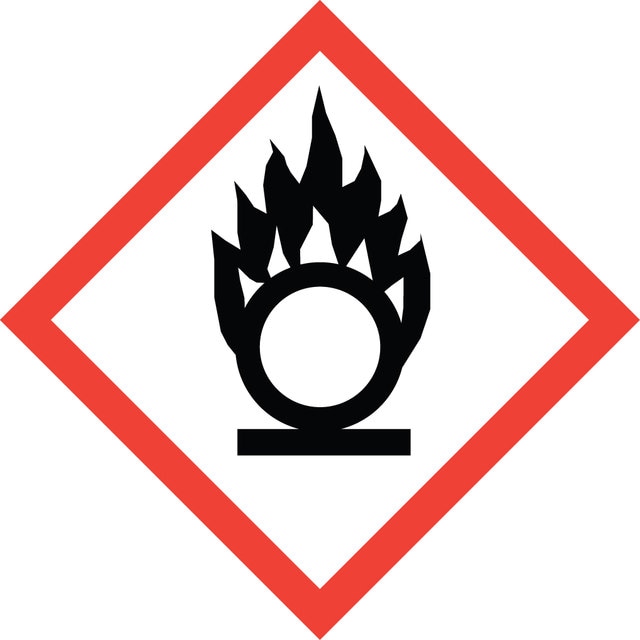

Signal Word
Danger
Hazard Codes
Precautionary Statements
Hazard Classifications
Eye Dam. 1 - Ox. Sol. 3 - Skin Irrit. 2
Storage Class
5.1B - Oxidizing hazardous materials
Flash Point (°F)
Not applicable
Flash Point (°C)
Not applicable
PPE (personal protective equipment)
Eyeshields, Faceshields, Gloves, type P3 (EN 143) respirator cartridges
Choose from one of the most recent versions:
Already Own This Product?
Find documentation for the products that you have recently purchased in the Document Library.