
695025

Nitric acid
reagent grade, fuming, >90%
Sign In to View Organizational & Contract Pricing.
Select a Size
Change View
About This Item
Empirical Formula (Hill Notation):
HNO3
CAS Number:
Molecular Weight:
63.01
UNSPSC Code:
12352106
PubChem Substance ID:
MDL number:
eCl@ss:
38060304
Assay:
>90%
Form:
liquid
Grade:
reagent grade
grade
reagent grade
vapor pressure
8 mmHg ( 20 °C)
assay
>90%
form
liquid
color
colorless to dark yellow
bp
120.5 °C (lit.)
SMILES string
O[N+]([O-])=O
InChI
1S/HNO3/c2-1(3)4/h(H,2,3,4)
InChI key
GRYLNZFGIOXLOG-UHFFFAOYSA-N
Other Notes
A -D suffix exists for administrative purposes only.
All -D packages are 100% the same product, same quality, same specification as the package sizes previously sold without a -D.
All -D packages are 100% the same product, same quality, same specification as the package sizes previously sold without a -D.
Still not finding the right product?
Explore all of our products under Nitric acid
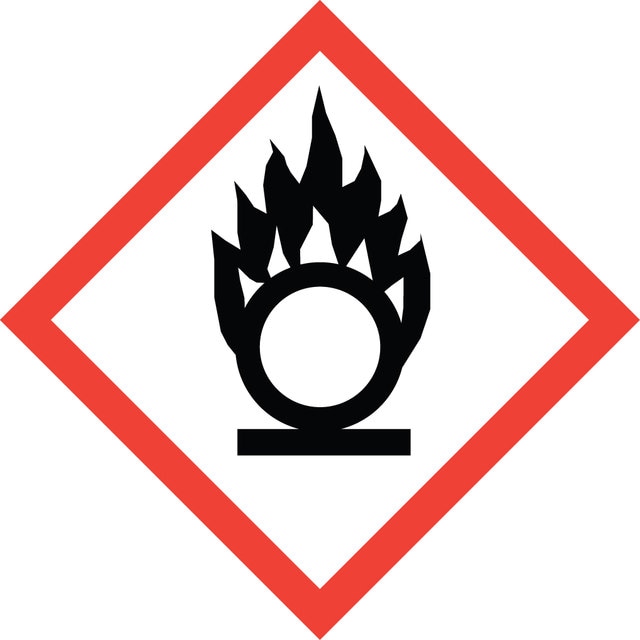


signalword
Danger
hcodes
Hazard Classifications
Acute Tox. 3 Inhalation - Eye Dam. 1 - Met. Corr. 1 - Ox. Liq. 2 - Skin Corr. 1A - STOT SE 3
target_organs
Respiratory system
supp_hazards
Storage Class
5.1A - Strongly oxidizing hazardous materials
wgk
WGK 2
flash_point_f
Not applicable
flash_point_c
Not applicable
ppe
Faceshields, Gloves, Goggles, type ABEK (EN14387) respirator filter
Regulatory Information
新产品
This item has
Choose from one of the most recent versions:
Already Own This Product?
Find documentation for the products that you have recently purchased in the Document Library.
Alyson M Baergen et al.
Environmental science & technology, 47(2), 815-820 (2012-12-15)
The fate of NO(x) (=NO + NO(2)) is important to understand because NO(x) is a significant player in air quality determination through its role in O(3) formation. Here we show that renoxification of the urban atmosphere may occur through the
Stijn Smulders et al.
Toxicological sciences : an official journal of the Society of Toxicology, 141(1), 132-140 (2014-06-14)
The unique physical and chemical properties of nanomaterials have led to their increased use in many industrial applications, including as a paint additive. For example, titanium dioxide (TiO2) engineered nanoparticles (ENPs) have well-established anti-UV, self-cleaning, and air purification effects. Silver
Paul A Adlard et al.
Neurobiology of disease, 81, 196-202 (2015-01-01)
Zinc transporter-3 (ZnT3) protein is responsible for loading zinc into presynaptic vesicles and consequently controls the availability of zinc at the glutamatergic synapse. ZnT3 has been shown to decline with age and in Alzheimer's disease (AD) and is crucially involved