Skip to Content
Merck
CN

232653

Chromium(VI) oxide

ReagentPlus®, 99.9% trace metals basis

Synonym(s):

Chromic anhydride

Sign In to View Organizational & Contract Pricing.

Select a Size


About This Item

Empirical Formula (Hill Notation):
CrO3
CAS Number:
Molecular Weight:
99.99
NACRES:
NA.55
PubChem Substance ID:
UNSPSC Code:
12352303
EC Number:
215-607-8
MDL number:
Assay:
99.9% trace metals basis
Form:
(powder and or flakes)
Technical Service
Need help? Our team of experienced scientists is here for you.
Let Us Assist
Technical Service
Need help? Our team of experienced scientists is here for you.
Let Us Assist

InChI key

WGLPBDUCMAPZCE-UHFFFAOYSA-N

InChI

1S/Cr.3O

SMILES string

O=[Cr](=O)=O

product line

ReagentPlus®

assay

99.9% trace metals basis

form

(powder and or flakes)

pH

<1 (20 °C, 100 g/L)

mp

196 °C (dec.) (lit.)

Quality Level

Looking for similar products? Visit Product Comparison Guide

Related Categories

General description

Chromium (VI) oxide is acidic anhydride of chromic acid. It is a useful oxidizing reagent for the conversions of:,Carbon-hydrogen bonds to alcohols,,Alkenes to α, β-unsaturated ketones,Alcohol to aldehydes, acids, and keto acids.

Application

Chromium (VI) oxide may be employed as a catalyst for the following reactions:
  • Transformation of various primary alcohols to carboxylic acids.
  • Oxidation of arenes (naphthalenes and anthrathene) to the corresponding quinones by using periodic acid as the terminal oxidant in acetonitrile.
  • Benzylic oxidation of various substituted toluene to the corresponding benzoic acids.
  • Oxidation of sulfides to sulfones.

Used with ammonium chloride to oxidize hydrobenzoins to benzils.

Legal Information

ReagentPlus is a registered trademark of Merck KGaA, Darmstadt, Germany

signalword

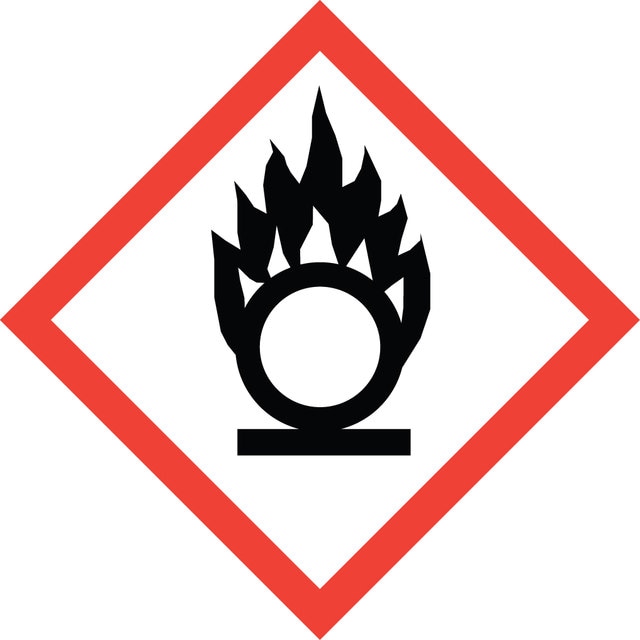
Danger

Hazard Classifications

Acute Tox. 2 Inhalation - Acute Tox. 3 Dermal - Acute Tox. 3 Oral - Aquatic Acute 1 - Aquatic Chronic 1 - Carc. 1A - Eye Dam. 1 - Muta. 1B - Ox. Sol. 1 - Repr. 2 - Resp. Sens. 1 - Skin Corr. 1A - Skin Sens. 1 - STOT RE 1 Inhalation - STOT SE 3

target_organs

Respiratory system

Storage Class

5.1A - Strongly oxidizing hazardous materials

wgk

WGK 3

flash_point_f

Not applicable

flash_point_c

Not applicable

Regulatory Information

危险化学品
This item has

Choose from one of the most recent versions:

Certificates of Analysis (COA)

Lot/Batch Number

Don't see the Right Version?

If you require a particular version, you can look up a specific certificate by the Lot or Batch number.

Already Own This Product?

Find documentation for the products that you have recently purchased in the Document Library.

Visit the Document Library

Letters in Organic Chemistry, 3, 842-842 (2006)
Chromium (VI) Oxide.
Freeman F, et al.
e-EROS Encyclopedia of Reagents for Organic Synthesis. (2008)
Chromium (VI) oxide-catalyzed oxidation of arenes with periodic acid.
Yamazaki S.
Tetrahedron Letters, 42(19), 3355-3357 (2001)
Sara L Holland et al.
Toxicology in vitro : an international journal published in association with BIBRA, 24(6), 1764-1767 (2010-07-20)
Toxicity of the environmental carcinogen chromate is known to involve sulfur starvation and also error-prone mRNA translation. Here we reconcile those facts using the yeast model. We demonstrate that: (i) cysteine and methionine starvation mimic Cr-induced translation errors, (ii) genetic
Evidence for the protective effect of ascorbic acid (vitamin C) in treatment with gamma-rays and chromium (VI) oxide (CrO3) in somatic cells of Drosophila.
O Olvera et al.
Mutation research, 346(1), 19-21 (1995-01-01)

Our team of scientists has experience in all areas of research including Life Science, Material Science, Chemical Synthesis, Chromatography, Analytical and many others.

Contact Technical Service