Skip to Content
Merck
CN

62580

Lithium perchlorate

purum p.a., ≥98.0% (calc. based on dry substance, T), powder

Sign In to View Organizational & Contract Pricing.

Select a Size


About This Item

Linear Formula:
LiClO4
CAS Number:
Molecular Weight:
106.39
NACRES:
NA.21
PubChem Substance ID:
UNSPSC Code:
12352302
EC Number:
232-237-2
MDL number:
Assay:
≥98.0% (calc. based on dry substance, T)
Form:
powder
Solubility:
alcohol: soluble(lit.)
water: soluble(lit.)
Technical Service
Need help? Our team of experienced scientists is here for you.
Let Us Assist
Technical Service
Need help? Our team of experienced scientists is here for you.
Let Us Assist

Product Name

Lithium perchlorate, purum p.a., ≥98.0% (calc. based on dry substance, T), powder

InChI key

MHCFAGZWMAWTNR-UHFFFAOYSA-M

InChI

1S/ClHO4.Li/c2-1(3,4)5;/h(H,2,3,4,5);/q;+1/p-1

SMILES string

[Li+].[O-]Cl(=O)(=O)=O

grade

purum p.a.

assay

≥98.0% (calc. based on dry substance, T)

form

powder

reaction suitability

reagent type: oxidant

impurities

≤3% water

pH

6.0-9.5 (25 °C, 106.4 g/L)

mp

236 °C (lit.)

solubility

alcohol: soluble(lit.)
water: soluble(lit.)

anion traces

chloride (Cl-): ≤50 mg/kg
sulfate (SO42-): ≤200 mg/kg

cation traces

Ca: ≤100 mg/kg
Cd: ≤50 mg/kg
Co: ≤50 mg/kg
Cu: ≤50 mg/kg
Fe: ≤50 mg/kg
K: ≤500 mg/kg
Na: ≤100 mg/kg
Ni: ≤50 mg/kg
Pb: ≤50 mg/kg
Zn: ≤50 mg/kg

Quality Level

Looking for similar products? Visit Product Comparison Guide

Application

Lithium perchlorate (LiClO4) may be used as a catalyst in the synthesis of bis(indolyl)methanes and in the Baylis-Hillman coupling reaction of α,β-unsaturated carbonyl compounds with aldehydes.

General description

Lithium perchlorate (LiClO4) is a colorless lithium salt. Upon crystallization from its aqueous solution, it affords lithium perchlorate trihydrate (LiClO4.3H2O). It can be synthesized by reacting lithium chloride with perchloric acid.

signalword

Danger

Hazard Classifications

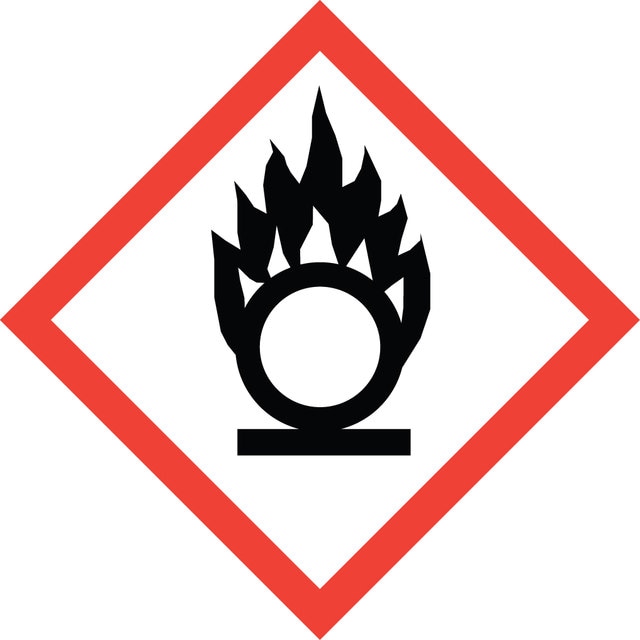
Acute Tox. 4 Oral - Eye Dam. 1 - Ox. Sol. 2 - Skin Corr. 1A - STOT SE 3

target_organs

Respiratory system

Storage Class

5.1A - Strongly oxidizing hazardous materials

wgk

WGK 1

flash_point_f

Not applicable

flash_point_c

Not applicable

Regulatory Information

易制爆化学品
危险化学品
This item has

Choose from one of the most recent versions:

Certificates of Analysis (COA)

Lot/Batch Number

Don't see the Right Version?

If you require a particular version, you can look up a specific certificate by the Lot or Batch number.

Already Own This Product?

Find documentation for the products that you have recently purchased in the Document Library.

Visit the Document Library

Lithium perchlorate-accelerated Baylis-Hillman reactions.
Kawamura M and Kobayashi S.
Tetrahedron Letters, 40(8), 1539-1542 (1999)
Lithium perchlorate catalyzed reactions of indoles: An expeditious synthesis of bis (indolyl) methanes.
Yadav JS, et al.
Synthesis, 2001(5), 0783-0787 (2001)
Witold Darlewski et al.
Journal of hazardous materials, 175(1-3), 460-467 (2009-11-17)
A process of dibutyl sulphide (DBS) electro-oxidation using electrolysis and cyclic voltamperometry was investigated in water-methanol solution using different electrodes (platinum, boron doped diamond, graphite and glassy carbon). Obtained results indicate that the DBS electro-oxidation process is irreversible in voltamperometric
Francisco Palacios et al.
The Journal of organic chemistry, 67(7), 2131-2135 (2002-04-02)
Functionalized keto-enamines 6 were obtained by nucleophilic addition of enol ethers to the imine moiety of 2-azadienes derived from dehydroaspartic esters 4. Reactions of 2-azadiene 4c containing three electron-withdrawing substituents (CO(2)R) with enol ethers 5 in the presence of lithium
Yu-Chuan Liu et al.
Analytica chimica acta, 584(2), 433-438 (2007-03-28)
In this work, the effect of supplemental LiClO(4) electrolytes in KCl solutions used in roughening silver substrates by electrochemical triangular-wave oxidation-reduction cycles (ORC) on surface-enhanced Raman scattering (SERS) was first investigated. To prepare SERS-active substrates by ORC procedures, electrolytes of

Our team of scientists has experience in all areas of research including Life Science, Material Science, Chemical Synthesis, Chromatography, Analytical and many others.

Contact Technical Service