Skip to Content
Merck
CN

M7750

Mercury Orange

powder

Synonym(s):

1-(4-Chloromercuriophenylazo)-2-naphthol

Sign In to View Organizational & Contract Pricing.

Select a Size


About This Item

Empirical Formula (Hill Notation):
C16H11ClHgN2O
CAS Number:
Molecular Weight:
483.31
UNSPSC Code:
12171500
PubChem Substance ID:
EC Number:
221-358-6
MDL number:
Technical Service
Need help? Our team of experienced scientists is here for you.
Let Us Assist
Technical Service
Need help? Our team of experienced scientists is here for you.
Let Us Assist

InChI key

CDEIGFNQWMSEKG-QIKYXUGXSA-M

InChI

1S/C16H11N2O.ClH.Hg/c19-15-11-10-12-6-4-5-9-14(12)16(15)18-17-13-7-2-1-3-8-13;;/h2-11,19H;1H;/q;;+1/p-1/b18-17+;;

SMILES string

Oc1ccc2ccccc2c1\N=N\c3ccc([Hg]Cl)cc3

form

powder

color

dark red

Looking for similar products? Visit Product Comparison Guide

Disclaimer

For U.S. Customers: Contains mercury; Do not place in trash - dispose according to local, state, or federal laws.

signalword

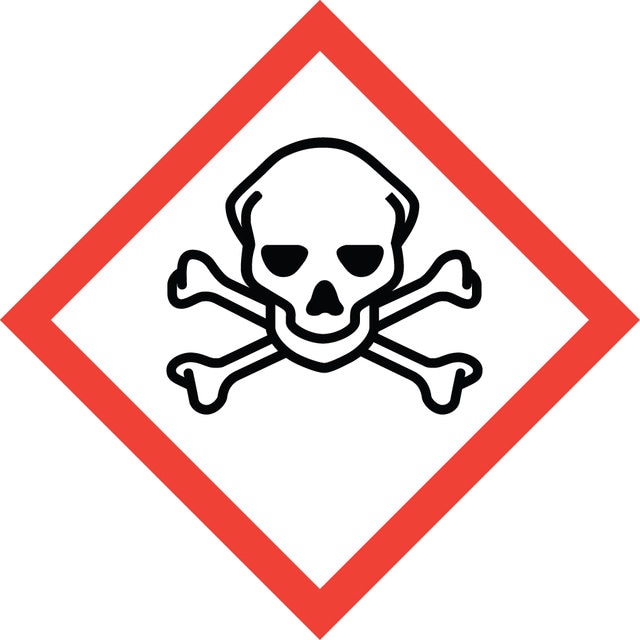
Danger

Hazard Classifications

Acute Tox. 1 Inhalation - Acute Tox. 2 Dermal - Acute Tox. 2 Oral - Aquatic Acute 1 - Aquatic Chronic 1 - STOT RE 2

Storage Class

6.1A - Combustible acute toxic Cat. 1 and 2 / very toxic hazardous materials

wgk

WGK 3

flash_point_f

Not applicable

flash_point_c

Not applicable

ppe

Eyeshields, Faceshields, Gloves, type P3 (EN 143) respirator cartridges

Regulatory Information

新产品
This item has

Choose from one of the most recent versions:

Certificates of Analysis (COA)

Lot/Batch Number

Don't see the Right Version?

If you require a particular version, you can look up a specific certificate by the Lot or Batch number.

Already Own This Product?

Find documentation for the products that you have recently purchased in the Document Library.

Visit the Document Library

H Szydłowska et al.
Polish journal of pharmacology and pharmacy, 32(4), 557-565 (1980-07-01)
Studies carried out with 34 chemicals (drugs or food additives) previously screened for the teratogenic activity revealed that the compounds which had shown teratogenic properties blocked or markedly depressed the intensity of an in vitro histochemical reaction for SH groups
David W Hedley et al.
International journal of radiation oncology, biology, physics, 61(1), 137-144 (2005-01-05)
The non-protein sulfydryls (NPSH) glutathione and cysteine are able to effect chemical repair of radiation-induced DNA damage, particularly under hypoxic conditions, and are implicated in radioresistance. The levels of NPSH in the nucleus are predicted to be more important than
A Larrauri et al.
The journal of histochemistry and cytochemistry : official journal of the Histochemistry Society, 35(2), 271-274 (1987-02-01)
Thiol groups of glutathione react with the organomercurial azo dye mercury orange at a faster rate than with -SH groups of proteins. This property makes possible visualization of glutathione in cells without appreciable interference from other -SH groups. To render
M J Beck et al.
Toxicological sciences : an official journal of the Society of Toxicology, 62(1), 92-102 (2001-06-16)
Glutathione (GSH), cysteine, and other low-molecular-weight thiols (LMWT) play a vital role in the detoxication of xenobiotics and endogenous chemicals. Differential alterations of LMWT status in various cell types of the developing embryo may underlie cell-specific sensitivity or resistance to
P Chieco et al.
The journal of histochemistry and cytochemistry : official journal of the Histochemistry Society, 31(7), 975-976 (1983-07-01)
We performed glutathione (GSH) staining at a low temperature to prevent GSH release from the section and, hence, improve morphology. Fresh frozen sections of liver, lung, kidney, heart, and stomach were incubated for GSH activity in an ice bath (2-5

Our team of scientists has experience in all areas of research including Life Science, Material Science, Chemical Synthesis, Chromatography, Analytical and many others.

Contact Technical Service