
V001092

Nitric acid
fuming, 99.5%
Sign In to View Organizational & Contract Pricing.
Select a Size
Change View
About This Item
Empirical Formula (Hill Notation):
HNO3
CAS Number:
Molecular Weight:
63.01
EC Number:
231-714-2
PubChem Substance ID:
MDL number:
eCl@ss:
38060304
vapor pressure
8 mmHg ( 20 °C)
assay
99.5%
bp
120.5 °C (lit.)
SMILES string
O[N+]([O-])=O
InChI
1S/HNO3/c2-1(3)4/h(H,2,3,4)
InChI key
GRYLNZFGIOXLOG-UHFFFAOYSA-N
Still not finding the right product?
Explore all of our products under Nitric acid
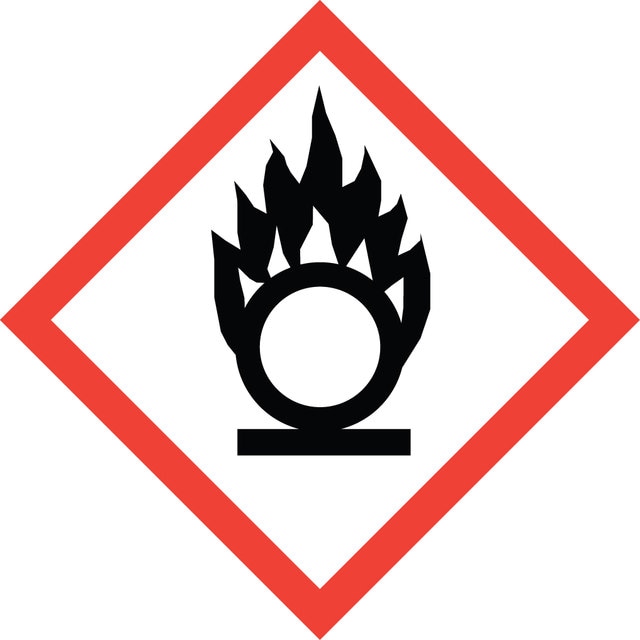


signalword
Danger
hcodes
Hazard Classifications
Acute Tox. 3 Inhalation - Eye Dam. 1 - Met. Corr. 1 - Ox. Liq. 3 - Skin Corr. 1A
supp_hazards
Storage Class
5.1A - Strongly oxidizing hazardous materials
wgk
WGK 2
flash_point_f
Not applicable
flash_point_c
Not applicable
Regulatory Information
新产品
This item has
Choose from one of the most recent versions:
Already Own This Product?
Find documentation for the products that you have recently purchased in the Document Library.
Nicole McGowan et al.
The Science of the total environment, 494-495, 177-186 (2014-07-22)
Microchemical analysis of otolith (calcified 'ear stones' used for balance and orientation) of fishes is an important tool for studying their environmental history and management. However, the spatial resolution achieved is often too coarse to examine short-term events occurring in
Lauren E Kremer et al.
Journal of inorganic biochemistry, 147, 227-234 (2015-05-11)
Uncontrolled reactions in biological media are a main obstacle for clinical translation of V-based anti-diabetic or anti-cancer pro-drugs. We investigated the use of controlled-release pharmaceutical formulations to ameliorate this issue with a series of V(V) and (IV) complexes of anionic
Stijn Smulders et al.
Toxicological sciences : an official journal of the Society of Toxicology, 141(1), 132-140 (2014-06-14)
The unique physical and chemical properties of nanomaterials have led to their increased use in many industrial applications, including as a paint additive. For example, titanium dioxide (TiO2) engineered nanoparticles (ENPs) have well-established anti-UV, self-cleaning, and air purification effects. Silver