
Crown Ethers and Cryptands for Advanced Applications
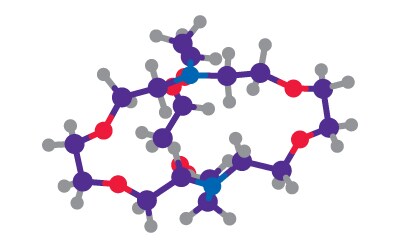
Molecular structure of Kryptofix® 222
Section Overview:
- Introduction
- Complexation Chemistry
- Crown Ethers: Monocyclic Complexing Agents
- Cryptands: Bicyclic Complexing Agents
- Crown Ethers and Cryptands in Synthesis
- Kryptofix® Cryptands
- Kryptofix® 222 in Radiotracer Synthesis
- Supramolecular Chemistry
- Comparative Analysis: Crown Ethers vs. Cryptands
- Related Products
Introduction
Crown ethers are monocyclic organic compounds composed of multiple ether groups arranged in a ring-like structure reminiscent of a crown. They were first discovered by Charles J. Pedersen during his efforts to modulate the catalytic activity of vanadium and copper complexes. The earliest example, dibenzo-18-crown-6, was synthesized unintentionally while Pedersen was attempting to prepare a phenolic ligand. This unexpected compound displayed a remarkable ability to selectively complex sodium ions, a finding that led to the identification of approximately 60 related compounds collectively known as coronates. Subsequent studies established optimal crown ether cavity sizes for different alkali metal ions and demonstrated their capacity to solubilize inorganic salts in otherwise incompatible solvents.¹
Building on these discoveries, cryptands were later developed as more sophisticated, bicyclic complexing agents capable of fully encapsulating metal cations to form exceptionally stable complexes known as cryptates.² The foundational contributions of Pedersen, along with Donald J. Cram and Jean-Marie Lehn, were recognized with the 1987 Nobel Prize in Chemistry for their pioneering work on structure-specific host–guest interactions. This body of work was instrumental in establishing supramolecular chemistry as a distinct field, centered on molecular recognition and the assembly of complex systems through noncovalent interactions.3
Complexation Chemistry
Coordination compounds, commonly referred to as complexes, are formed when a central metal atom binds to surrounding atoms, ions, or molecules known as ligands, which donate electron pairs to the metal center. These metal–ligand interactions are typically described as Lewis acid–base reactions and give rise to properties that differ markedly from those of the individual components.
Ligands may be monodentate, donating a single electron pair, or polydentate, donating multiple pairs that enhance complex stability through chelation. The coordination number, defined as the number of ligand donor atoms directly attached to the metal, generally ranges from 1 to 16 and strongly influences the geometry, reactivity, and overall behavior of the complex. Owing to these versatile interactions, coordination compounds are integral to a wide range of pharmaceutical applications and biological systems.⁴
Crown Ethers: Monocyclic Complexing Agents
Crown ethers are cyclic polyethers made of ether groups arranged in a ring, typically derived from ethylene oxide oligomers with repeating units of (CH₂CH₂O)ₙ, where n can be 4 (tetramer), 5 (pentamer), or 6 (hexamer). They follow the X-crown-Y nomenclature, where X indicates the total atoms in the ring and Y specifies the number of oxygen atoms.
Oxygen atoms in the ring selectively coordinate with cations, with binding affinity influenced by cavity size. For instance, 18-crown-6 has a strong affinity for K⁺, 15-crown-5 for Na⁺, and 12-crown-4 for Li⁺. Crown ethers have a hydrophobic exterior, aiding ion complexation in nonpolar environments.⁵
Owing to their conformational flexibility and the presence of both oxygen donors and ethylene bridges, crown ethers exhibit a balance of hydrophilic and lipophilic character.⁶ They readily form stable complexes with a variety of cations, in particular, alkali and alkaline earth ions (including ammonium ions), giving rise to 1:1 or 1:2 inclusion compounds known as coronates. In these structures, the cation is either is trapped within the crown ether cavity or sandwiched between two crown ether molecules.7 The stability of these complexes is greatest when the crown cavity size closely matches the guest cation's diameter.
Solvent effects further influence binding behavior; in aqueous systems, water molecules may participate directly in the coordination environment, altering complex stability relative to that observed in organic solvents.⁷
Cryptands: Bicyclic Complexing Agents
Cryptands are three-dimensional analogs of crown ethers8 featuring cage-like architectures in which one or more bridges span the cyclic framework.⁸,¹⁰ This structural feature creates an enclosed cavity that enables effective metal ion encapsulation. Despite their more rigid appearance, cryptands retain sufficient conformational flexibility to accommodate relatively large cations, while orienting donor atoms with high affinity for the metal center in close proximity for efficient coordination.⁹
The presence of a bridge unit enhances ion encapsulation, resulting in complexes that are generally more stable than those formed with crown ethers.10 C as their three-dimensional cavities preferentially bind specific alkali metal ions based on the match between cavity size and cation radius.⁸,¹⁰
As with crown ethers, substituting oxygen atoms with other heteroatoms or introducing organic substituents along the ring backbone can influence binding behavior. However, cryptands differ in that they coordinate guest ions through both oxygen and nitrogen donor sites, further strengthening metal–ligand interactions and contributing to their enhanced stability and selectivity.⁸,¹⁰
Crown Ethers and Cryptands in Synthesis
Crown ethers and cryptands are indispensable ligands in modern synthetic chemistry due to their ability to selectively complex metal cations, thereby enabling reactions that would otherwise be inaccessible. By binding and solvating cations, crown ethers render inorganic salts soluble in nonpolar organic solvents, effectively liberating reactive, poorly solvated anions. These “naked” anions exhibit enhanced nucleophilicity, basicity, or oxidizing power, making crown ethers especially valuable in phase-transfer catalysis and general synthesis.⁷,⁸
A classic example is 18-crown-6, which strongly complexes potassium ions and allows potassium salts to dissolve in nonpolar solvents such as toluene. This behavior enables reactions like the Wittig reaction and alkene oxidations under mild conditions, with systems such as KMnO₄ in toluene functioning as effective reagents.¹² The solubilizing effect of crown ethers parallels that of polar aprotic solvents (e.g., DMSO or DMF), in which cation solvation enhances SN2 reactivity by minimizing ion pairing.¹²
Cryptands exhibit similar phase-transfer capabilities but form even more stable metal complexes due to their three-dimensional encapsulation. This enhanced binding makes them particularly valuable in specialized synthetic applications, including the crystallization of Zintl ions, the preparation of electrides and alkalides, and the complexation of radiometals. Notably, cryptands such as Kryptofix® 222 are widely used in the synthesis of radiotracers for positron emission tomography (PET).¹¹
Beyond synthesis, both crown ethers and cryptands are effective tools for cation separation and identification, underscoring their broad utility in chemical analysis and radiochemistry.⁷
Kryptofix® Cryptands
Kryptofix®221 and Kryptofix® 222 (cryptand 221, C₁₈H₃₆N₂O₅, and cryptand 222, C₁₈H₃₆N₂O₆) are organic bicyclic compounds named for the number of ether donor groups in their three bridging chains connecting two tertiary amines (binding positions).⁸,⁹ These chains form a cage-like structure that can encapsulate metal cations via up to eight donor atoms (oxygen and nitrogen).
The flexible framework allows larger cations to enter the cavity, positioning donor atoms for strong metal–ligand interactions and partially shielding the cation from solvent, enhancing complex stability.
Kryptofix® cryptands adopt three main conformations—exo–exo, exo–endo, and endo–endo—based on nitrogen lone-pair orientation, which interconvert rapidly according to the environment, influencing binding. When cations are too large for full encapsulation, coordination can occur in an “exclusive” manner, retaining more solvation. The stability and preference of these binding modes can be analyzed via the thermodynamics of associated equilibria.⁹
Kryptofix® 222 in Radiotracer Synthesis
Positron emission tomography (PET) is a noninvasive imaging technique that enables three-dimensional visualization of physiological processes and biochemical pathways. The continued expansion of PET imaging relies on reliable access to radiopharmaceuticals, biologically active molecules labeled with short-lived radionuclides, most notably fluorine-18 (t₁/₂ = 109.77 min).¹³
Fluorine-18 is commonly produced by cyclotron irradiation of enriched target materials, typically heavy water containing ¹⁸O.¹³ In aqueous media, however, fluoride ions are strongly solvated and therefore exhibit poor nucleophilicity, limiting their direct use in labeling reactions. To overcome this challenge, a chelating agent such as Kryptofix® 222 is employed to sequester the counterion and effectively liberate “free” [¹⁸F]fluoride.
Supramolecular Chemistry
Crown ethers, as first-generation synthetic host molecules, have played a foundational role in the development of supramolecular chemistry and have been widely applied in supramolecular polymers, molecular machines, and drug delivery systems. However, their inherent conformational flexibility and relatively simple binding modes limit the degree of structural organization achievable in complex assemblies, driving ongoing efforts to modify and expand crown ether architectures.¹⁴
Cryptands, as three-dimensional derivatives of crown ethers, address these limitations through more rigid and preorganized frameworks that enable true encapsulation of guest species.¹⁴ This enhanced preorganization leads to host–guest complexes with substantially greater stability and higher ion selectivity than those formed by crown ethers. By incorporating additional binding sites and tunable structural arms, cryptands offer greater control over association processes and support the design of responsive, highly functionalized supramolecular systems.¹⁴
Comparative Analysis: Crown Ethers vs. Cryptands
The choice between crown ethers and cryptands depends on the balance required between binding strength, selectivity, and practical considerations.
Crown ethers are favored for cost-effectiveness and routine applications, whereas cryptands are selected when maximal binding strength and specificity are required.