Skip to Content
Merck
CN
HomeCross-CouplingBuchwald G6 Precatalysts: Oxidative Addition Complexes for Efficient L–Pd(0) Generation

Buchwald G6 Precatalysts: Oxidative Addition Complexes for Efficient L–Pd(0) Generation

The efficient generation of L–Pd(0) active species is critical to the development of efficient and robust cross-coupling reactions.1 Therefore, precatalysts with a pre-associated ligand to the metal center typically affords higher activity, shorter reaction time, and lower catalyst loading than a similar catalyst system which requires in-situ coordination of a ligand to the metal center.

Buchwald and coworkers have developed a family of Pd(0) precatalysts based on Pd(II) palladacycles with N,C-chelating ligands (Figure 1). These precatalysts are comprised of five generations (G1 through G5), which are distinguished by structural variations to the N,C-chelating ligand, and/or the anion X. Although the activation mode is the same for each precatalyst generation, deprotonation of the nitrogen leads to reductive elimination and generation of L–Pd(0). Each generation has unique advantages and disadvantages, which are described in previously published Technology Spotlights.2,3
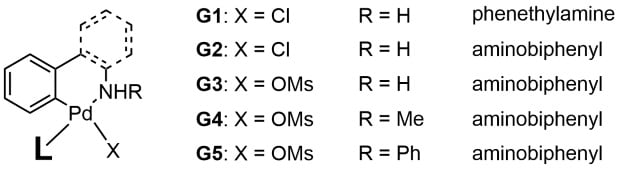
General breakdown of the main components of the first five generations of Buchwald precatalysts.

Figure 1.General Structures of Buchwald Precatalysts G1 to G5 (L = ligand)

The Buchwald G6 precatalysts are oxidative addition complexes (OACs), which exhibit the same advantages as the previous generations of Buchwald precatalysts: quantitative generation of L–Pd(0),  thermal stability, air stability, moisture stability, ease of handling, and high efficiency (Figure 2).4 Furthermore, G6 Buchwald precatalysts demonstrate several comparative advantages over the previous generations of Buchwald precatalysts.

Key Benefits of Buchwald G6 Oxidative Addition Precatalysts for Pd-catalyzed Cross-coupling

  • Catalyst activation does not require base and generates innocuous byproducts.
  • OAC precatalysts are “on-cycle” intermediates that typically have higher reactivity and selectivity.
  • Precatalyst synthesis is performed in a single step at room temperature.
  • Versatile and tunable precatalyst design:
    • Each of the three ligand types (X, L, and Ar) can be independently tuned to create a nearly endless number of precatalyst variations
    • Improved solubility, greater stability, increased reactivity, and/or easier purification can be achieved by design or selection of X, L, and Ar
    • Bulky ligands (e.g., tBuBrettPhos, AdBrettPhos, and AlPhos) are easily accommodated by G6 precatalysts
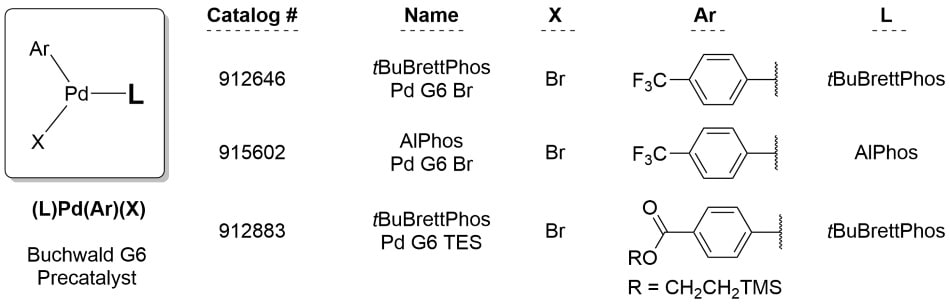
The diagram features a palladium (Pd) center with varying ligands (L) and substituents (X) across three precatalysts. The catalog numbers and names include: 912646 for rBuBrettPhos Pd G6 Br, 915602 for AlPhos Pd G6 Br, and 912883 for rBuBrettPhos Pd G6 TES, with the corresponding aryl groups (Ar) and ligands indicated.

Figure 2.General structures and catalog number examples of three Buchwald G6 precatalysts.

Broad Reaction Scope and Applications of Buchwald G6 Palladium Precatalysts

Buchwald G6 precatalysts and other OACs have been applied as effective catalysts for the formation of C–C, C–N, C–O, C–F, and C–S bonds.4-9 Screening and comparison studies of a variety of catalyst systems and precatalysts typically show that OAC precatalysts have superior reactivity, selectivity, reaction scope, and/or yields.


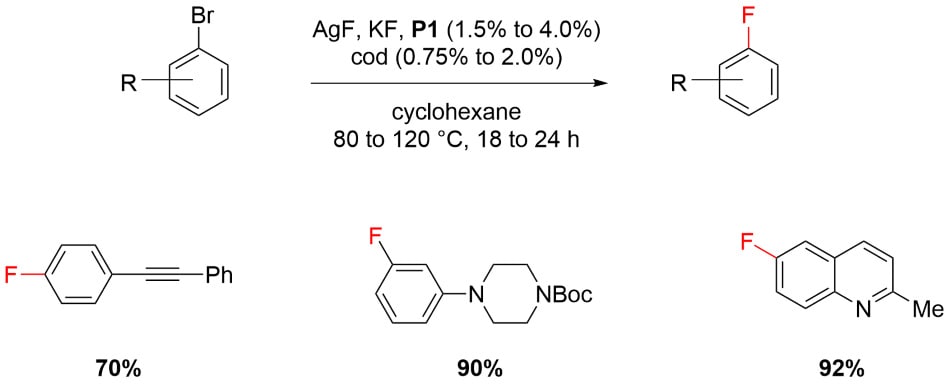
Fluorination of Aryl Bromides4

Reaction scheme showing the fluorination of an aryl bromide using P1 precatalyst from Table 1.

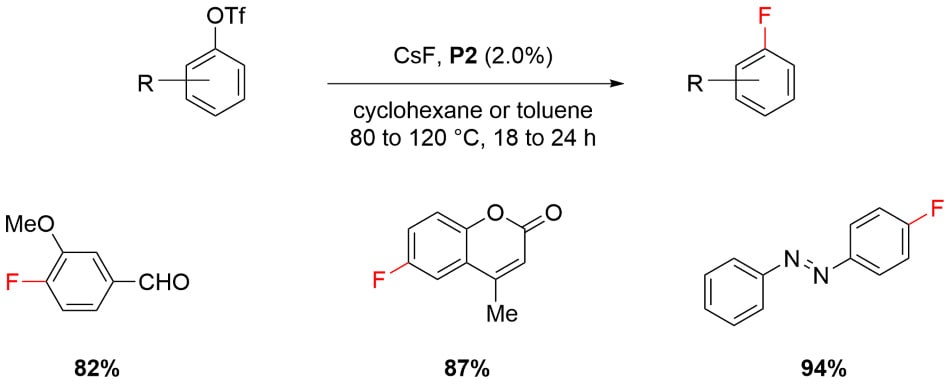
Fluorination of Aryl Triflates4

Reaction scheme showing the fluorination of an aryl triflate using P2 precatalyst from Table 1

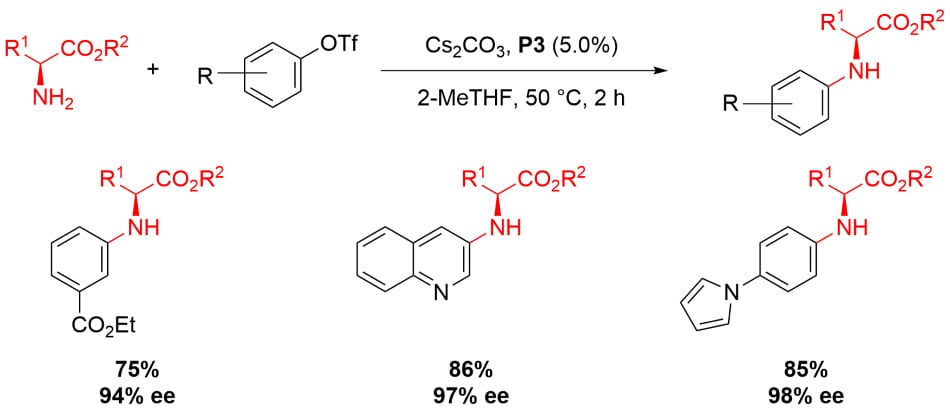
Amino Acid Ester Arylation4

Reaction scheme showing the arylation of an amino acid ester using P3 precatalyst from Table 1

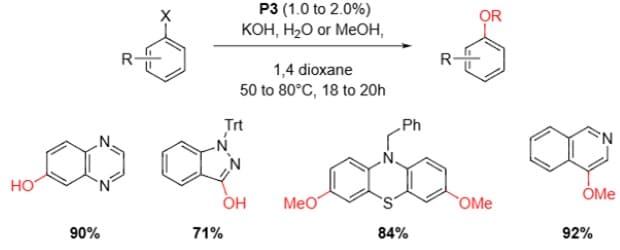
Alcohol and Hydroxide Coupling4

Reaction scheme showing alcohol-hydroxide coupling using P3 precatalyst from Table 1

Buchwald Hartwig Aminations with Primary Aliphatic Amines7
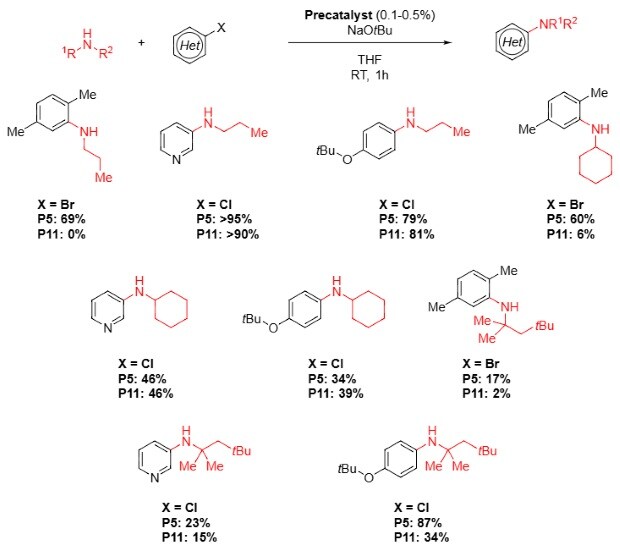
A chemical reaction diagram depicting the Buchwald-Hartwig amination involving primary aliphatic amines and different halides (X = Br, Cl). The image shows the reaction conditions (NaO tBu, precatalyst, THF, room temperature for 1 hour) and yields for various products (P5, P11) with percentages provided for each product structure across different conditions.

Buchwald Hartwig Amination with Alkyl Amines and N Heterocycles10
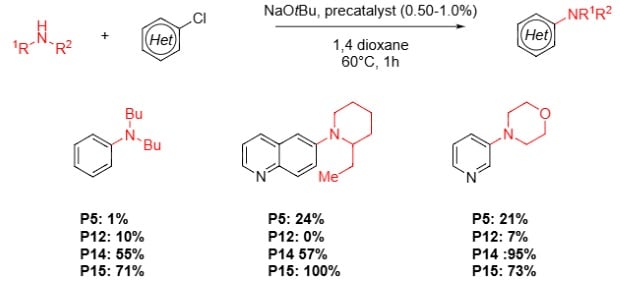
A chemical reaction diagram illustrating the Buchwald-Hartwig amination of alkyl amines with various heterocycles. The diagram includes reactants, conditions (NaO tBu, precatalyst, 1,4-dioxane, 60°C for 1 hour), and yields for different products (P5, P12, P14, P15) with percentages listed below each product structure.

Aliphatic Thiol Coupling of Hetero(Aryl) Bromides9
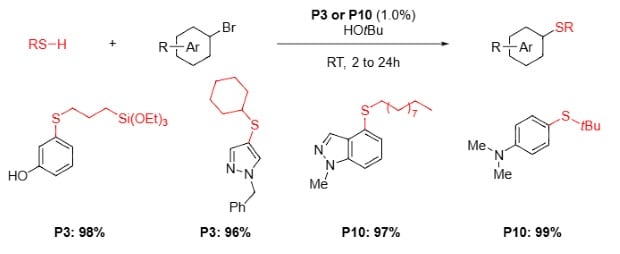
Reaction schemes showing aliphatic thiol coupling of hetero(aryl) bromides with either P3 or P11 precatalysts from Table 1

Buchwald-Hartwig Amination of Base-sensitive Five-membered Heteroaryl Halides and Aliphatic Amines11
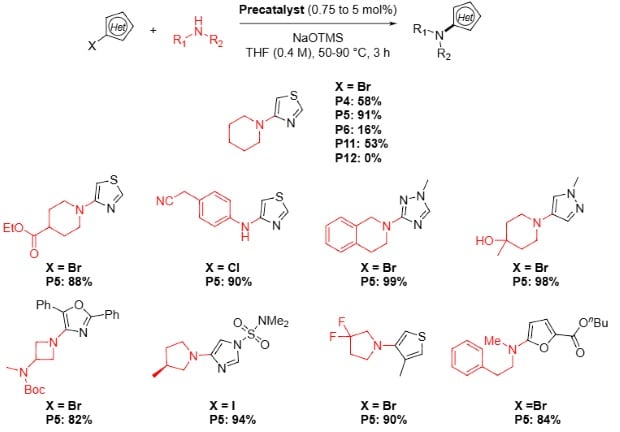
Reaction scheme showing a Buchwald Hartwig amination of  base sensitive five-membered heteroaryl halides and aliphatic amines using P9 precatalyst from Table 1 with different X groups including Br, Cl, and I on different heteroaryl-X

For reaction and application details, see supplemental data sheet: Buchwald G6 Precatalysts: Oxidative Addition Complexes for Efficient L–Pd(0) Generation

References

1.
Shaughnessy KH. 2019. Development of Palladium Precatalysts that Efficiently Generate LPd(0) Active Species. Isr. J. Chem.. 60(3-4):180-194. https://doi.org/10.1002/ijch.201900067
2.
2011. Technology Spotlight: 2nd Generation Buchwald Precatalysts. [Internet]. Available from: http://www.sigmaaldrich.com/technical-documents/technical-article/chemistry-and-synthesis/cross-coupling/2nd-generation-buchwald-precatalysts
4.
Ingoglia BT, Buchwald SL. 2017. Oxidative Addition Complexes as Precatalysts for Cross-Coupling Reactions Requiring Extremely Bulky Biarylphosphine Ligands. Org. Lett.. 19(11):2853-2856. https://doi.org/10.1021/acs.orglett.7b01082
5.
Dennis JM, White NA, Liu RY, Buchwald SL. 2018. Breaking the Base Barrier: An Electron-Deficient Palladium Catalyst Enables the Use of a Common Soluble Base in C-N Coupling. J. Am. Chem. Soc.. 140(13):4721-4725. https://doi.org/10.1021/jacs.8b01696
6.
Baumgartner LM, Dennis JM, White NA, Buchwald SL, Jensen KF. 2019. Use of a Droplet Platform To Optimize Pd-Catalyzed C-N Coupling Reactions Promoted by Organic Bases. Org. Process Res. Dev.. 23(8):1594-1601. https://doi.org/10.1021/acs.oprd.9b00236
7.
McCann SD, Reichert EC, Arrechea PL, Buchwald SL. 2020. Development of an Aryl Amination Catalyst with Broad Scope Guided by Consideration of Catalyst Stability. J. Am. Chem. Soc.. 142(35):15027-15037. https://doi.org/10.1021/jacs.0c06139
8.
Chen L, Francis H, Carrow BP. 2018. An "On-Cycle" Precatalyst Enables Room-Temperature Polyfluoroarylation Using Sensitive Boronic Acids. ACS Catal.. 8(4):2989-2994. https://doi.org/10.1021/acscatal.8b00341
9.
Xu J, Liu RY, Yeung CS, Buchwald SL. 2019. Monophosphine Ligands Promote Pd-Catalyzed C-S Cross-Coupling Reactions at Room Temperature with Soluble Bases. ACS Catal.. 9(7):6461-6466. https://doi.org/10.1021/acscatal.9b01913
10.
Feng K, Raguram ER, Howard JR, Peters E, Liu C, Sigman MS, Buchwald SL. 2024. Development of a Deactivation-Resistant Dialkylbiarylphosphine Ligand for Pd-Catalyzed Arylation of Secondary Amines. J. Am. Chem. Soc.. 146(39):26609-26615. https://doi.org/10.1021/jacs.4c09667
11.
Reichert EC, Feng K, Sather AC, Buchwald SL. 2023. Pd-Catalyzed Amination of Base-Sensitive Five-Membered Heteroaryl Halides with Aliphatic Amines. J. Am. Chem. Soc.. 1453323-3329. https://pubs.acs.org/doi/10.1021/jacs.2c13520
Sign In To Continue

To continue reading please sign in or create an account.

Don't Have An Account?