
Glycol Analysis in Cough Syrup Using an SPB®-624 GC Capillary Column
Abstract
Gas chromatography coupled to mass spectrometry detection (GC-MS/MS) was used as an analytical tool to analyze glycols present in commercial cough syrup samples with an SPB®-624 Capillary GC Column (60 m × 0.32 mm, df 1.80 μm). The developed method is able to separate and quantify ethylene glycol, propylene glycol, diethylene glycol, glycerin, and triethylene glycol and was used for commercial cough syrup preparations. For the quantification, certified reference materials (CRMs) were used. The method is partially validated for establishing the performance characteristics.
Section Overview
Introduction
Glycols are chemical compounds characterized by two hydroxyl groups attached to separate carbon atoms, commonly referred to as aliphatic diols.1 Various forms of glycols are utilized in industries for different purposes, such as liquid desiccants in air conditioning systems, antifreeze in car radiators2, and are also used as additives in hydraulic and brake fluids. Ethylene glycol is recognized as the simplest type. Diethylene, triethylene, and propylene glycols are oligomers of ethylene glycol. Ethylene glycol is a potent cause of acute toxicity in humans, in contrast, propylene glycol is a generally recognized as safe additive for foods and medications.3 Propylene glycol is generally considered safe, but for use in high doses or for prolonged periods, adverse effects including central nervous system (CNS) toxicity, hyperosmolarity, hemolysis, cardiac arrhythmia, seizures, agitation, and lactic acidosis are reported.4 Typically, colorless, and odorless, ethylene glycol and diethylene glycol have a sweet taste5 and are often considered inexpensive adulterants, making them attractive for commercial sectors involved in drug formulation, including pediatric drugs.
However, when glycols are added to drug formulations beyond recommended limits, they can be toxic to human health, potentially leading to acute hepatotoxicity, renal failure, and even death in some cases. In recent times fatal incidences were reported, e.g., from Indonesia and Gambia where ethylene glycol and diethylene glycol were found in syrup medicines. 6,7,8. As a response, the US Food and Drug Administration (US FDA) provided guidance for high-risk drug components 9 and the United States Pharmacopoeia (USP) revised the monograph for propylene glycol that addresses the toxicity concerns by specifying the limits for ethylene glycol and diethylene glycol in formulation components such as propylene glycol to be not more than (NMT) 0.1% to ensure quality standards for pharmaceutical products.10
Here a method for the simultaneous determination of 5 glycols using GC-MS/MS and certified reference materials (CRMs) for calibration is presented. Two commercially available cough syrups are analyzed unspiked and spiked. The developed method was partially validated as per the ICH recommended guidelines11 and used for determination of the minimum limit of detection and quantification of glycols.
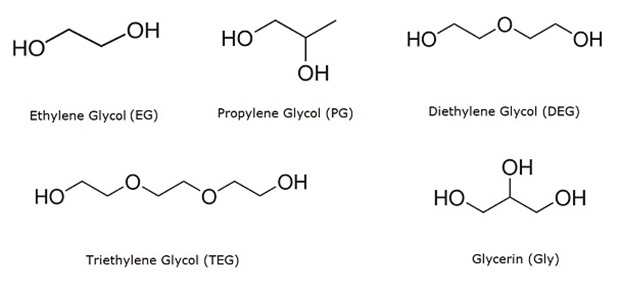
Chemical structures of ethylene glycol, propylene glycol, diethylene glycol, glycerin, and triethylene glycol.
Experimental
Standard preparation
The glycol standards were prepared as single component solutions of ethylene glycol (EG), propylene glycol (PG), diethylene glycol (DEG), glycerin (Gly), triethylene glycol (TEG) according to the following procedures using certified reference materials (CRMs) and methanol/water (95:5, v/v) as a diluent.
- Stock solutions (500 µg/mL): Weigh and transfer about 10 mg of glycol substance into a 20 mL volumetric flask, add about 10 mL of diluent and sonicate for 5 minutes, make up to volume with diluent and shake to mix thoroughly. The concentration of the glycol in the resulting solution is 500 µg/mL.
- Standard solution (SS, 25 µg/mL): Transfer 500 µL of each stock solution into a 10 mL volumetric flask, add 5 mL of diluent, and sonicate for 5 minutes. Then make up the volume with the diluent and mix thoroughly.
Calibration Solutions
Calibration solutions were prepared as single component solutions using the following dilution schemes:
- Ethylene Glycol: Transfer 50, 100, 250, 500, 750, and 1000 µL of ethylene glycol standard stock solution into individual 10 mL volumetric flasks and make up to volume with diluent. Sonicate for 5 minutes and mix thoroughly.
- Other glycols: Transfer 5, 10, 50, 100, 250, 500, 750, and 1000 µL of glycol standard stock solution into individual 10 mL volumetric flasks and make up to volume with diluent. Sonicate for 5 minutes and mix thoroughly. 0.25, 0.5, 2.5, 5.00, 12.50, 25.00, 37.50, 50.00 µg/mL
Sample Preparation
Two commercially available syrups (A & B) were used for the assessments. Cough syrup formulation B was rich in texture and more viscous as compared to formulation A. The formulation A is a combination medication designed to relieve cough accompanied by mucus, whereas formulation B is a combination cough syrup formulated to relieve dry cough and associated symptoms such as nasal congestion, sneezing, and throat irritation.
Syrup sample: Transfer 12 mg of commercially available cough syrup into a 10 mL volumetric flask, add 5 mL of diluent and sonicate for 5 minutes. Fill up to the mark with diluent and mix thoroughly.
Spiked Samples
- Spiked sample 1- PG & Gly (20.8 mg/g): Weigh 12 mg of syrup sample A into a 10 mL volumetric flask and add 500 µL of each of PG and Gly stock solutions. Make up to mark with diluent, mix thoroughly, and sonicate for 5 minutes. The solution contains 25 µg/mL of each glycol.
- Spiked sample 2- PG & Gly (41.7 mg/g): Weigh 12 mg of syrup sample A into a 10 mL volumetric flask and add 1000 µL of each of the PG and Gly stock solutions. Make up to mark with diluent, mix thoroughly, and sonicate for 5 minutes. The solution contains 50 µg/mL of each glycol.
- Spiked Sample 3- PG, DEG, TEG, Gly (20.8 mg/g): Weigh 12 mg of syrup sample B into a 10 mL volumetric flask, and add 500 µL of each of PG, DEG, TEG, and Gly stock solutions. Make up to mark with diluent, mix thoroughly, and sonicate for 5 minutes. The solution contains 50 µg/mL of each glycol.
- Spiked sample 4- PG, DEG, TEG, Gly (41.7 mg/g): Weigh and transfer 12 mg of commercially available sample B to a 10 mL volumetric flask, and add 1000 µL of each of PG, DEG, TEG, and Gly stock solutions. Make up to mark with diluent, mix thoroughly, and sonicate for 5 minutes. The solution contains 50 µg/mL of each glycol.
GC-MS Analysis
The GC-MS analysis (Table 1) was performed on an intermediate polarity SPB®-624 column. Depending upon the fragmentation recorded for each individual glycols, the selection of specific target ions and reference ions was selected for scanning at a defined retention time. Selection of the retention time was done as per the separation acquired by the developed method on the selected column (Table 2).
Results & Discussion
The developed method applying an SPB®-624 (60 m × 0.32 mm I.D., df 1.80 μm) capillary GC column and splitless injection showed good retention and sufficient resolution of the analytes in scope. A representative chromatogram of an analyte mixture at 25 µg/mL each is shown in Figure 1.
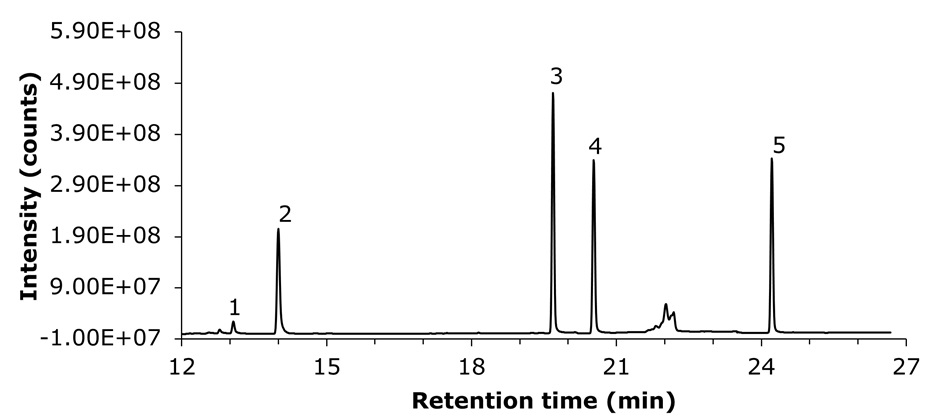
Figure 1.GC-MS chromatogram (SIM) for the standard solution (SS) mixture containing ethylene glycol (1), propylene glycol (2), diethylene glycol (3), glycerin (4), and triethylene glycol (5), prepared in diluent at 25 µg/mL each compound.
Calibration
The quantification was based on an external calibration using single reference standard solutions as described in the experimental section. The GC-MS method linearity for propylene glycol, diethylene glycol, glycerin, and triethylene glycol was established in the concentration range of 0.25 to 50 μg/mL, and for ethylene glycol 2.5-50 µg/mL. In Table 3 the experimental results, including the linearity (R2 ≥ 0.996) and the limits of detection (LOD) and limits of quantification (LOQ) are summarized. Based on the developed method’s linearity study, the minimum concentrations of glycols that can be detected in the injected solutions as per the ICH guidelines11 range from 2.46 µg/mL to 4.41 µg/mL, and the quantification can be done in the range of 7.46 µg/mL to 13.37 µg/mL.
Recovery Determination
For recovery determinations, four solutions were prepared with two spike concentration levels, 20.8 mg/g and 41.7 mg/g (25 and 50 µg/mL in the resulting injection solutions), and two sets of compounds (Tables 4 & 5) and two cough syrups (A & B). For recovery calculations, the existing glycol background was subtracted. The recovery for spiked syrup A (PG & Gly) ranged from 84.4 to 93.2%, for spiked syrup B (PG, DEG, Gly, TEG) 77.0 to 103.6%.
Reproducibility
The system repeatability was demonstrated by injecting five replicates of the standard solution (SS) containing mixture of glycol standards of ethylene glycol (EG), propylene glycol (PG), diethylene glycol (DG), glycerin (Gly), triethylene glycol (TG), prepared in diluent with 25 μg/mL each compound (see Figure 1 and for diluent blank Figure 2) The determined RSD ranged from 1.02-3.85% (Table 6).
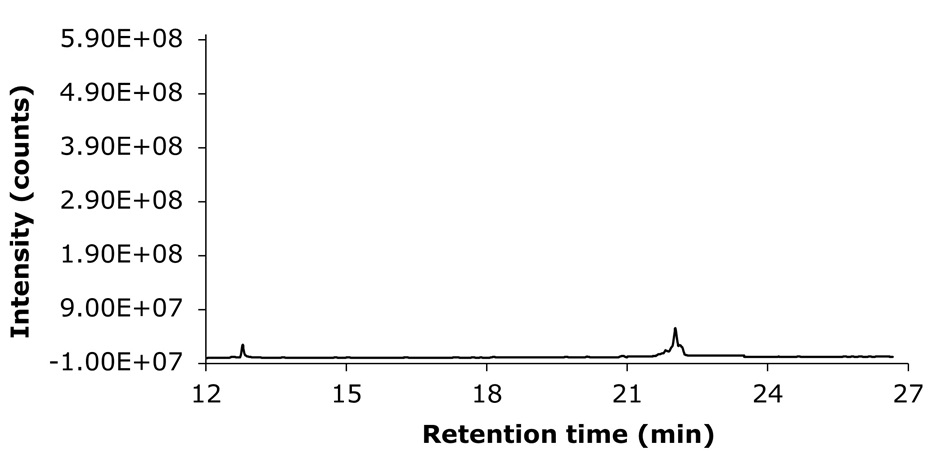
Figure 2.GC-MS chromatogram (TIC) for diluent (blank) containing methanol and water (95:5 v/v).
Original Sample Analysis
The method was applied for analyzing two different commercially available cough syrup samples (A & B) solutions (see Figure 3). Table 7 shows the results for the analysis of glycols present in the two commercially available cough syrup samples (A & B).
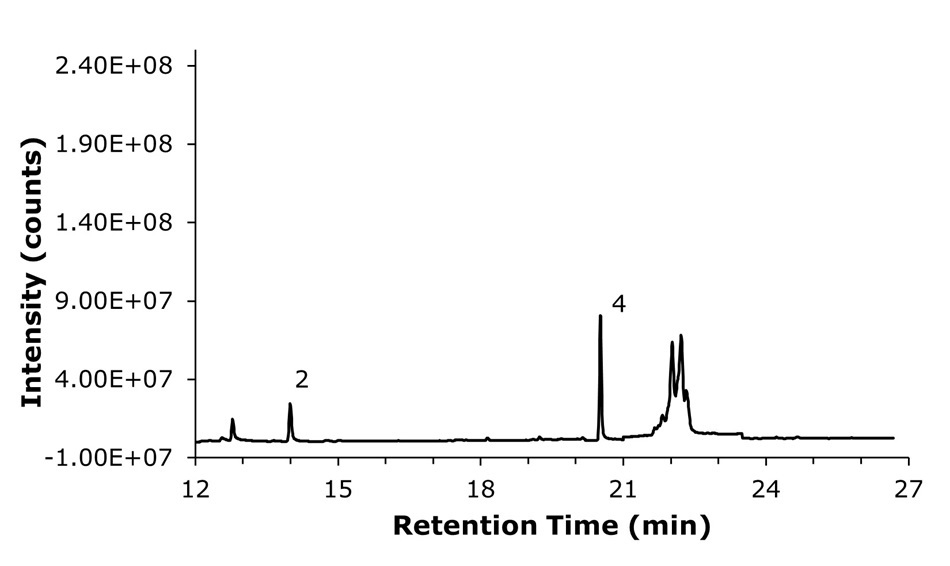
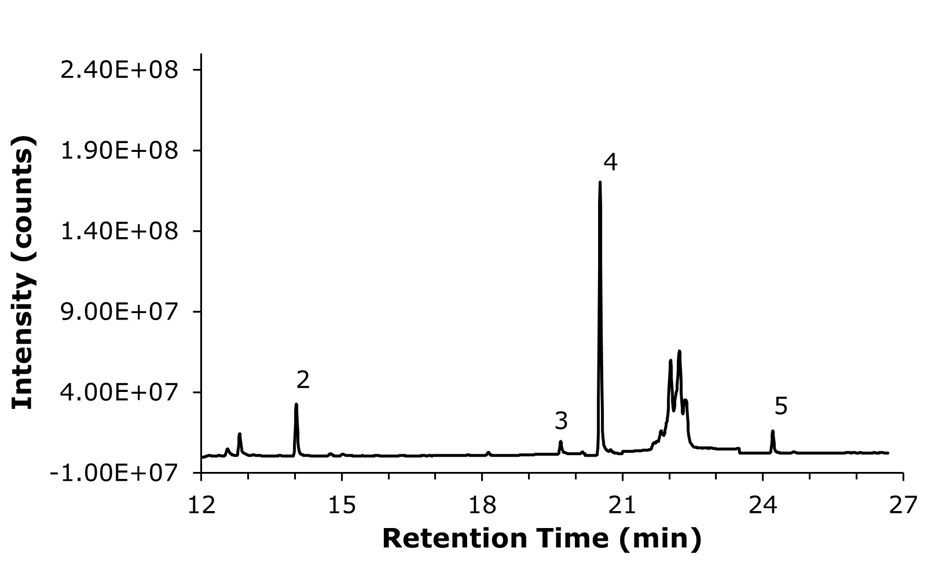
Figure 3. GC-MS chromatograms of commercially available cough syrups (left) sample A and (right) sample B. (2), diethylene glycol (3) glycerin (4), and triethylene glycol (5).
Conclusion
This study presents a GC-MS/MS method for quantifying ethylene glycol, propylene glycol, diethylene glycol, triethylene glycol, and glycerin in formulations utilizing an SPB®-624 capillary column. The % RSD for system repeatability with a standard solution (SS) of the glycol mixture was well below 10% (1.02 to 3.85%). Derived from the external calibration data (R2 ≥ 0.996), the GC methods were in the range of 2.46 µg/mL to 4.41 µg/mL. Two commercially available cough syrups were spiked with glycols and displayed recovery rates ranging from 77.2% to 103.6%. The investigated unspiked samples showed, besides a glycerin background for one and three other glycols respectively.