
Immunoassays for Cosmetics and Personal Care Research

With the growing popularity of cosmetics and personal care products, research around the safety of these products is critical. Immunoassays can be used in cosmetics and personal care research to assess biomarkers of inflammation, irritation, and more to find potential harmful effects of cosmetics.
Research Cosmetics and Personal Care Product Effects with Immunoassays
“Clean” cosmetics have become a hot topic in cosmetics research due to the growing concerns around the toxicology of cosmetics and the potential harmful effects of cosmetics. Biomarker immunoassays help cosmetics and personal care researchers characterize the interactions between a biological system and a potential hazard. Immunoassays allow direct monitoring research on the biological effects of cosmetic products by assessing markers of inflammation, sensitization, aging, and tissue regeneration among others.
These immunoassays can include:
- Multiplex immunoassays
- Ultrasensitive immunoassays
- ELISAs
Multiplex Immunoassays
Multiplex immunoassays are used in cosmetics and personal care research to analyze multiple biomarkers simultaneously. This includes analytes relating to the skin, MMPs and TIMPs, aging, cytokines, chemokines, growth factors, steroid/thyroid/pituitary hormones, and immunoglobulin isotyping.
Based on the Luminex® xMAP® platform, high-quality MILLIPLEX® multiplex assays can assist researchers with their analysis of these biomarkers while saving time and sample volume. Below describes specific research applications of MILLIPLEX® panels.
For Research Use Only. Not For Use In Diagnostic Procedures.
MMPs and TIMPs
The matrix metalloproteinases (MMPs) play a key role in normal physiological processes, such as embryonic development and tissue morphogenesis, tissue and bone remodeling, wound healing, and angiogenesis. An increase in MMP expression occurs in response to a wide range of stimuli, including adhesion molecules, growth factors, cytokines, and hormones.
The regulation of MMP activity is controlled primarily by tissue inhibitors of metalloproteinases (TIMPs). TIMPs also exhibit several other biochemical and physiological/biological functions such as proMMP activation, cell growth promotion, matrix binding, inhibition of angiogenesis, and the induction of apoptosis.
The MILLIPLEX® MMP and TIMP panels detect the analytes in question to help monitor these physiological processes.
Materials
Aging Biomarkers
The MILLIPLEX® Human Aging Panel 1 covers multifaceted biomarkers of aging-related conditions. Monitoring these novel biomarkers helps researchers understand the basic mechanisms that drive aging and eventually lead to improved clinical interventions for extending the human healthspan.
Mice are widely used models for both aging and senescence because of their similarity to humans. Aging-associated physiological changes and the pathological consequences of these changes make the elderly population vulnerable to many chronic diseases, such as cancer, heart disease, arthritis, osteoporosis, and cognitive decline. Many of these conditions have been modeled in mice. Over the years, intensive research of model organisms has provided fundamental evidence that aging can be delayed, and longevity extended. These findings gave rise to a new era in aging research aiming to elucidate the underlying mechanisms that drive the aging process.
The MILLIPLEX® Mouse Aging Panel 1 covers biomarkers of aging-related conditions. Monitoring these biomarkers helps researchers understand the complex biological process which may lead to new therapies postponing age-related diseases.
Cytokines, Chemokines, and Growth Factors
Cytokines are immunomodulatory polypeptides that play key roles in both adaptive and innate immune responses. These proteins also mediate direct interactions between cells and regulate processes taking place in the extracellular environment. Growth factors are involved in the stimulation of target cell survival, proliferation, and differentiation with effects on angiogenesis, vasculogenesis, cell migration, apoptosis, wound healing, and embryogenesis. Angiogenesis, the development of new vascular networks, is a key process in normal growth and development as well as in wound healing.
The transforming growth factor beta (TGFβ) system, a superfamily of cytokines as well as signaling pathways, functions in immune cell development, angiogenesis, wound healing, embryonic development, and bone development.
All of the MILLIPLEX® panels for these cytokines, chemokines, and growth factors can be used to help researchers better understand the signaling pathways and immune responses related to their research.
Materials
Steroid, Thyroid, and Pituitary Hormones
Steroid and thyroid hormones play key roles in the regulation of energy balance, mental and physical development, sex organ development, reproduction, and pregnancy. The MILLIPLEX® Multi-Species Hormone Panel allows the study of the biological functions of hormones in the reproductive cycle and in the pathophysiology of many diseases. This assay is a valuable tool for research on endocrine-disrupting chemicals.
Called the “master gland” because it controls many other endocrine glands, the pituitary gland secretes several key hormones that play important roles in the regulation of metabolism, growth, and reproduction. The MILLIPLEX® Rat Pituitary Magnetic Bead Panel is used for the simultaneous quantification of 7 rat pituitary hormones.
Immunoglobulin Isotyping
Found only in mammals, Immunoglobulin E (IgE) plays an essential role in allergic reactions, and is predominantly associated with type 1 hypersensitivity. IgE binds with high affinity to the receptor FcεRI, found primarily on mast cells and basophils, priming the cells to recognize specific antigens such as dust mites, pet dander, or pollen. Once primed and with repeated exposure to the same antigen, these cells release molecules such as histamines, prostaglandins, and leukotrienes, resulting in an “allergic reaction”. The MILLIPLEX® Human and Mouse IgE Singleplex Kits allow for monitoring of IgE levels and possible allergic reactions.
Don’t see what you need? Develop a new assay or customize an assay by contacting our expert Custom Assay Development & Innovation (CADI) services team.
For Research Use Only. Not For Use In Diagnostic Procedures.
Ultrasensitive Immunoassays
From inflammatory cytokines to dermal-specific proteins, researchers in the cosmetics and personal care product industry study biomarkers as molecular indicators of product safety and efficacy. The ultrasensitive Single Molecule Counting (SMC®) technology can contribute to these efforts by improving the study of early and low dose adverse effects from products, as well as more thoroughly tracking the downregulation of inflammatory biomarkers to evaluate product efficacy.
Combining the ultrasensitive SMC® technology with our easy-to-use FemtoQuest™ system and a menu of highly verified commercially available kits, you can enhance your key biomarker studies in a variety of sample types. Our custom assay development and sample testing services can also accelerate your research based on your precise biomarker needs.

Figure 1.Analyze using ultrasensitive SMC® technology on the FemtoQuest™ platform.
Materials
For Research Use Only. Not For Use In Diagnostic Procedures.
Enzyme-Linked Immunosorbent Assays (ELISAs)
ELISAs can be used in cosmetics research to analyze immune biomarkers and research any potential inflammatory processes from cosmetics or personal care products. Lot-to-lot consistency is crucial in this research where longitudinal studies are needed to investigate the long-term effects of cosmetics, as well as to perform research and development of new products.
The Conferma® ELISAs are a range of products designed to address lot-to-lot variability within immunoassays. Each assay uses a pair of monoclonal antibodies (mAbs) and a recombinant protein calibrator (standard and quality control) developed in-house. The reagents undergo significant physiochemical characterization to confirm their lot-to-lot consistency, in R&D and throughout the lifetime of the product (Table 1).
Applying these techniques allows for monitoring of the individual reagents, as well as confirming their relationship batch-to-batch against the calibrator material. Each lot of finished kits is evaluated against the previous batch using both a sample QC library and a comparison of the mathematical parallelism of the standard curves. Together, these tests ensure that the inter-assay variability continues to fall within the parameters established at the launch of the product.
Conferma® ELISAs can test cytokines which are markers often used by a laboratory over a long period, either as part of a longitudinal study or as a standard investigational tool. In either case, the Conferma® ELISA process will ensure consistent and reproducible performance (Figure 2).
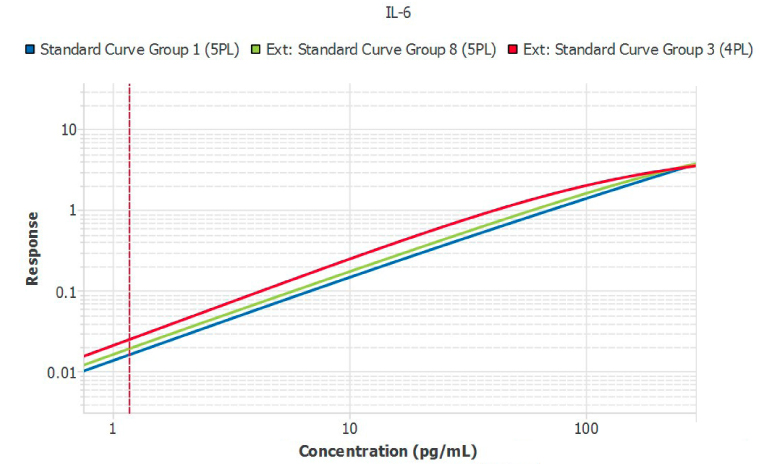
Figure 2.Mathematical parallelism of contrasted standard curves from individual plates of three lots of IL-6 ELISAs run by the same analyst. Lot 1 (blue line) was used as the reference curve for Lot 2 (green line) and Lot 3 (red line). Using Lot 1 as a reference, the slope ratio of Lots 2 and 3 was less than 0.1 indicating excellent similarity.
Materials
For Research Use Only. Not For Use In Diagnostic Procedures.
Highlighted Publications
See how our immunoassays are being used in cosmetics and personal care research.
MILLIPLEX® Panels
- Barcelos Cunha Azeredo D, et al. Endocrine-disrupting chemical, methylparaben, in environmentally relevant exposure promotes hazardous effects on the hypothalamus-pituitary-thyroid axis. Molecular and Cellular Endocrinology 2025. https://doi.org/10.1016/j.mce.2024.112444
- de Sousa Anselmo D, et al. The environmental contaminants, tributyltin and bisphenol S, alone or in combination, harm the hypothalamus-pituitary-gonadal axis and uterus. Molecular and Cellular Endocrinology 2025. https://doi.org/10.1016/j.mce.2025.112558
- Fujita K, et al. Pulmonary inflammation and immune responses induced by nanocellulose: Insights from in vivo and in vitro models. Current Research in Toxicology 2025. https://doi.org/10.1016/j.crtox.2025.100259
- Bacqueville D, et al. New Plant Extracts Exert Complementary Anti-Hair Loss Properties in Human In Vitro and Ex Vivo Models. Journal of Cosmetic Dermatology 2024. https://doi.org/10.1111/jocd.16616
- Ratanabunyong S, et al. Exploring the apoptotic effects of sericin on HCT116 cells through comprehensive nanostring transcriptomics and proteomics analysis. Scientific Reports 2024. https://doi.org/10.1038/s41598-024-52789-8
- Yegorov S, et al. Psoriasis Is Associated with Elevated Gut IL-1α and Intestinal Microbiome Alterations. Front Immunol. 2020. https://doi.org/10.3389/fimmu.2020.571319
- González-López MA, et al. Circulating levels of adiponectin, leptin, resistin and visfatin in nondiabetics patients with hidradenitis suppurativa. Arch Dermatol Res. 2020. https://doi.org/10.1007/s00403-019-02018-4
- Lee, JK, et al. Para-phenylenediamine, an oxidative hair dye ingredient, increases thymic stromal lymphopoietin and proinflammatory cytokines causing acute dermatitis. Toxicol Res. 2020. https://doi.org/10.1007/s43188-020-00041-6
- Fusco L, et al. Impact of the surface functionalization on nanodiamond biocompatibility: a comprehensive view on human blood immune cells. Carbon. 2019. https://doi.org/10.1016/j.carbon.2020.01.003
- Kerr K, et al. Epidermal changes associated with symptomatic resolution of dandruff: biomarkers of scalp health. 2010. https://doi.org/10.1111/j.1365-4632.2010.04629.x
SMC® Kits
- Stober B, et al. Apremilast mechanism of efficacy in systemic-naive patients with moderate plaque psoriasis: Pharmacodynamic results from the UNVEIL study. J Dermatol Sci. 2019. https://doi.org/10.1016/j.jdermsci.2019.09.003
- Tomalin LE, et al. Early quantification of systemic inflammatory proteins predicts long-term treatment response to Tofacitinib and Etanercept. J Invest Dermatol. 2019. https://doi.org/10.1016/j.jid.2019.09.023
- Gordon KB, et al. Guselkumab efficacy after withdrawal is associated with suppression of serum IL-23-regulated IL-17 and IL-22 in psoriasis: VOYAGE 2 study. J Invest Dermatol. 2019. https://doi.org/10.1016/j.jid.2019.05.016
- Bruin G, et al. Secukinumab Treatment Does Not Alter the Pharmacokinetics of the Cytochrome P450 3A4 Substrate Midazolam in Patients with Moderate to Severe Psoriasis. Clin Pharmacol Ther. 2019. https://doi.org/10.1002/cpt.1558
- Wen HC, et al. Serum from Asian patients with atopic dermatitis is characterized by T H 2/T H 22 activation, which is highly correlated with nonlesional skin. J Allergy Clin Immunol. 2018. https://doi.org/10.1016/j.jaci.2018.02.047
- Song T, et al. An integrated model of alopecia areata biomarkers highlights both TH1 and TH2 upregulation. J Allergy Clin Immunol. 2018. https://doi.org/10.1016/j.jaci.2018.06.029
- Ungar B, et al. An Integrated Model of Atopic Dermatitis Biomarkers Highlights the Systemic Nature of the Disease. J Invest Dermatol. 2017. https://doi.org/10.1016/j.jid.2016.09.037
For Research Use Only. Not For Use In Diagnostic Procedures.