Sign In to View Organizational & Contract Pricing.
Select a Size
Change View
About This Item
Linear Formula:
Pr(NO3)3·6H2O
CAS Number:
Molecular Weight:
435.01
UNSPSC Code:
12352302
NACRES:
NA.54
MDL number:
Assay:
99.99% (trace rare earth metals basis)
Form:
crystals
Solubility:
H2O: soluble ((lit.))
Quality Level
assay
99.99% (trace rare earth metals basis)
form
crystals
reaction suitability
core: praseodymium
impurities
≤150 ppmtrace (rare earth metals), ≤500 ppm (trace metals)
mp
<100 °C ((lit.))
solubility
H2O: soluble ((lit.))
density
2.233 g/cm3 ((lit.))
application(s)
material synthesis precursor
SMILES string
O.O.O.O.O.O.[Pr+3].[O-][N+]([O-])=O.[O-][N+]([O-])=O.[O-][N+]([O-])=O
InChI
1S/3NO3.6H2O.Pr/c3*2-1(3)4;;;;;;;/h;;;6*1H2;/q3*-1;;;;;;;+3
InChI key
LXXCECZPOWZKLC-UHFFFAOYSA-N
General description
Praseodymium nitrate is a green, crystalline salt commonly found as a hexahydrate. The salt is soluble in polar solvents including water, alcohols, amines, ethers, and acetonitrile. Like many trivalent nitrates, praseodymium nitrate has a low thermal decomposition temperature with onset temperature of 100 °C. Praseodymium nitrate is produced from ores rich in rare earth metals. Dissolving the ores in nitric acid yields solutions of rare earth nitrates, which can be separated by solvent extraction, isolated into individual rare earth metals, and purified.
Application
Praseodymium nitrate is used in the preparation of praseodymium-doped materials and praseodymium compounds because it is one of the most convenient sources of praseodymium ions. Owing to its high solubility and low thermal decomposition temperature, praseodymium is a particularly useful reagent in reactions that use sol-gel processing and hydrothermal-calcination methods. Like other rare earth metals, praseodymium has a cloud of shielded f-electrons, which allow for long excited state lifetimes and high luminescence yields. Because of these properties, Pr-doped materials and Pr-compounds are used as phosphors in optics and added to oxides used in ceramics for colorful effects. Researchers continue to find ways to leverage the unique optical effects. For example, praseodymium metal-organic frameworks synthesized using Pr(NO3)3 have been explored for luminescence-sensing of small molecules and Pr-doped metal oxides researched for improved optical thermometry . Another common application of praseodymium nitrate is the synthesis of double perovskite oxides for solid-oxide fuel cells (SOFC). For example, researchers have shown that praseodymium cobaltites, praseodymium manganates, and praseodymium nickelates offer excellent ionic and electronic conductivities for SOFCs at intermediate temperatures above 400 °C. The unique band structure afforded by Pr3+ ions stabilizes oxygen vacancies, which are integral to ionic diffusion.
signalword
Warning
hcodes
Hazard Classifications
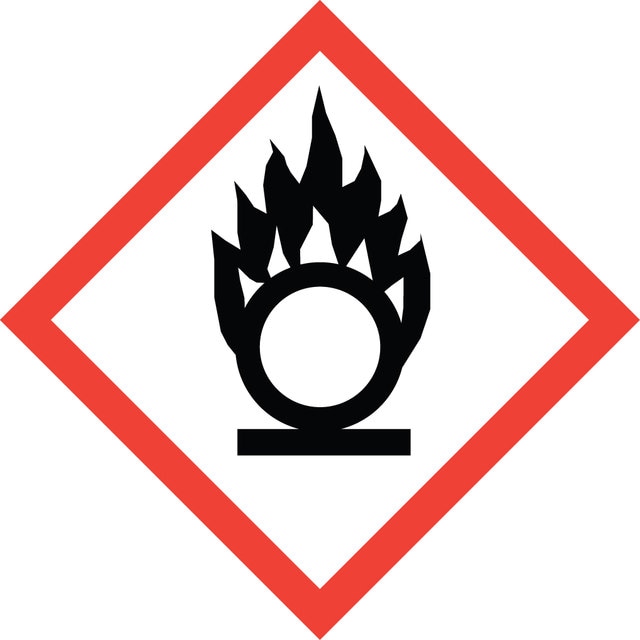
Aquatic Acute 1 - Aquatic Chronic 1 - Eye Irrit. 2 - Ox. Sol. 3 - Skin Irrit. 2
Storage Class
5.1B - Oxidizing hazardous materials
wgk
WGK 2
Regulatory Information
危险化学品
This item has
Choose from one of the most recent versions:
Already Own This Product?
Find documentation for the products that you have recently purchased in the Document Library.
A Novel Optical Thermometry Strategy Based on Diverse Thermal Response from Two Intervalence Charge Transfer States.
Gao, Y., et al.
Advances in Functional Materials, 26, 3139?3145-3139?3145 (2016)
Praseodymium and gadolinium doped ceria as a cathode material for low temperature solid oxide fuel cells.
Chockalingam, R., et al.
Journal of Power Sources, 250, 80-89 (2014)
Self-sustainable protonic ceramic electrochemical cells using a triple conducting electrode for hydrogen and power production.
Ding, H., et al.
Nature Communications, 11, 1907-1907 (2020)
Global Trade Item Number
| SKU | GTIN |
|---|---|
| 930911-100G | 04065268033074 |
| 930911-25G | 04065268033081 |
| 930911-5G | 04065268033098 |