
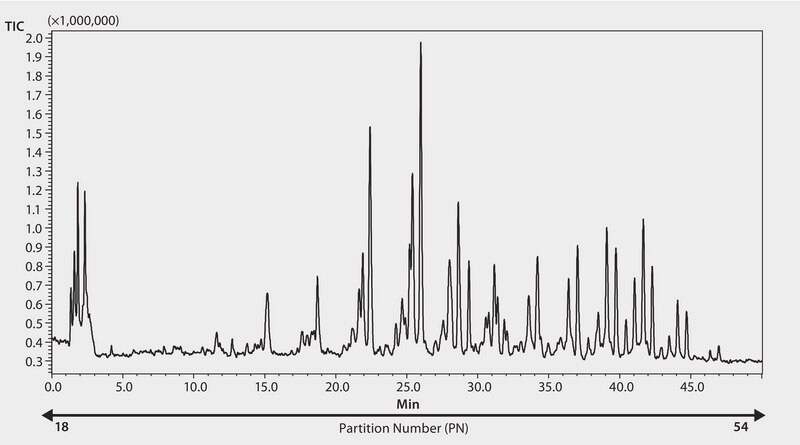
NARP-HPLC-APCI-MS Analysis of TAGs from Yogurt on Ascentis® Express C18
Materials
related product
CONDITIONS
column
Ascentis Express C18, 15 cm x 4.6 mm I.D., 2.7 μm particles (53829-U)
mobile phase
[A] acetonitrile; [B] 2-propanol (IPA)
gradient
0 to 70% B in 50 min; held at 70% B for 5 min; to 0% B in 1 min
flow rate
1 mL/min
detector
MS, APCI(+), mass range 250–1100 m/z
injection
7-20 μL
sample
lipid extract, 15 to 30 mg/mL in acetone
Description
Analysis Note
Shown here is a procedure to extract lipids from yogurt and analyse the TAG profile using LC/MS methodology.
Sample prep: The extraction of the yogurt lipid fraction proceeded by adding 10 g of the yogurt sample (accurately weighed), 20 mL of 0.5 N NH3, and 80 mL of ethyl alcohol to a separatory funnel. While swirling the flask, 100 mL of diethyl ether followed by 100 mL of n-pentane were added. The suspension was left to stand for 10 minutes to allow phase separation. The ether phase was recovered and dried over anhydrous sodium sulphate, filtered, and then taken to dryness by a rotary evaporator. The final dry residue was stored at -18 °C until use. Samples ranging from 15 to 30 mg of each of the dry residue from the final lipid extracts were diluted with 1 mL of acetone and filtered through a 0.45 μm Acrodisc nylon membrane filter prior to LC/MS analysis.
Other Notes
Shimadzu LCMS-2010 APCI(+): range 250-1100 m/z;
nebulizing gas (N2) flow: 2.0 L/min;
heat block: 300 °C, CDL temperature: 300 °C; interface temperature: 450 °C;
detector voltage: 1.6 kV
Legal Information
Ascentis is a registered trademark of Merck KGaA, Darmstadt, Germany