
Analysis of PFAS compounds in human serum utilizing Dispersive In-Pipette SPE prior to LC-MS/MS analysis
Abstract
This study analyses seven per- and polyfluoroalkyl substances (PFAS) identified as highly persistent in the environment and in biological systems. A methodology for the analysis of human serum was developed to support improved understanding of human exposure to PFAS. Sample preparation and cleanup were performed using hybrid solid phase extraction (HybridSPE®) in a DPX tip (dispersive pipette) format to enable efficient automation. Subsequent analysis was conducted by ultra-high performance liquid chromatography coupled with tandem mass spectrometry (UHPLC-MS/MS). Reproducibility testing of matrix-prepared samples showed good accuracy and precision. The accurate and reliable detection achieved by this method can support future studies on PFAS exposure and associated health implications.
Section Overview
Introduction
PFAS (per- and polyfluoroalkyl substances) testing in clinical research is crucial and has gained increasing attention due to their occurrence as environmental contaminants and their associated health risks. The “Guidance on PFAS Testing and Health Outcomes” report issued by the National Academies of Sciences, Engineering, and Medicine (NASEM) highlights the need for biomonitoring of seven key PFAS compounds, namely perfluorooctanoic acid (PFOA), perfluorooctanesulfonic acid (PFOS), perfluorononanoic acid (PFNA), perfluorohexanesulfonic acid (PFHxS), perfluorodecanoic acid (PFDA), perfluoroundecanoic acid (PFUnA), and N-methyl perfluorooctanesulfonamidoacetic acid (MeFOSAA). These substances are persistent and bioaccumulative, which necessitates rigorous testing to investigate exposure pathways and potential health implications. Understanding these aspects is vital for evaluating strategies to reduce PFAS exposure and for supporting public health and regulatory decisions aimed at mitigating their impact on human health and the environment.
Human serum samples can be an appropriate matrix of choice for evaluation the presence of PFAS in the body. But the complex composition of serum necessitates sample cleanup prior to LC-MS analysis. One of the compound classes that interfere with LC-MS quantitation through disruption of compound ionization in the mass spectrometric source are phospholipids. Several technologies are available for selective removal phospholipids from serum and plasma. HybridSPE® technology is one such approach which has been widely applied for phospholipid removal from biological matrices.2-11
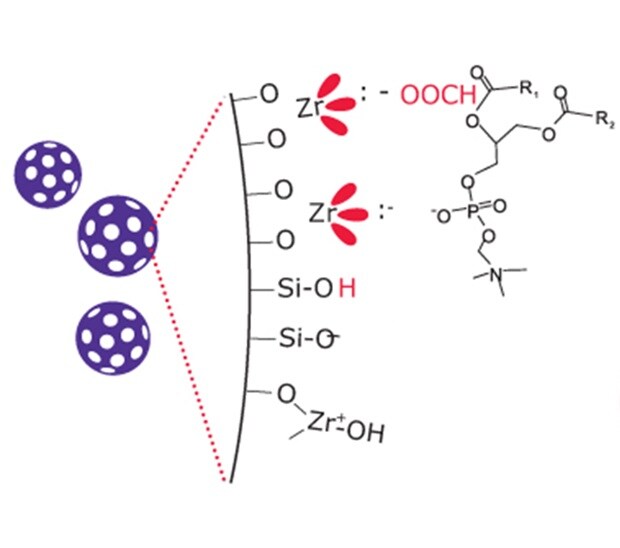
Figure 1.Retention mechanism for phospholipid removal based on a Lewis acid-base interaction between the zirconia coated silica HybridSPE® material and the phosphate group of the phospholipids.
Unlike the "bind-elute" method used in other solid phase extraction processes, the HybridSPE® approach facilitates “interference removal” or "chemical filtration" by specifically targeting and removing phospholipids based on their chemical properties, as illustrated in Figure 1. This strategy provides a simpler and faster workflow compared to “bind-elute” processes and supports higher sample throughput with reduced method complexity.
In this study, the HybridSPE® adsorbent was used in a dispersive SPE pipette tip (DPX tip) format, in which the loose sorbent is contained within the tip (Figure 2) to allow mixing and interaction with the aspirated sample. The DPX tips are typically arranged in a 96-well plate format, allowing straightforward integration into automated liquid handling systems.
Experimental
Standards and sample preparation
Standards
Standards of PFOA, PFOS, PFNA, PFHxS, PFDA, PFUnA, and MeFOSAA were prepared in methanol at concentrations ranging from 0.02 to 2.5 ng/mL for quantitation of the spiked samples. Isotopically labelled internal standards (listed in Table 3) were used to construct calibration curves at concentrations of 1.25 and 5.0 ng/mL, depending on the compound.
Spiked samples
A blank processed serum extract was spiked at 0.5 ng/mL with each compound to assess reproducibility and remaining matrix interference.
Serum samples were spiked with the seven PFAS compounds, each at 1.25 ng/mL for recovery determination.
Sample preparation
Samples were prepared/cleaned using protein precipitation followed by HybridSPE® DPX tips on a liquid handler system (Table 1). Binding, or chemical filtration, when using HybridSPE® technology, refers to the selective removal of phospholipids from the sample. Conditioning decreases the affinity of the analytes-of-interest for the SPE material, thereby ensuring improved recovery.
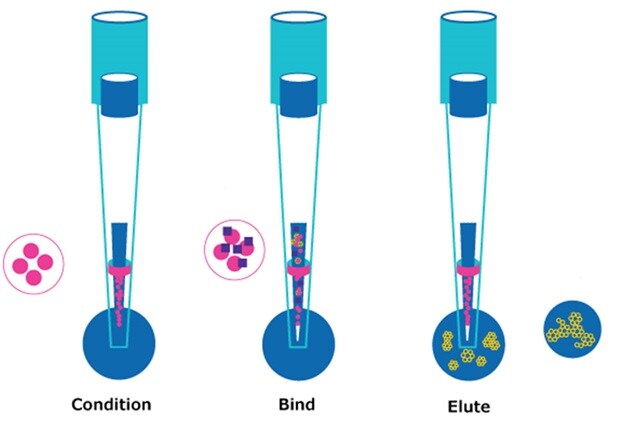
Figure 2.Schematic of the automated removal of phospholipids (purple squares) using hybrid solid phase extraction (HybridSPE®) in DPX format.
LC-MS analysis
Standards and spiked samples were analyzed by LC-MS/MS using Ascentis® Express PFAS analytical and delay columns (Table 2).
Results and discussion
Serum samples spiked with seven PFAS compounds were analyzed using protein precipitation and phospholipid removal by dispersive SPE, followed by LC-MS/MS. Automation of the sample preparation was achieved using a liquid handler, enhancing reproducibility, and allowing simultaneous preparation of up to 96 samples using in-pipette-tip dispersive adsorbent. This approach eliminated the need for positive or negative pressure SPE devices, resulting in a more economical workflow in terms of instrument design and simplified programming.
A calibration method assessment was performed by comparing standards at 0.5 ng/mL of each compound prepared as matrix-matched and solvent-based solutions to evaluate accuracy and matrix interference (Figure 3). Concentrations were determined using external calibration curves (0.02-2.25 ng/mL) in methanol. Both methods showed similar results across all seven analytes, with only a single concentration for one analyte (PFDA), differing by 10% (Table 4). These findings demonstrate the effectiveness of the developed sample preparation in mitigating matrix effects for the selected analytes, allowing future studies to utilize solvent-prepared calibration curves.
Reproducibility tests for the matrix matched samples spiked at 0.5 ng/mL showed relative standard deviation (RSDs) below 6% for all analytes, except for PFUnA, which showed a 15% deviation (Table 4).
Background evaluation of the serum samples identified some of the studied compounds at very low levels. In all cases, the compound background was at or below the lowest calibration point of 0.02 ng/mL and therefore is not reported here.

Figure 3.Comparison of a 0.5 ng/mL standard prepared in methanol to an equivalent standard prepared in blank serum, cleaned by HybridSPE® and subsequently spiked.
Recovery spiked serum
For serum samples spiked at 1.25 ng/mL with each analyte (PFOA, PFOS, PFNA, PFHxS, PFDA, PFUnA, and N-MeFOSAA), and processed by protein precipitation and HybridSPE® clean-up, relative recoveries (quantified using IS) ranged from 77.2% to 101.8%, while absolute recoveries varied from 72.8% to 92.6% (Table 5).
Conclusion
As PFAS exposure and monitoring continue to receive the attention of government agencies for their long-lasting health impacts, a growing number of body fluid samples will require analysis in the future. Here an LC-MS/MS method was developed to assess the seven PFAS analytes identified in the NASEM report in human serum, using a sample preparation approach that can be readily automated on a liquid handling system. The use of HybridSPE® sorbents in a DPX tip format enable accurate and reliable detection of PFAS compounds in complex biological matrices, supporting efficient future research on PFAS exposure and associated health implications.
Enhance your PFAS analysis with high-quality standards and sample preparation solutions designed for reliable, trace-level detection. Explore the full portfolio and find the right tools for your workflow at SigmaAldrich.com/PFAS.