
AP1165

Anti-FIS1 Mouse mAb (1G9)
liquid, clone 1G9, Calbiochem®
别名:
Anti-TTC11, Anti-Fission 1 Homolog
登录 查看组织和合同定价。
选择尺寸
关于此项目
UNSPSC Code:
12352203
Clone:
1G9, monoclonal
Species reactivity:
human
Application:
—
Citations:
1
biological source
mouse
antibody form
purified antibody
antibody product type
primary antibodies
clone
1G9, monoclonal
form
liquid
does not contain
preservative
species reactivity
human
manufacturer/tradename
Calbiochem®
storage condition
OK to freeze, avoid repeated freeze/thaw cycles
isotype
IgG2b
shipped in
wet ice
storage temp.
−20°C
target post-translational modification
unmodified
Quality Level
Gene Information
human ... FIS1(51024)
General description
Anti-FIS1, mouse monoclonal, clone 1G9, recognizes the ~15 kDa FIS1 protein in A431 cells and human liver and small intestine tissue. It is validated for use in ELISA, WB, and IHC (paraffin sections)
Purified mouse monoclonal antibody. Recognizes the ~15 kDa FIS1 protein.
Recognizes the ~15 kDa FIS1 protein in A431 cells and human liver and small intestine tissue.
Immunogen
Full-length, recombinant human FIS1 (aa 1-153), expressed as a GST fusion protein
Application
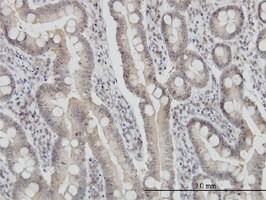

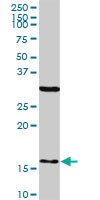
ELISA (see comments)
Immunoblotting (1-5 g/ml)
Paraffin Sections (3 g/ml)
Physical form
In PBS, pH 7.2.
Preparation Note
Following initial thaw, aliquot and freeze (-20°C).
Analysis Note
Positive Control
Human liver tissue, A-431 cells, Human small intestine tissue
Human liver tissue, A-431 cells, Human small intestine tissue
Other Notes
For ELISA, this antibody can be used as the capture antibody; recommended concentration is 10 ng/ml, 1 µg/well, 100 µl total volume. Variables associated with assay conditions will dictate the proper working dilution.
Legal Information
CALBIOCHEM is a registered trademark of Merck KGaA, Darmstadt, Germany
Disclaimer
Toxicity: Regulatory Review (Z)
未找到合适的产品?
试试我们的产品选型工具.
存储类别
12 - Non Combustible Liquids
wgk
nwg
flash_point_f
Not applicable
flash_point_c
Not applicable
Abhinav Kanwal et al.
FASEB journal : official publication of the Federation of American Societies for Experimental Biology, 33(10), 10872-10888 (2019-07-19)
Sirtuins (Sirts) are implicated in regulating a myriad of biologic functions ranging from cell growth and metabolism to longevity. Here, we show that nuclear Sirt, Sirt6, and mitochondrial Sirt, Sirt3, regulate each other's activity and protect the heart from developing
我们的科学家团队拥有各种研究领域经验,包括生命科学、材料科学、化学合成、色谱、分析及许多其他领域.
联系客户支持