

biological source
rabbit
Quality Level
antibody product type
primary antibodies
clone
polyclonal
form
liquid
contains
≤0.1% sodium azide as preservative (antibody only)
species reactivity
human, bovine, rat, mouse
manufacturer/tradename
Calbiochem®
storage condition
do not freeze
isotype
IgG
shipped in
wet ice
storage temp.
2-8°C
General description
Purified rabbit polyclonal antibody. Recognizes orexin A. Supplied with a control peptide.
Recognizes orexin A in mouse and rat brain. Supplied with a control peptide.
The hypothalamus has been shown to play a central role in the regulation of energy homeostasis and in the control of feeding behavior. Two homologous peptides have recently been identified for which the message and protein have been localized to the lateral hypothalamus. Orexin A (hypocretin 1), a 33 amino acid peptide, and orexin B (hypocretin 2), a 28 amino acid peptide, are both encoded by a single mRNA transcript. These peptides stimulate food consumption in a dose-dependent manner when administered intracerebroventricularly, and precursor mRNA levels are upregulated upon fasting. In addition to the orexins (hypocretins), two G-protein coupled receptors, designated orexin receptor-1 and orexin receptor-2, have been identified which presumably mediate the signaling events from these neuropeptides. Competitive radioligand binding assays suggest that the orexin receptor-1 is selective for orexin A, while orexin receptor-2 is nonselective for both peptides.
This Anti-Orexin A (14-33) (Ab-1) Rabbit pAb is validated for use in ELISA, Frozen Sections, Immunofluorescence for the detection of Orexin A (14-33) (Ab-1).
Immunogen
Human
a synthetic peptide (CRLYELLHGAGNHAAGILTL) corresponding to amino acids 14-33 of human orexin A
Application
ELISA (see comments)
Frozen Sections (1-3 g/ml)
Immunofluorescence (1-4 g/ml)
Packaging
Please refer to vial label for lot-specific concentration.
Physical form
100 µg antibody in 0.05 M sodium phosphate buffer, 0.2% gelatin and 25 µg lyophilized control peptide.
Preparation Note
Reconstitute peptide with 25 µl dH₂O for a working stock of 1 mg/ml. Following reconstitution, aliquot and freeze (-20°C). Avoid freeze/thaw cycles of solutions.
Analysis Note
Positive Control
Mouse or rat brain
Mouse or rat brain
Other Notes
De Lecea, L., et al. 1998. Proc. Natl. Acad. Sci. USA95, 322.
Flier, J.S. and Maratos-Flier, E. 1998. Cell92, 437.
Sakurai, T., et al. 1998. Cell92, 573.
Schwartz, M.W. 1998. Nat. Med.4, 385.
Flier, J.S. and Maratos-Flier, E. 1998. Cell92, 437.
Sakurai, T., et al. 1998. Cell92, 573.
Schwartz, M.W. 1998. Nat. Med.4, 385.
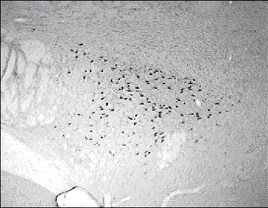
This amino acid sequence is identical to orexin A from mouse, rat, and bovine. Immunohistochemistry was performed using floating mouse and rat brain sections fixed in 4% paraformaldehyde. Staining was completely abolished by preincubating the purified antibody with peptide at 10-6 M. Unconjugated control peptide has been included for use as an internal control for antibody specificity. This antibody has been reported to work for ELISA. This antibody is also available in serum form, Anti-Orexin A (Ab-2) Rabbit pAb (Cat.No. PC362). Antibody should be titrated for optimal results in individual systems.
Legal Information
CALBIOCHEM is a registered trademark of Merck KGaA, Darmstadt, Germany
Disclaimer
Toxicity: Standard Handling (A)
Still not finding the right product?
试用我们的 产品选型工具 工具缩小选择范围
存储类别
10-13 - German Storage Class 10 to 13
法规信息
新产品
此项目有
Iain J Clarke et al.
Neuroendocrinology, 95(4), 305-316 (2012-01-31)
Gonadotropin-inhibitory hormone (GnIH)-3 is a neuropeptide that plays a major role in the regulation of reproduction and feeding in mammals. We measured endocrine and behavioural parameters of reproduction in sheep, and sexual behaviour in sheep, mice and cynomolgus monkeys. In
Huiyuan Zheng et al.
American journal of physiology. Regulatory, integrative and comparative physiology, 284(6), R1436-R1444 (2003-05-09)
Corticolimbic circuits involving the prefrontal cortex, amygdala, and ventral striatum determine the reward value of food and might play a role in environmentally induced obesity. Chemical manipulation of the nucleus accumbens shell (AcbSh) has been shown to elicit robust feeding
Marilena Marraudino et al.
Metabolites, 11(7) (2021-08-07)
The phytoestrogen genistein (GEN) may interfere with permanent morphological changes in the brain circuits sensitive to estrogen. Due to the frequent use of soy milk in the neonatal diet, we aimed to study the effects of early GEN exposure on