

biological source
rabbit
antibody product type
primary antibodies
clone
polyclonal
form
liquid
contains
≤0.1% sodium azide as preservative
species reactivity
mouse, rat, human
manufacturer/tradename
Calbiochem®
storage condition
do not freeze
isotype
IgG
shipped in
wet ice
General description
This product has been discontinued.
Recognizes the ~85 kDa hMre-11 protein in IMR90 and K562 cells.
Affinity purified rabbit polyclonal antibody. Recognizes the ~85 kDa hMre-11 protein.
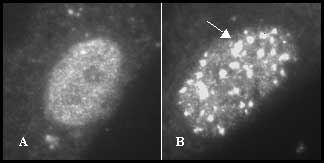
Anti-hMre-11, rabbit polyclonal, recognizes the ~85 kDa hMre-11 protein in IMR90 and K562 cells. It is validated for use in Western blotting, immunofluorescence, and immunoprecipitation.
Immunogen
Human
recombinant, human hMre11 protein
Application
Immunoblotting (1 g/ml)
Immunofluorescence (1 g/ml)
Immunoprecipitation (1 g/reaction)
Packaging
Please refer to vial label for lot-specific concentration.
Physical form
In 50 mM sodium phosphate buffer, 0.2% gelatin, pH 7.5.
Analysis Note
Positive Control
IMR90 or K562 cells
IMR90 or K562 cells
Other Notes
Antibody should be titrated for optimal results in individual systems.
Dong, Z., et al. 1999. J. Biol. Chem.274, 19513.
Luo, G., et al. 1999. Proc. Natl. Acad. Sci. USA96, 7376.
Petrini, J.H. 1999. Am. J. Hum. Genet.64, 1264.
Carney, J.P., et al. 1998. Cell93, 477.
Haber, J.E. 1998. Cell95, 583.
Nelms, B.E., et al. 1998. Science280, 590.
Maser, R.S., et al. 1997. Mol. Cell Biol.17, 6087.
Xiao, Y. and D.T. Weaver. 1997. Nucleic Acids Res.25, 2985.
Dolganov, G.M., et al. 1996. Mol. Cell Biol.16, 4832.
Petrini, J.H., et al. 1995. Genomics29, 80.
Luo, G., et al. 1999. Proc. Natl. Acad. Sci. USA96, 7376.
Petrini, J.H. 1999. Am. J. Hum. Genet.64, 1264.
Carney, J.P., et al. 1998. Cell93, 477.
Haber, J.E. 1998. Cell95, 583.
Nelms, B.E., et al. 1998. Science280, 590.
Maser, R.S., et al. 1997. Mol. Cell Biol.17, 6087.
Xiao, Y. and D.T. Weaver. 1997. Nucleic Acids Res.25, 2985.
Dolganov, G.M., et al. 1996. Mol. Cell Biol.16, 4832.
Petrini, J.H., et al. 1995. Genomics29, 80.
Legal Information
CALBIOCHEM is a registered trademark of Merck KGaA, Darmstadt, Germany
Disclaimer
Toxicity: Standard Handling (A)
未找到合适的产品?
试试我们的产品选型工具.
存储类别
10-13 - German Storage Class 10 to 13
法规信息
新产品
此项目有
Z Dong et al.
The Journal of biological chemistry, 274(28), 19513-19516 (1999-07-03)
The Nijmegen breakage syndrome (NBS), a chromosomal instability disorder, is characterized in part by cellular hypersensitivity to ionizing radiation. Repair of DNA double-strand breaks by radiation is dependent on a multifunctional complex containing Rad50, Mre11, and the NBS1 gene product
R S Maser et al.
Molecular and cellular biology, 17(10), 6087-6096 (1997-10-07)
We previously identified a conserved multiprotein complex that includes hMre11 and hRad50. In this study, we used immunofluorescence to investigate the role of this complex in DNA double-strand break (DSB) repair. hMre11 and hRad50 form discrete nuclear foci in response
Y Xiao et al.
Nucleic acids research, 25(15), 2985-2991 (1997-08-01)
Repair of DNA damage resulting in double-strand breaks (DSBs) is controlled by gene products executing homologous recombination or end-joining pathways. The MRE11 gene has previously been implicated in DSB repair in the yeast Saccharomyces cerevisiae . Here we have developed
The many interfaces of Mre11.
J E Haber
Cell, 95(5), 583-586 (1998-12-09)
G Luo et al.
Proceedings of the National Academy of Sciences of the United States of America, 96(13), 7376-7381 (1999-06-23)
The Mre11/Rad50 protein complex functions in diverse aspects of the cellular response to double-strand breaks (DSBs), including the detection of DNA damage, the activation of cell cycle checkpoints, and DSB repair. Whereas genetic analyses in Saccharomyces cerevisiae have provided insight
我们的科学家团队拥有各种研究领域经验,包括生命科学、材料科学、化学合成、色谱、分析及许多其他领域.
联系客户支持